China’s top anti-corruption watchdog has placed former securities regulator Fang Xinghai, a Stanford-trained economist and one-time associate of Chinese leader Xi Jinping, under investigation in Shanghai, marking the latest high-profile casualty in Beijing’s years-long anti-corruption campaign targeting the financial sector.The Central Commission for Discipline Inspection, the regime’s top anti-corruption watchdog, announced on July 24 that Fang, the former vice chairman of the China Securities Regulatory Commission, is being investigated for “serious violations of discipline and law,” the CCP’s standard euphemism for corruption-related offenses.Fang left the China Securities Regulatory Commission in July 2024 after serving nearly nine years as one of the regulator’s top officials. As recently as June, he appeared publicly at the World Economic Forum in Tianjin, China, in his capacity as vice president of the China Society for Finance and Banking.His investigation extends a sweeping crackdown that has engulfed China’s financial bureaucracy in recent years, with senior officials at regulators, state-owned banks, and investment firms increasingly falling under anti-corruption scrutiny.While the Chinese Communist Party (CCP) describes such investigations as part of its anti-corruption campaign, U.S.-based China current affairs analyst Li Linyi said, in reality, they reflect internal political struggles.“This case has attracted particular attention because Fang was considered to have relatively close ties to [CCP leader] Xi Jinping, prompting speculation about the political dynamics behind the investigation,” Li told The Epoch Times.“With the CCP’s 21st National Congress approaching, internal power struggles are expected to intensify.”Another Senior Official FallsThe China Securities Regulatory Commission has emerged as one of China’s most politically vulnerable financial institutions since the country’s stock market turmoil in 2015.The regulator’s last three chairmen all left office under difficult circumstances.Former chairman Xiao Gang stepped down in early 2016 after a stock market crash and the collapse of a controversial circuit-breaker mechanism. Several of his deputies, including former vice chairman Yao Gang, were later investigated.His successor, Liu Shiyu, was transferred to another government position in 2019 before turning himself in to disciplinary authorities later that year. He was subsequently demoted following disciplinary action for corruption.Yi Huiman, who became China Securities Regulatory Commission chairman in 2019, was removed from office in February 2024 amid a prolonged decline in China’s stock market. He was placed under investigation in September 2025.Fang served as vice chairman from October 2015 to July 2024, making him one of the longest-serving members of the regulator’s leadership during a period marked by repeated market turbulence and regulatory overhaul. He worked under Xiao, Liu, and Yi and served alongside Yi for nearly five years before Yi became chairman.Unlike many Chinese financial regulators, Fang built an international career before entering government. Born in 1964, he earned a bachelor’s degree from China’s prestigious Tsinghua University before completing a doctorate in economics at Stanford University under future Nobel laureate Joseph Stiglitz.After graduating, he worked at the World Bank before returning to China in 1998. He subsequently held senior positions at China Construction Bank, China Galaxy Securities, the Shanghai Stock Exchange, and the Shanghai municipal government, where he oversaw financial affairs.His international background and fluent English made him one of China’s best-known financial officials among global investors. At the China Securities Regulatory Commission, he played a prominent role in promoting capital market reforms and represented Beijing at major international forums.Fang’s rise also coincided with Xi’s ascent to power.He worked as a senior financial official in Shanghai during Xi’s brief tenure as the city’s Party secretary in 2007, making him one of several Shanghai officials later promoted under Xi’s administration.Public Profile During Market VolatilityFang became internationally known in early 2016 when, while attending the WEF in Davos, he publicly distanced himself from China’s newly introduced stock-market circuit-breaker mechanism, a policy associated with then-China Securities Regulatory Commission chairman Xiao Gang.His comments on the stock market, the yuan’s depreciation, and China’s economic policies drew widespread attention because senior Chinese officials rarely speak publicly on such sensitive issues, particularly when their remarks differ from those of their superiors.Fang’s career reflected the generation of Chinese economists shaped by the country’s reform era.While studying economics at Tsinghua University, he attended lectures by Zhu Rongji, then the state economic planner who later became China’s premier. Fang later wrote that Zhu’s vision of building a world-class economics school and his call for overseas Chinese scholars to return home influenced his decision to come back to China after working abroad.Chinese financial media The Paper has also reported that Fang returned in 1998 after being invited by Zhou Xiaochuan, then president of China Construction Bank and later governor of the People’s Bank of China.Fang’s investigation adds another prominent name to the growing list of senior financial officials swept up in Xi’s anti-corruption campaign, underscoring the continued political risks facing even some of China’s most internationally recognized economic policymakers.Dongfang Hao contributed to this report.

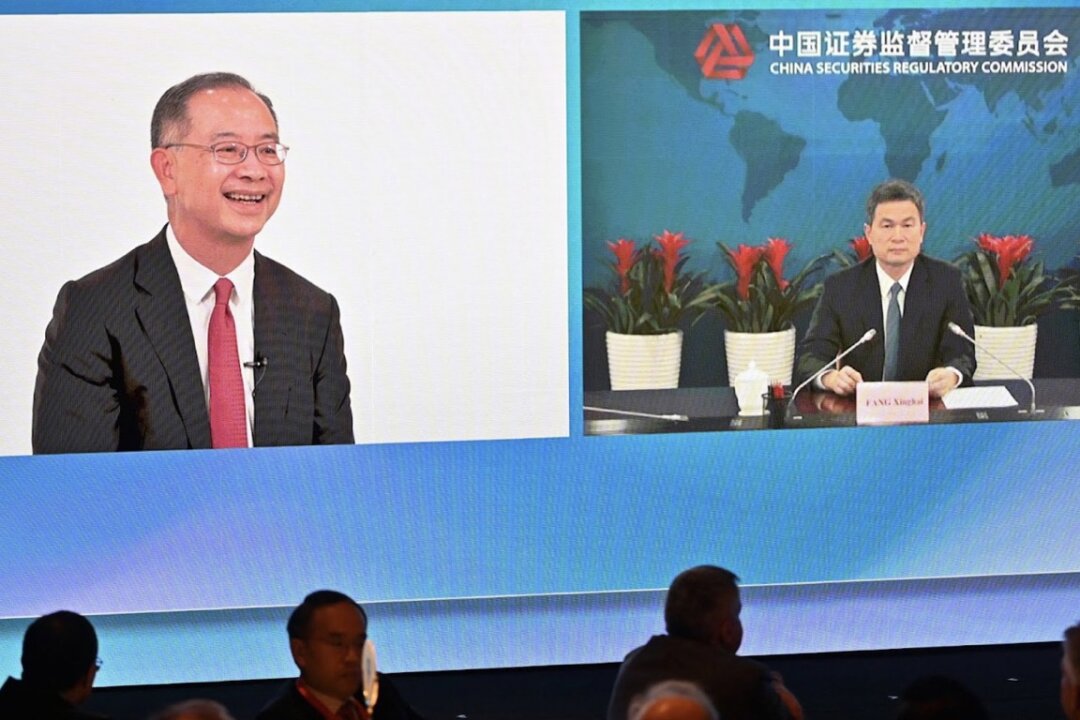
Former Chinese Securities Regulator Investigated in Latest Financial Sector Purge








Related Articles
China Business & EconomyChina NewsChina Technology
China Tech Index Plunges More Than 40 Percent From July Peak
China’s technology-heavy STAR 50 index has fallen by more than 40 percent...
China Military NewsChina NewsChinese RegimeInside CCP OfficialdomSpecial TopicsZhang Youxia
Xi Opens CCP Plenum Amid Sweeping Purges, Record-Low Attendance Forecast
Chinese Communist Party leader Xi Jinping opened a four-day meeting of senior...
China Business & EconomyChina NewsChinese RegimeFinance & Business TiesInside CCP OfficialdomSpecial Topics
Chinas Economic Woes Deepen as CCP Plenum Focuses on Political Control
The Chinese Communist Party (CCP) opened a four-day leadership meeting in Beijing...


China NewsEuropeGlobalUK NewsWorld News
UK Must Be Ready for War in 1,000 Days, Says British Defense Secretary
British Defense Secretary Wes Streeting has said the country must be ready...
