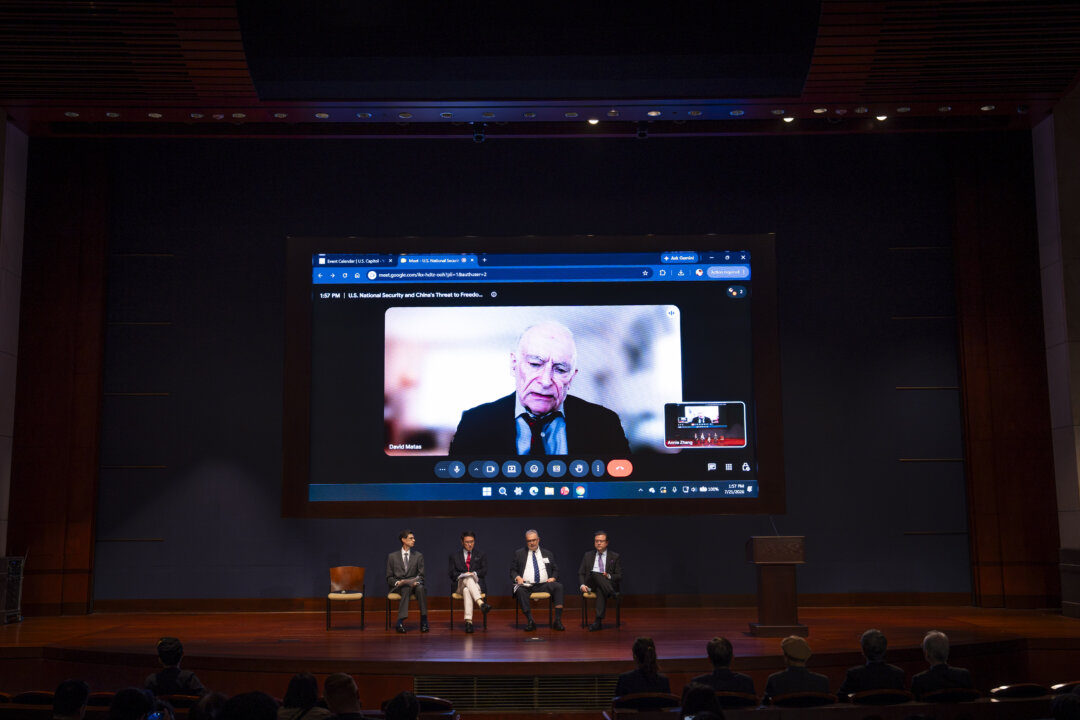
The Chinese regime’s state-sanctioned practice of forced organ harvesting is not only a human rights issue but also a test of the medical profession’s ethical responsibility, according to Dr. Alejandro Centurion.Centurion, a neurologist and an associate director of medical affairs at U.S.-based advocacy group Doctors Against Forced Organ Harvesting (DAFOH), called China’s forced organ harvesting “one of the gravest violations of medical ethics in the 21st century.”“It really represents the ultimate corruption of medicine. It transforms a profession dedicated to preserving life into an instrument of persecution, and the physician from healer into executioner,” Centurion said during a panel discussion at the Chinese Freedom & U.S.–Taiwan Security Forum 2026 in Washington on July 21.Despite evidence accumulated over two decades, Centurion said the medical community has become less willing to address the issue, driven by three factors: weaponized medicine, the verification trap, and institutional normalization.Centurion said that the Chinese Communist Party’s (CCP) framing has influenced the medical community, leading physicians to regard forced organ harvesting as a political or human rights issue rather than a core medical ethics question.The CCP “routinely characterizes its human rights record as political when challenged,” he explained, and that framing has increasingly ”seeped into Western academic and medical discourse.”“Once medicine becomes an instrument of persecution, and once physicians become participants—as the China Tribunal states, a crime against humanity—it no longer is a political human rights responsibility,” Centurion said.The China Tribunal, a London-based independent people’s tribunal, concluded after a yearlong investigation that the Chinese regime had been forcibly harvesting organs from prisoners of conscience for many years, with Falun Gong practitioners as the primary victims.Alejandro Centurion, Doctors Against Forced Organ Harvesting associate director of medical affairs, at the U.S. Capitol on July 21, 2026. Madalina Kilroy/The Epoch TimesFalun Gong, also known as Falun Dafa, is a spiritual practice centered on the principles of truth, compassion, and tolerance. Introduced to the public in China in the early 1990s, it gained widespread popularity, reaching between 70 million and 100 million practitioners by the end of the decade, according to official estimates at the time.In July 1999, the CCP, fearing that Falun Gong’s popularity threatened the regime’s power, launched a brutal campaign to eradicate the practice. Since then, many have suffered arbitrary detention, forced labor, and torture, as well as death from forced organ harvesting.The China Tribunal found that medical tests conducted specifically on Falun Gong and Uyghur prisoners were “highly suggestive of methods used to assess organ function.”The verification trap happens when a regime controls all the evidence of its own crimes, according to Centurion. Since independent audits of Chinese transplant centers are “almost impossible” to carry out, and without access to proof, the international community fails to take action—effectively rewarding the regime for hiding the truth, he said.“If independent verification becomes the prerequisite for action, the perpetrator only needs to prevent independent verification, as China has successfully done for years,” Centurion said.He described institutional normalization as a process by which unresolved ethical concerns gradually fade from professional discourse—not because the issues have been resolved, but because they have been “accepted as part of the status quo.”At the same time, Western institutions have a “powerful incentive” to “avoid public confrontation” with Beijing to preserve their ties with Chinese counterparts, according to Centurion.“Over time, institutional silence itself becomes normalized, and routine scientific exchange creates the impression that the underlying ethical questions have already been answered,” he said.Centurion said he witnessed that phenomenon firsthand at this year’s American Transplant Congress, held in Boston in June. He recalled speaking with a highly respected transplant surgeon who held a leadership role in a major international transplant society.When Centurion asked about China’s forced organ harvesting, the surgeon acknowledged that although no thorough, impartial investigation had ever taken place, many within that transplant society’s leadership wanted to move on from the issue.The panel discussion was moderated by Jan Jekielek, senior editor at The Epoch Times. In his bestselling book “Killed to Order,” published in March, Jekielek explores how the Chinese regime’s industrial practice of forced organ harvesting became an estimated $9 billion industry.

Doctor Urges Medical Community to Take Action Against Chinas Forced Organ Harvesting








Related Articles
China Business & EconomyChina NewsChina Technology
China Tech Index Plunges More Than 40 Percent From July Peak
China’s technology-heavy STAR 50 index has fallen by more than 40 percent...
China Military NewsChina NewsChinese RegimeInside CCP OfficialdomSpecial TopicsZhang Youxia
Xi Opens CCP Plenum Amid Sweeping Purges, Record-Low Attendance Forecast
Chinese Communist Party leader Xi Jinping opened a four-day meeting of senior...
China Business & EconomyChina NewsChinese RegimeFinance & Business TiesInside CCP OfficialdomSpecial Topics
Chinas Economic Woes Deepen as CCP Plenum Focuses on Political Control
The Chinese Communist Party (CCP) opened a four-day leadership meeting in Beijing...



China NewsEuropeGlobalUK NewsWorld News
UK Must Be Ready for War in 1,000 Days, Says British Defense Secretary
British Defense Secretary Wes Streeting has said the country must be ready...
