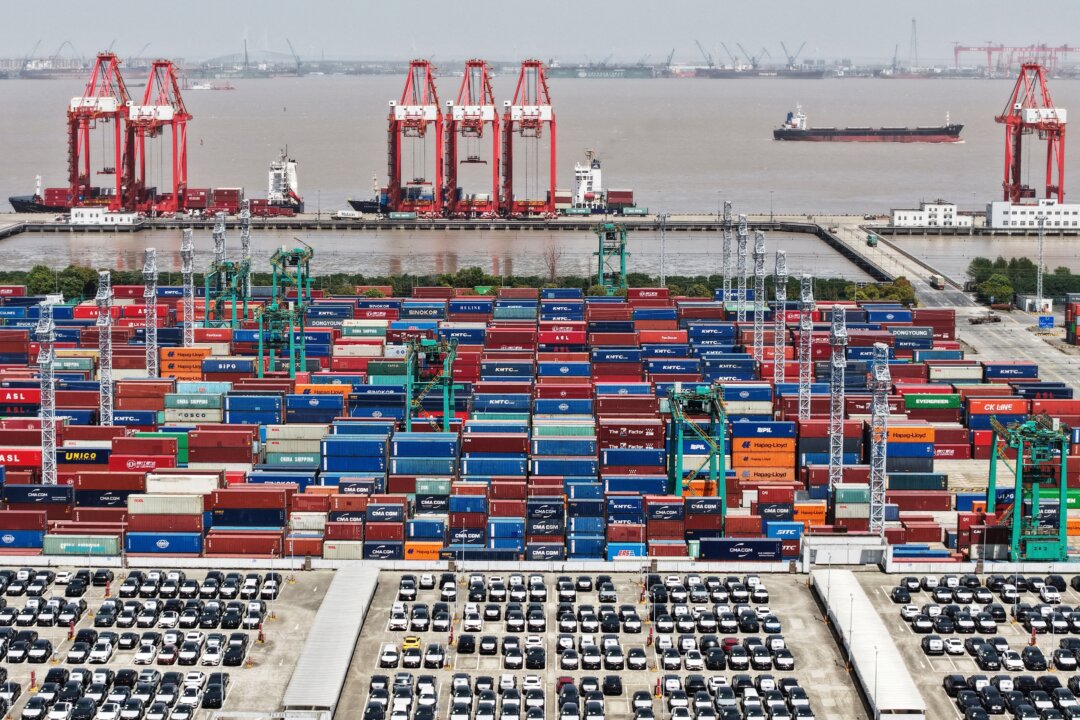
News AnalysisChina’s economy narrowly met Beijing’s annual growth target in the first half of the year, but newly released data point to deepening structural problems beneath the headline figures, with private investment contracting sharply, consumer demand remaining weak, and growth becoming increasingly reliant on exports.Official data from China’s National Bureau of Statistics (NBS) showed second-quarter gross domestic product (GDP) grew 4.3 percent from a year earlier, below the regime’s target range of 4.5 to 5 percent. Growth averaged 4.7 percent over the first half of the year, barely keeping the economy within Beijing’s annual target.The second-quarter figure marks China’s weakest quarterly growth since the final quarter of 2022, when much of the country was still under the regime’s draconian COVID-19 lockdowns.Economists and analysts say the latest figures underscore an increasingly unbalanced economy, with investment and household consumption continuing to deteriorate even as exports remain strong.Investment Slump One of the clearest warning signs in the latest data is the sharp decline in fixed-asset investment, a traditional driver of China’s economic growth.According to NBS, fixed-asset investment fell 5.7 percent in the first half of the year from a year earlier. Private-sector investment dropped 8.5 percent, while investment by domestic firms declined 5.5 percent. Investment from Hong Kong, Macau, and Taiwan fell 7.9 percent, and foreign investment dropped 4.7 percent.The downturn extends well beyond private investment.Investment in China’s service sector, which Beijing has promoted for years as a key engine of future growth, fell 8.4 percent during the first six months of the year.Manufacturing investment also contracted 1.2 percent despite extensive government subsidies and aggressive price competition aimed at boosting production. Mining was the only major industrial sector posting notable growth, rising 5.9 percent.Infrastructure investment, long used by Beijing to stimulate the economy during downturns, also declined 2.4 percent.Export Boom and Weak Domestic DemandAs investment weakens, China’s economy has become increasingly dependent on exports.Chinese customs data showed exports surged 27 percent in June from a year earlier, according to financial outlet Chinese Economic Information Network via news portal Sina. Industry data also showed automobile exports exceeded one million units in a single month for the first time, according to Chinese media Securities Times.Those gains stand in sharp contrast to domestic demand.June auto sales inside China fell more than 23 percent year over year, while retail sales of consumer goods rose just 0.8 percent.Sun Kuo-hsiang, a professor of international affairs and business at Nanhua University in Taiwan, said the divergence illustrates the uneven nature of China’s recovery.“Factories are busy, but households remain cold,” Sun told The Epoch Times.He said export growth is concentrated in capital-intensive industries such as semiconductors and electric vehicles, where increased production generates relatively few new jobs because of automation.As a result, much of the economic benefit remains within state-owned enterprises and industries supported by government subsidies, rather than translating into higher household incomes or stronger consumer spending, he said.Davy Jun Huang, a U.S.-based economist and former columnist for Chinese state media outlet CNTV, told The Epoch Times that China’s export performance is driven largely by government subsidies and foreign-invested manufacturers such as Tesla and Foxconn.“The profits from those companies don’t belong to ordinary Chinese people,” Huang said.He said many workers earn only 9 to 12 yuan (about $1.33 to $1.77) per hour while facing unemployment risks, underfunded social security systems, and concerns over healthcare and retirement costs.“This means people simply don’t having the ability or the willingness to spend,” he said.Deflation Risks and Housing Weakness Despite signs that China’s GDP deflator turned positive during the second quarter, both analysts rejected suggestions that the country has emerged from deflationary pressures.Sun said the improvement largely reflected higher energy and commodity prices rather than stronger wages or consumer demand.He described the trend as “bad inflation” because price increases were driven by production costs instead of healthier household spending.Huang likewise said China remains trapped in deflation despite modest increases in headline prices.“The rise in prices is mainly tied to imported energy costs and geopolitical tensions in the Middle East,” he said. “Meanwhile, wages, bonuses, and housing prices continue to fall.”The property sector remains one of the economy’s weakest areas. Real estate investment fell 18 percent in the first half of the year.Although official data suggest home price declines have moderated, Huang said prices have already fallen for several consecutive years, and local governments have intervened administratively to limit further price cuts.Outside a handful of major coastal cities, he said, much of China’s housing market remains effectively frozen, with sellers listing properties but few transactions taking place.Sun added that official new-home prices also fail to capture widespread discounts offered through incentives such as free renovations and parking spaces.The weakness in housing and consumption has intensified debate over whether Beijing’s traditional growth model can address the economy’s current problems.The aerial view shows residential buildings under construction by Chinese real estate developer Vanke in Hangzhou, in eastern China’s Zhejiang Province, on March 15, 2024. STR/AFP via Getty ImagesBeijing’s Policy Model Faces Growing Questions Sun said that the Chinese regime has a longstanding emphasis on production, investment, and industrial policy over household consumption. Channeling resources through local governments and state-owned enterprises also allows authorities to retain tighter control over capital allocation, he said.Huang argued that direct support for households runs counter to the CCP’s governing philosophy.He said policies such as cash transfers or broader welfare programs are often viewed within the Party as resembling capitalist approaches, making them politically unattractive despite weakening consumer demand.Sun said China’s domestic economic imbalances have increasingly produced “externalized effects,” with government credit and subsidies flowing into industries such as electric vehicles and semiconductors. Since domestic demand cannot absorb the additional production, companies have turned to overseas markets, exporting excess capacity.That strategy effectively shifts China’s industrial overcapacity, corporate losses, and employment pressures onto foreign competitors through lower-priced exports, he said.Huang also criticized China’s industrial policy, arguing that export industries benefit from subsidies financed at the expense of broader social welfare while relying on low wages and environmental costs to remain competitive.The OECD projects China’s economic growth will slow from 5.0 percent last year to 4.5 percent in 2026 and 4.3 percent in 2027.With global demand expected to soften and trade barriers continuing to rise, China’s structural economic challenges are likely to become increasingly difficult to address.Cheng Mulan and Luo Ya contributed to this report.

Chinas Growth Target Masks Deepening Economic Imbalances as Investment and Consumer Demand Falter
Chinas Growth Target Masks Deepening Economic Imbalances as Investment and Consumer Demand Falter








Related Articles
China Business & EconomyChina NewsChina Technology
China Tech Index Plunges More Than 40 Percent From July Peak
China’s technology-heavy STAR 50 index has fallen by more than 40 percent...
China Military NewsChina NewsChinese RegimeInside CCP OfficialdomSpecial TopicsZhang Youxia
Xi Opens CCP Plenum Amid Sweeping Purges, Record-Low Attendance Forecast
Chinese Communist Party leader Xi Jinping opened a four-day meeting of senior...
China Business & EconomyChina NewsChinese RegimeFinance & Business TiesInside CCP OfficialdomSpecial Topics
Chinas Economic Woes Deepen as CCP Plenum Focuses on Political Control
The Chinese Communist Party (CCP) opened a four-day leadership meeting in Beijing...



China NewsEuropeGlobalUK NewsWorld News
UK Must Be Ready for War in 1,000 Days, Says British Defense Secretary
British Defense Secretary Wes Streeting has said the country must be ready...
