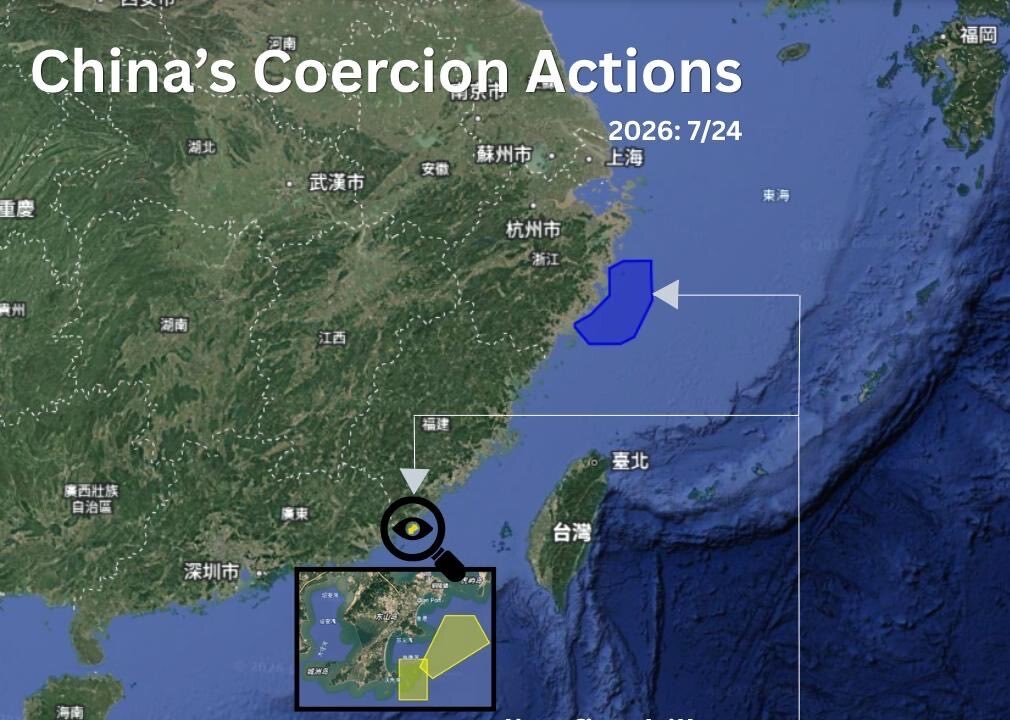
Chinese maritime authorities scheduled two days of live-fire exercises in the western Taiwan Strait this week amid a wider stretch of military activity extending from the Bohai and Yellow seas to the East and South China seas.Mainland Chinese sources interviewed by The Epoch Times, who requested anonymity or used pseudonyms out of fear of reprisal, said the military drills should not necessarily be viewed as an isolated event. They said the exercises could be viewed through multiple lenses, including routine military assessments, regional political signaling, tests of foreign responses, and an effort to make repeated Chinese military movements appear ordinary.The Zhangzhou Maritime Safety Administration in Fujian published a Navigation Warning on July 22, classifying the activity as a military exercise.The warning barred vessels from a five-point firing area from 6 a.m. to 6 p.m. on July 23 and a separate four-point area during the same hours on July 24. Both zones were off Dongshan Island on China’s Fujian coast.The notice identified the firing times and coordinates but did not name the exercise, disclose the participating military branch or unit, identify the weapons involved, or explain the training objective.Hu Zhiying, a mainland Chinese military scholar using a pseudonym, said the location and timing should be considered alongside other military activities announced across China’s coastal waters.Hu told the Chinese edition of The Epoch Times that the spread of firing and training areas carried significance beyond any individual exercise.Taiwan Condemns FiringTaiwan’s Ministry of National Defense tracked the firing areas through joint intelligence, surveillance, and reconnaissance and remained on alert, according to the Central News Agency (CNA).CNA reported that Taiwan’s Maritime and Port Bureau placed the areas about 57.6 nautical miles from Kinmen, 103 nautical miles from Penghu, and 55.8 nautical miles west of the Taiwan Strait median line.Kinmen is controlled by Taiwan but lies just off China’s Fujian coast. Penghu is a Taiwan-controlled island group much farther east in the strait.Taiwan’s Foreign Ministry condemned the firing as a military provocation and “gray-zone” intrusion that endangered maritime and air traffic.Later on July 24, Taiwan’s Defense Ministry reported a separate increase involving People’s Liberation Army (PLA) air activity around the island.The ministry said it detected 19 Chinese military aircraft—including J-10 and J-16 fighters, H-6 bombers, and KJ-500 early-warning aircraft—operating with PLA naval vessels. Twelve crossed the Taiwan Strait median line or its extension and entered areas north, central, and southwest of Taiwan.The ministry described the activity as a Chinese “joint combat readiness patrol” and said Taiwan deployed aircraft, naval vessels, and shore-based missile systems in response. The statement did not explicitly link the air and naval activity to the Dongshan Island firing zones.Warnings Span China’s Coastal WatersThe Dongshan firing occurred during a dense period of military training, military activity, and live-fire warnings along China’s coast.In the Yellow Sea, the Qingdao Maritime Safety Administration designated two areas for military activity from July 8 through July 11.Separate official warnings covered live firing in the southern Yellow Sea on July 16 and 17 and another three-hour firing period on July 22.Military notices were also issued for the Bohai Sea and Laizhou Bay, including three days of live firing near Weifang.In the East China Sea, the Zhejiang Maritime Safety Administration designated a large 11-point military-training area for July 24 and 25.Zhoushan authorities separately announced military firing activity on July 23 and July 24 and 25.Farther south, warnings covered military training and live firing in the Gulf of Tonkin and South China Sea.A Beihai Maritime Safety Administration warning designated a large seven-point training area from July 23 through July 26, with a limited nighttime corridor through which vessels could pass.The Sansha Maritime Safety Administration announced military training from July 24 through July 27 in a large South China Sea area southeast of Hainan.A separate Qinglan Maritime Safety Administration notice covered military training from July 21 through July 24 off Hainan’s eastern coast.The notices identified restricted waters and operating periods but did not name a common operation connecting the different regions. Some covered small or repeatedly used coastal ranges, while others designated larger offshore areas.A partial list of Chinese military-training, military-activity, and live-fire areas announced in official maritime navigation warnings in July 2026. Arthur Zhang/The Epoch Times‘Not Purely Isolated’Hu said the geographic spread gave the exercises regional significance beyond any one firing zone.Yellow Sea activity affects waters within the broader operating environment of U.S. forces stationed in Japan and South Korea, he said, while military activity in the Taiwan Strait bears more directly on Taiwan and the U.S.–Japan security structure.Hu assessed the exercises as a demonstration that Beijing can sustain military activity in several directions while observing how Taiwan, the United States, and regional allies respond.The maritime notices did not identify foreign targets or state that the activities were coordinated under a single command.Li Qianshi, a Fujian-based military enthusiast also using a pseudonym, offered a more routine explanation.Li said a military contact told him that June and July are commonly used for midyear training assessments, including evaluations under the PLA’s training syllabus and live-fire qualification tests.The public warnings did not identify the Dongshan firing or the other exercises as midyear assessments. The sources said, however, that routine training and political signaling need not be mutually exclusive.Warning Over ‘Desensitization’Hu said repeated exercises can gradually condition military forces, governments, and the public to treat Chinese military activity as ordinary.He compared the process to “boiling a frog in warm water,” saying recurring exercises presented as routine could reduce the urgency attached to later PLA movements closer to Taiwan.A future operation, he said, could initially be mistaken for another exercise, giving the PLA an element of surprise.A separate source, an insider in the Chinese system, said the Dongshan exercise also occurred as the PLA continued to experience senior personnel turmoil following a series of purges.The source described the theater commands as operating through what he called a post-purge “general-officer vacuum,” but said established training and pressure campaigns could continue through institutional routines.“It is like a machine—the path has already been programmed,” the source said.The insider interpreted the absence of an exercise name, participating services, and weapon details as suggesting a possible short-notice intensification and test for the military’s political loyalty to Chinese leader Xi Jinping.

China Holds Taiwan Strait Live-Fire Drills Amid Wider Coastal Military Activity









Related Articles
China Business & EconomyChina NewsChina Technology
China Tech Index Plunges More Than 40 Percent From July Peak
China’s technology-heavy STAR 50 index has fallen by more than 40 percent...
China Military NewsChina NewsChinese RegimeInside CCP OfficialdomSpecial TopicsZhang Youxia
Xi Opens CCP Plenum Amid Sweeping Purges, Record-Low Attendance Forecast
Chinese Communist Party leader Xi Jinping opened a four-day meeting of senior...

China Business & EconomyChina NewsChinese RegimeFinance & Business TiesInside CCP OfficialdomSpecial Topics
Chinas Economic Woes Deepen as CCP Plenum Focuses on Political Control
The Chinese Communist Party (CCP) opened a four-day leadership meeting in Beijing...



China NewsEuropeGlobalUK NewsWorld News
UK Must Be Ready for War in 1,000 Days, Says British Defense Secretary
British Defense Secretary Wes Streeting has said the country must be ready...
