Ford Motor Co. has agreed to sell Chinese automaker Geely a 34 percent stake in its Spanish manufacturing business, giving Geely an established European production base, as a senior House lawmaker accused Ford of strengthening a strategic competitor.Geely will pay 221 million euros ($252 million) for the minority interest in Ford España, according to a July 23 filing with the Hong Kong Stock Exchange. Ford will retain 66 percent of the operation.The companies plan to operate Ford’s Almussafes plant near Valencia as a contract manufacturer for both automakers. The venture is expected to begin operating in the first half of 2027, subject to regulatory approval, with the first new vehicles scheduled to roll off the production line in 2028.Geely told investors that the transaction would give it immediate access to an established European manufacturing platform, experienced workers, and an existing supply chain while reducing the capital requirements and execution risks of building a separate factory.Ford described the venture as a way to increase use of the Valencia plant, reduce manufacturing costs, and compete at what it called a new global cost standard. The facility has a potential annual capacity of about 500,000 vehicles.Aiding Chinese Auto ExpansionRep. John Moolenaar (R-Mich.), chairman of the House Select Committee on the Chinese Communist Party, criticized the agreement shortly after it was announced.“Ford is actively helping the Chinese Communist Party advance its ambitions to dominate global automotive supply chains and increase the world’s dependence on China,” Moolenaar said in a statement.He said the partnership would further damage European auto markets as Chinese automakers set their sights on North America.“Ford’s decision is incomprehensible as it seeks protection from Chinese automakers coming to the United States,” Moolenaar said. “Ford should work with our nation’s allies, not our adversaries.”Ford and Geely did not respond by publication time to questions concerning technology sharing, the use of China-origin batteries and components, and how vehicles assembled in Spain would be treated under European Union trade measures.Geely Production Inside EUThe transaction goes beyond an agreement for Ford to assemble vehicles on Geely’s behalf. Geely will become a minority owner of the Spanish manufacturing entity and will contribute funding in proportion to its 34 percent interest if the operation cannot obtain sufficient outside financing, according to the Hong Kong exchange filing.The joint venture will manufacture passenger vehicles for Ford and Geely but will not independently conduct vehicle design, research and development, branding, sales, or distribution, the filing says.Ford said the plant will produce two Geely electric sport utility vehicles, an all-new Ford multi-energy crossover, and a new vehicle in Ford’s Bronco family. The plant will continue producing the Ford Kuga during the transition.The arrangement allows Geely to produce within the European Union, while battery-electric vehicles it imports from China remain subject to an additional EU countervailing duty of 18.8 percent.The European Commission imposed the duty in 2024 after concluding that China’s battery-electric vehicle industry benefited from subsidies that threatened economic injury to European producers. The duties apply to battery-electric vehicles imported from China for five years.It remains unclear how the rules will apply to Geely vehicles assembled in Spain if they use batteries, software, equipment, or other components supplied from China.Paula Ritter-Moschütz, a European Commission press officer for competition and customs, said the commission requested additional time to provide an official response.Ford’s CATL PartnershipIn his statement, Moolenaar also pointed to Ford’s continuing partnership with Contemporary Amperex Technology Co. Ltd., or CATL, a major Chinese battery manufacturer.Ford announced in 2023 that its wholly owned subsidiary would manufacture lithium-iron phosphate batteries in Michigan using battery-cell knowledge and services provided by CATL.Ford said in a June 17 update that workers had begun assembling the first full lithium-iron phosphate cells and that the plant remained on track to ship electric-vehicle batteries in 2026.The Department of Defense placed CATL on its list of Chinese military companies operating directly or indirectly in the United States in January 2025.The Pentagon retained CATL on an updated Section 1260H list released in June 2026.Moolenaar and other lawmakers have separately alleged that CATL’s supply chain is connected to Chinese state labor-transfer programs and companies operating in Xinjiang.In a June 2024 investigation, lawmakers said CATL sourced lithium-ion anode materials from a company controlled by the Xinjiang Production and Construction Corps and electrolytic nickel from a subsidiary of Xinjiang Nonferrous Metal Industry (Group) Co.They also said CATL had previously owned a stake in Xinjiang Zhicun Lithium Industry Co., a company they said participated in state labor-transfer programs, and remained linked to it through shareholding relationships and its new owner, a former CATL executive.The lawmakers asked the Department of Homeland Security’s Forced Labor Enforcement Task Force to add CATL to the Uyghur Forced Labor Prevention Act Entity List.The task force later added Xinjiang Nonferrous and Xinjiang Joinworld—two suppliers the lawmakers had linked to CATL or Chinese battery maker Gotion—to the list, according to a November 2024 committee statement.Ford says the Michigan operation is wholly owned and controlled by Ford and that CATL provides battery-cell technology, technical knowledge, and services.Regulatory Approval PendingThe Ford–Geely transaction remains subject to regulatory clearances and completion of a corporate carve-out separating the manufacturing business from Ford’s sales, customer service, and other operations in Spain, according to the Geely filing.The companies expect the joint venture to begin operations during the first half of 2027. Until the transaction closes, Ford will continue to own and operate the Valencia facility.

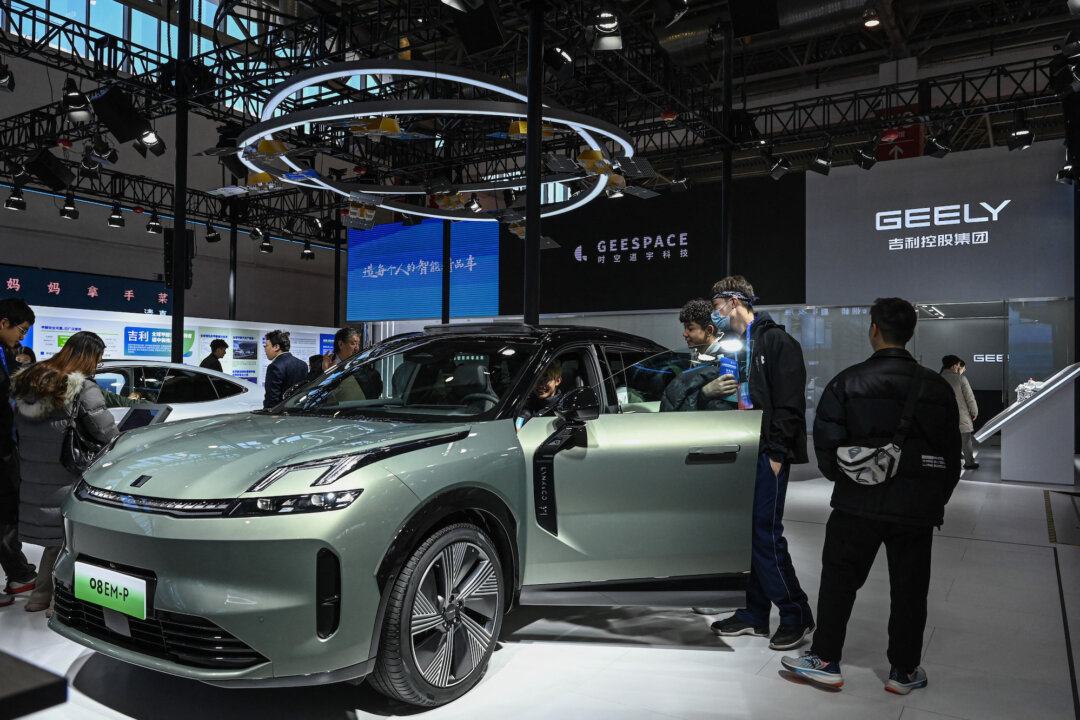
Ford Gives Geely European Manufacturing Foothold, Drawing Rebuke From Washington









Related Articles

EuropeThe Final wakeup call
Lula wins a miracle election in Brazil. Now comes the hard part: putting the country back on the right track
Three weeks ago, Brazilian President Luiz Inácio Lula da Silva’s political obituaries...

EuropeThe Final wakeup call
US midterms: what a new Congress could and could not change for Europe
US midterm elections traditionally attract fewer voters than presidential contests. But this...

EuropeThe Final wakeup call
Political power without balance leads to the erosion of democracy, what Montesquieu can teach modern-day France
KEY TAKEAWAYS Democratic erosion does not start by doing away with elections;...



China Business & EconomyChina NewsChina Technology
China Tech Index Plunges More Than 40 Percent From July Peak
China’s technology-heavy STAR 50 index has fallen by more than 40 percent...
