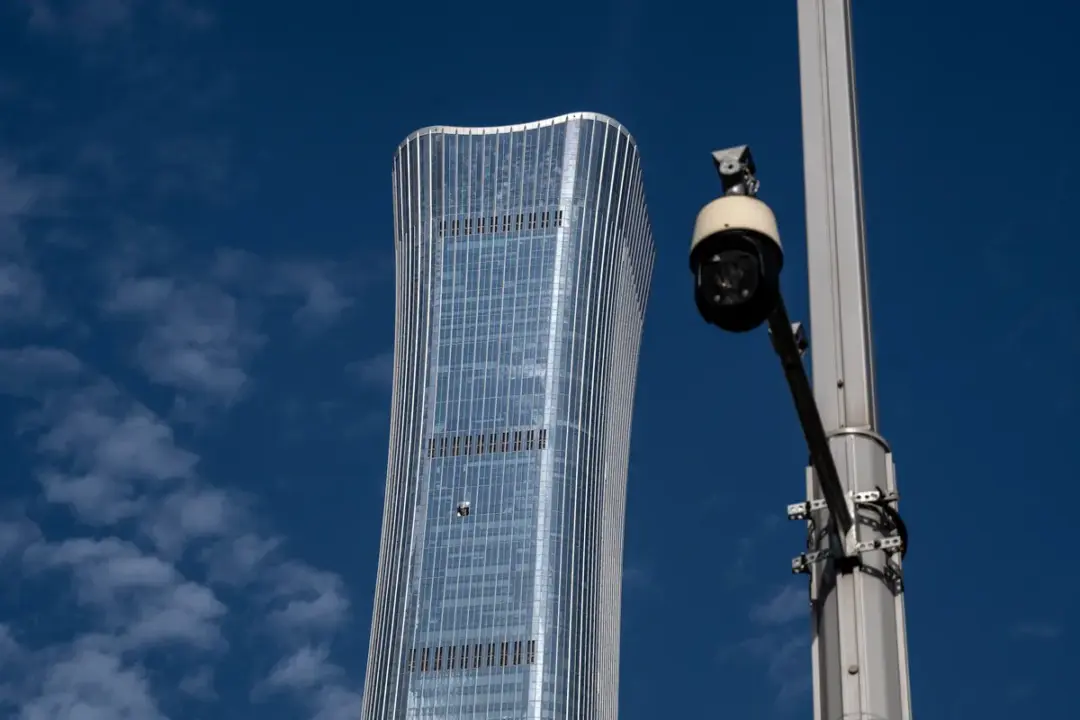
A small aircraft crash into Beijing’s CITIC Tower on June 26 is triggering intense online speculation in China, with some analysts suggesting the incident may have political implications amid a tightening information environment.The aircraft struck the CITIC Tower, the tallest building in Beijing, located only a few kilometers from Zhongnanhai, the luxury compound housing China’s top leadership. The Chinese regime said the crash left one person dead and 13 injured, but has not disclosed the cause of the accident or the identity of the pilot.Beijing has released only limited official information, and public discussion of the incident has been heavily censored on Chinese social media platforms. As of now, no independent verification has confirmed whether the crash was accidental or deliberate.Yuan Hongbing, the former head of the law school at Peking University and renowned Chinese dissident based in Australia, suggested the crash could be linked to political tensions within the Chinese Communist Party (CCP) leadership.Yuan told The Epoch Times that the incident may reflect deeper political conflicts tied to China’s financial sector and the CCP’s elite networks, including factions associated with state-owned financial conglomerates.These claims cannot be independently verified by The Epoch Times.CITIC Group Background Draws AttentionMuch of the online speculation has focused on CITIC Group, the state-owned financial conglomerate headquartered in the CITIC Tower.CITIC was founded in 1979 during China’s “reform and opening up” era, with the approval of former CCP leader Deng Xiaoping, and has long been considered one of China’s most influential state-owned financial institutions. Over decades, it has been associated with elite political and business networks within the CCP.Yuan suggested that there are historical ties between CITIC Group leadership and political factions linked to former CCP leaders.Shortly after the incident, social media posts widely circulated an allegation that the pilot may have been a woman named Liu Junhua. Some posts also linked the name to an executive at CITIC Group-affiliated financial services.However, the Chinese regime has not confirmed the pilot’s identity, and the online rumors remain unverified.Separately, Chinese financial media outlet Shanghai Securities News published an interview report on June 27 with a CITIC Group-affiliated executive also named Liu Junhua, prompting widespread speculation that the report is the regime’s attempt to dispel the rumors. The report did not show any photos of Liu.Police officers keep watch at a junction near CITIC Tower, also known as China Zun, where damage is visible on a high floor of the exterior, in Beijing, China, June 26, 2026. Maxim Shemetov/ReutersAircraft Details, Ownership Claims, and Allegations of Elite TiesAccording to earlier posts on Chinese social media, the aircraft that struck the skyscraper was a China-produced Sunward SA 60L Aurora light sport aircraft. Flight-tracking data showed that the aircraft was registered under the identifier B-12PP.A 2024 promotional video on Chinese social media showed that B-12PP was operated by Dongshi Shuangyue General Aviation, a Beijing-based aviation school. Reuters reported that an employee of Dongshi Shuangyue General Aviation said on June 27 that she could not confirm whether the aircraft B-12PP belonged to the company and declined to provide further details.Dongshi Shuangyue General Aviation’s parent company, Eastern Pioneer Driving School Co. Ltd., is one of China’s first publicly listed pilot training institutions and is headquartered in Beijing.Yuan said the aviation school and its operations are linked to China’s political and military elite. He explained that operating an aviation training institution within Beijing would be impossible without deep political backing from the Party and the military.Citing his sources within the regime, Yuan said the aviation school has ties to the family of Peng Liyuan, the wife of Chinese leader Xi Jinping, and to the family of Cai Qi, a current member of the CCP Politburo Standing Committee.He further said that the aviation training institution has backing from the Chinese air force, arguing that it was approved as part of efforts to cultivate “dual-use civilian and military aviation talent.”Yuan said, again citing his sources within the regime, that the school’s application documents emphasized China’s perceived gap with the United States in private pilot training capacity and argued that China needed to build a civilian reserve of pilots in preparation for potential wartime conditions. On this basis, Yuan described the institution as a dual-use civilian-military entity.China has publicly promoted civil-military integration for decades, and in 2015, Xi elevated military-civil fusion to a national strategy.“The aircraft was continuously tracked by radar systems, but no interception was carried out due to internal procedural constraints,” Yuan said. “In Beijing’s airspace, unauthorized aircraft can only be directly shot down without higher approval if they enter a five-kilometer radius of three designated high-security zones—Zhongnanhai, the Great Hall of the People, and the Western Hills Central Military Commission command center.”He said that because the aircraft was linked to a politically sensitive institution associated with powerful CCP elites, officials were reluctant to authorize interception. He explained that decision-making delays, combined with bureaucratic caution, allowed the aircraft to continue until it struck the building.“Everyone is afraid that if they shoot it down, it might involve someone connected to Xi Jinping, Peng Liyuan, Cai Qi, or elites in the CCP’s air force,” Yuan said.He concluded that the incident reflects not only technical weaknesses in China’s air defense system but also deeper systemic governance issues. Under Xi’s leadership, officials are increasingly risk-averse and unwilling to take responsibility for emergency decisions, which Yuan described as a form of bureaucratic paralysis.“This is a political vulnerability more serious than any military or technical gap,” he said.Tang Bing and Luo Ya contributed to this report.

Beijing Aircraft Crash Near Leadership Compound Stirs Questions








Related Articles
China Business & EconomyChina NewsChina Technology
China Tech Index Plunges More Than 40 Percent From July Peak
China’s technology-heavy STAR 50 index has fallen by more than 40 percent...
China Military NewsChina NewsChinese RegimeInside CCP OfficialdomSpecial TopicsZhang Youxia
Xi Opens CCP Plenum Amid Sweeping Purges, Record-Low Attendance Forecast
Chinese Communist Party leader Xi Jinping opened a four-day meeting of senior...
China Business & EconomyChina NewsChinese RegimeFinance & Business TiesInside CCP OfficialdomSpecial Topics
Chinas Economic Woes Deepen as CCP Plenum Focuses on Political Control
The Chinese Communist Party (CCP) opened a four-day leadership meeting in Beijing...



China NewsEuropeGlobalUK NewsWorld News
UK Must Be Ready for War in 1,000 Days, Says British Defense Secretary
British Defense Secretary Wes Streeting has said the country must be ready...
