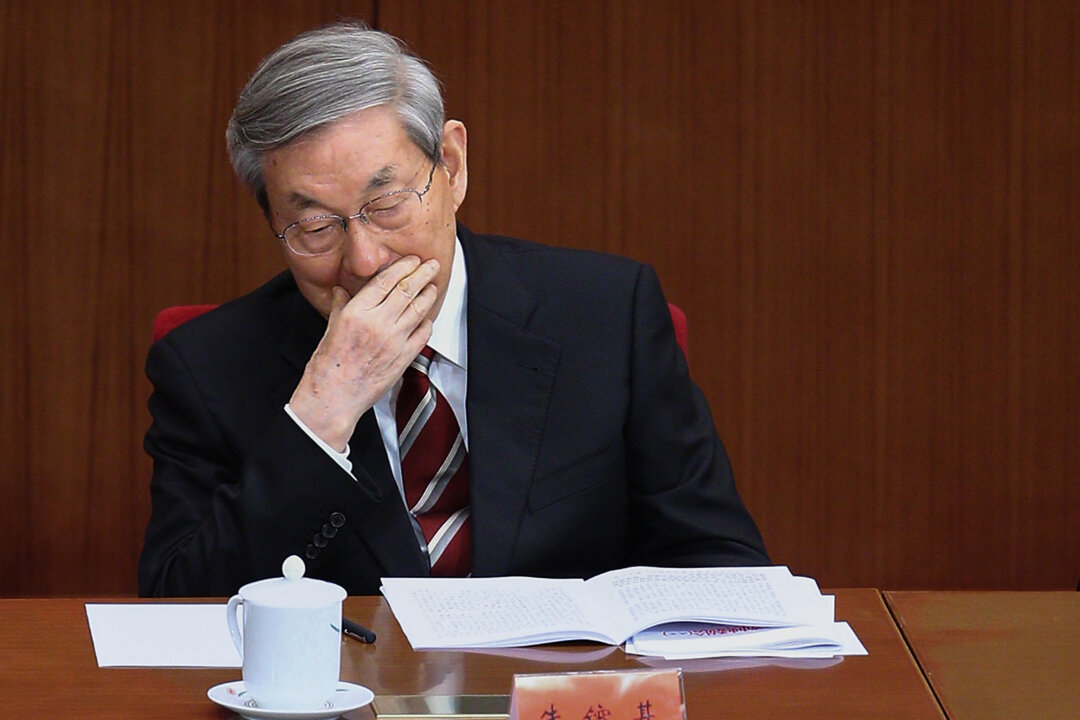
Former Chinese Premier Zhu Rongji’s death could become a symbolic focal point for expressions of political discontent as the Chinese Communist Party (CCP) prepares for a key leadership meeting, according to analysts who spoke to The Epoch Times.Zhu’s death on Aug. 12 comes at a politically sensitive time, as the CCP prepares for its Fifth Plenum in October and senior leaders gather for the annual Beidaihe retreat.Shen Ming-shih, a research fellow at Taiwan’s Institute for National Security and Defense Research, told The Epoch Times that Zhu “has always been regarded as someone who opposed Xi Jinping.”Zhu served as premier from 1998 to 2003 and was closely associated with China’s economic reforms and its efforts to join the World Trade Organization (WTO).In recent years, there have also been claims that Zhu criticized Xi’s economic policies and submitted recommendations to the CCP leadership, according to Shen.Shen said Zhu’s death could take on political significance because it comes as the CCP approaches another major leadership meeting.“The Fifth Plenum will be held in October, and whether Xi Jinping will continue in office and whether there will be a transfer of power are sensitive issues,” he said.“We also cannot rule out the possibility that if Xi Jinping insists on continuing in office, or is currently carrying out various arrangements or actions to secure another term, someone or an anti-Xi faction could use memorial activities for Zhu Rongji to oppose Xi or trigger a political movement. It is difficult to say.”Shen cautioned, however, that Zhu’s death alone was unlikely to trigger a reshuffling of power at the top of the Party.“It could perhaps become a symbol that provides a legitimate outlet for dissatisfaction with politics and the economy,” he said.Shen also predicted that the CCP would tightly control the public response to Zhu’s death and likely organize a state funeral at the highest official level while restricting large-scale public memorial activities that could evolve into expressions of broader political discontent.Zhu’s Reform LegacyChina has a history of political protests emerging around the deaths of senior leaders who became symbols of dissatisfaction with the ruling party.In 1989, the death of former CCP leader Hu Yaobang prompted students to gather in Beijing to mourn him, with the demonstrations eventually expanding into nationwide protests calling for political and economic reform.Students put flowers and wreaths in front of a portrait of former Chinese Communist Party leader and liberal reformer Hu Yaobang on April 19, 1989. Catherine Henriette/AFP/Getty ImagesChen Pokong, a U.S.-based political commentator and author who spent years in Chinese prisons for his role in the 1989 democracy movement, told The Epoch Times that Zhu’s death was unlikely to produce a nationwide mourning movement on the scale of earlier episodes.“Zhu Rongji’s death may bring mourning, but there probably will not be anything on such a large scale,” he said.Chen said Zhu’s death could ultimately benefit Xi politically.“For Xi Jinping, Zhu Rongji’s death is good news,” he said. “Zhu Rongji was a political elder and also a reformist. Xi Jinping fears political elders, and he fears reformists even more.”Zhu’s political significance stems in part from the contrast between his reform-era legacy and the direction of China’s economy and politics under Xi. As premier, Zhu pushed major economic reforms and played a pivotal role in China’s accession to the WTO in 2001, helping usher China deeper into the global economy.Whether Zhu’s death becomes a broader political flashpoint will depend on the scale of public mourning, how authorities respond to it, and whether existing political tensions intensify as the Party prepares for its October meeting.Xia Song and Luo Ya contributed to this report.

Zhu Rongjis Death Raises Questions About Political Discontent as Xi Faces Key Party Meeting








Related Articles
China Business & EconomyChina NewsChina Technology
China Tech Index Plunges More Than 40 Percent From July Peak
China’s technology-heavy STAR 50 index has fallen by more than 40 percent...
China Military NewsChina NewsChinese RegimeInside CCP OfficialdomSpecial TopicsZhang Youxia
Xi Opens CCP Plenum Amid Sweeping Purges, Record-Low Attendance Forecast
Chinese Communist Party leader Xi Jinping opened a four-day meeting of senior...
China Business & EconomyChina NewsChinese RegimeFinance & Business TiesInside CCP OfficialdomSpecial Topics
Chinas Economic Woes Deepen as CCP Plenum Focuses on Political Control
The Chinese Communist Party (CCP) opened a four-day leadership meeting in Beijing...



China NewsEuropeGlobalUK NewsWorld News
UK Must Be Ready for War in 1,000 Days, Says British Defense Secretary
British Defense Secretary Wes Streeting has said the country must be ready...
