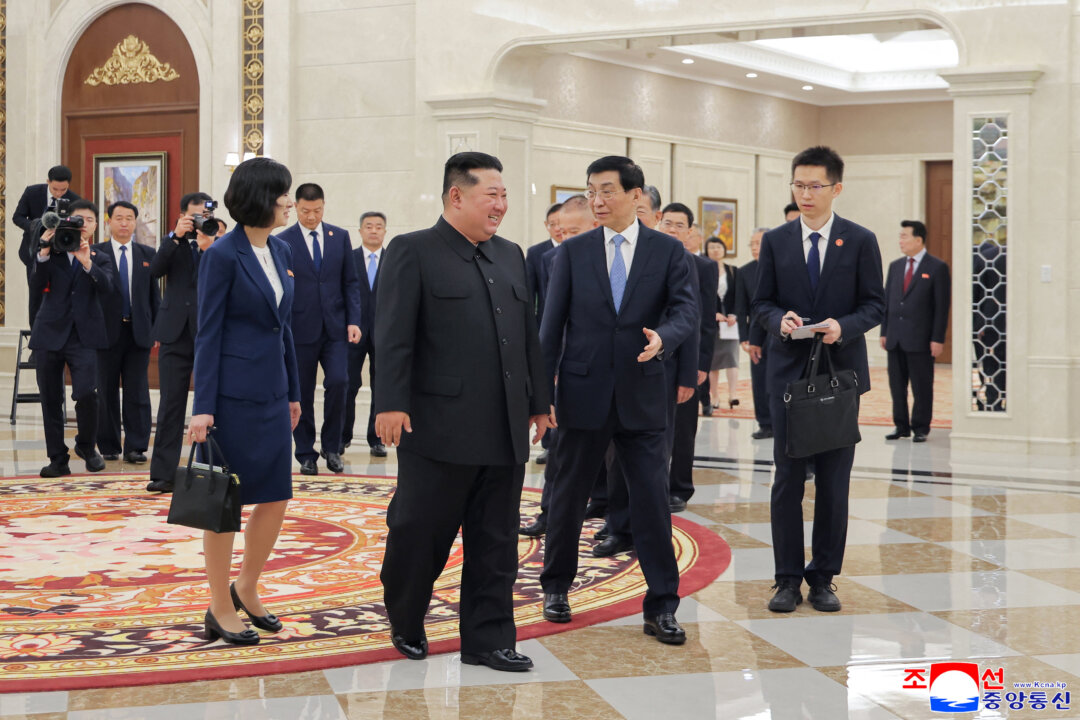
The Chinese communist regime’s fourth-highest-ranked official, Wang Huning, led a high-level delegation to Pyongyang to meet with North Korean leader Kim Jong Un from July 15 to July 17.Analysts who spoke to The Epoch Times said Beijing is trying to bring Pyongyang closer and pull it away from Moscow, while Wang’s visit also aimed to exchange methods of totalitarian rule with Kim’s regime.Wang is a top adviser of Chinese Communist Party (CCP) leader Xi Jinping and is the Party’s chief political theoretician and the chairman of the National Committee of the Chinese People’s Political Consultative Conference (CPPCC).According to Chinese state-run media China Daily, Wang said at the meeting with Kim that China is ready to work with North Korea to maintain close communication and cooperation.Kim, according to the report, said the decision to commemorate the 65th anniversary of the China–North Korea Treaty of Friendship, Cooperation, and Mutual Assistance was an important common understanding he reached with Xi in June.The treaty includes a mutual military defense clause stipulating that if one party faces aggression, the other must intervene; it is the only alliance treaty of a military-defense nature that the CCP has signed with a foreign country, and that remains in effect.Wang’s visit to North Korea is the latest in a series of high-level exchanges between Beijing and Pyongyang since last year.Pak Thae-song, premier of North Korea, led a delegation to China from July 10 to 12 and attended events marking the 65th anniversary of the signing of the China–North Korea Treaty of Friendship, Cooperation, and Mutual Assistance.Kim visited China in September 2025; the following month, Chinese Premier Li Qiang led a delegation to visit Pyongyang. In April this year, Chinese Foreign Minister Wang Yi visited North Korea. Last month, Xi visited North Korea for the first time in seven years.Lin Chih-Hao, an assistant research fellow at the Institute for National Defense and Security Research in Taiwan who specializes in Korean Peninsula security, told The Epoch Times that this round of high-level China–North Korea interaction indicates that North Korea and China are accelerating the advancement of bilateral relations.“The two sides may first restore the North Korea–China border port exchanges to pre-epidemic levels, and then gradually open up tourism, commerce, logistics and other projects,” he said.Feng Chongyi, an associate professor of Chinese Studies at the University of Technology Sydney, told The Epoch Times that while China and North Korea strike a high-profile geopolitical pose, each is pursuing its own agenda.“The Kim dynasty initially relied on the Soviet Union and remained wary of the Chinese regime due to the latter’s desire to exert control; consequently, it repeatedly purged pro-CCP figures. Later, it sought out Russia as an alternative patron, but Russia is currently struggling to manage its own affairs,” Feng said.North Korea has sent troops to assist Russia in the war against Ukraine, while Russia has provided North Korea with missile and nuclear technology, leading to a significant improvement in their bilateral relations in recent years.While North Korea currently maintains close ties with Russia regarding national defense, it turns to the Chinese regime when it needs food or money, Feng said.“As for the CCP’s desire to strengthen ties with North Korea, it doesn’t want North Korea to be closer to Russia than to China. However, the CCP is reluctant to provide North Korea with too much new defense technology, given the latter’s tendency to be uncooperative,” he said.Geopolitical Concerns China and Russia conducted joint naval exercises in the East China Sea from July 6 to July 13.Meanwhile, strengthening ties with Pyongyang offers strategic leverage, Su Tzu-yun, researcher and director of the division of defense strategy and resources at Taiwan’s Institute for National Defense and Security Research, told The Epoch Times.“It allows for countering Japan in the East China Sea, targeting Taiwan and the United States in the Taiwan Strait, and confronting the Philippines and the United States in the South China Sea. Given North Korea’s location north of the First Island Chain, Beijing sees a need to draw it back into its orbit,” Su said.First and second island chains. Courtesy of Department of DefenseThe Korean Peninsula is a crucial strategic anchor for the “First Island Chain,” a strategic line made up of a string of major Pacific archipelagos in the Asia-Pacific, including Japan, Taiwan, and the Philippines, designed by the U.S. military to contain the maritime expansion of the Chinese regime and its allies.Earlier this year, North Korea removed the terms “socialist” and “reunification” from its constitution updates. Analysts who spoke to The Epoch Times at the time said that the changes indicate that Kim was focusing solely on preserving the regime amid geopolitical tensions while signaling to the United States and the West that the Kim regime is merely a dynastic dictatorship, not a communist one, therefore not in conflict with the West ideologically.Russian President Vladimir Putin (L) and North Korean leader Kim Jong Un attend a signing ceremony following their bilateral talks at Kumsusan state residence in Pyongyang, North Korea, on June 19, 2024. Kristina Kormilitsyna/Pool/AFP via Getty ImagesGiven its possession of mature nuclear weapons technology, North Korea is eager to negotiate directly with the Trump administration and maintain an independent diplomatic course, according to Lin.The CCP’s increased interaction with Pyongyang amid the intertwining changes and turmoil characterizing U.S.–China competition is intended to ensure that North Korea does not “shift its allegiance,” he said.“The goal is to forge a genuine ‘blood alliance’ between North Korea and the Chinese regime, thereby maintaining a unified stance regarding the military standoff involving South Korea, the United States, and Japan, as well as other issues concerning the Korean Peninsula,” Lin said.Therefore, it is necessary to develop a relationship between North Korea and China that differs from the past—one that effectively counters the security cooperation among South Korea, the United States, and Japan, while preventing Kim from being drawn into the U.S. orbit, Lin said.Swapping Totalitarian MethodsNorth Korean leader Kim Jong Un holds a meeting with Chinese People’s Political Consultative Conference Chairman Wang Huning, during Wang’s visit in Pyongyang, North Korea, on July 16, 2026, in this picture released July 17, 2026, by North Korea’s official Korean Central News Agency. KCNA via ReutersPhotos of the meeting released by North Korean state media have drawn attention from international media. They show Kim sitting alone on one side of a large oval table with an interpreter behind him, while the nine-member Chinese delegation sat opposite him, separated by a vast expanse of empty tabletop. As Kim spoke, the Chinese officials all took notes with their heads down.Wang is known as the top adviser and Party theoretician for three CCP leaders over the decades, and the Chinese delegation that he’s leading is called “Party-state delegation,” which Lin said indicates another purpose of the meeting with Kim.“The visit likely involves sharing insights on internal governance, political theory, and ideology, specifically exchanging experiences regarding domestic rule,” which are areas that align with Wang’s expertise, Lin said.North Korea is highly likely to adopt CCP practices regarding domestic stability maintenance, technology-driven law enforcement, united front work targeting Taiwan, and “gray-zone” tactics; while the CCP may study North Korea’s Party-state propaganda apparatus and its model of rule based on supreme personal authority, he said.Feng said that Wang rose to high office by focusing on communist ideology, while North Korea represents the archetype of totalitarianism.“China had—for a time—pursued ‘reform and opening-up’ and existed as a post-totalitarian state. Since Xi Jinping took power, however, he has sought to reimpose totalitarianism, and they need to learn from Kim’s totalitarian rule,” he said.However, many ordinary Chinese citizens have awakened to the reality in China, Feng said.“The Chinese regime cannot simply emulate North Korea; it is now caught in a dilemma,” he said.“For China to find a way forward, the Chinese Communist Party must be completely dismantled.”Luo Ya and Tang Bing contributed to this report.

Xis Top Advisor Visited Pyongyang to Meet Kim Jong Un for Closer Relations Amid Geopolitical Tensions
Xis Top Advisor Visited Pyongyang to Meet Kim Jong Un for Closer Relations Amid Geopolitical Tensions







Related Articles
China Business & EconomyChina NewsChina Technology
China Tech Index Plunges More Than 40 Percent From July Peak
China’s technology-heavy STAR 50 index has fallen by more than 40 percent...
China Military NewsChina NewsChinese RegimeInside CCP OfficialdomSpecial TopicsZhang Youxia
Xi Opens CCP Plenum Amid Sweeping Purges, Record-Low Attendance Forecast
Chinese Communist Party leader Xi Jinping opened a four-day meeting of senior...
China Business & EconomyChina NewsChinese RegimeFinance & Business TiesInside CCP OfficialdomSpecial Topics
Chinas Economic Woes Deepen as CCP Plenum Focuses on Political Control
The Chinese Communist Party (CCP) opened a four-day leadership meeting in Beijing...



China NewsEuropeGlobalUK NewsWorld News
UK Must Be Ready for War in 1,000 Days, Says British Defense Secretary
British Defense Secretary Wes Streeting has said the country must be ready...
