
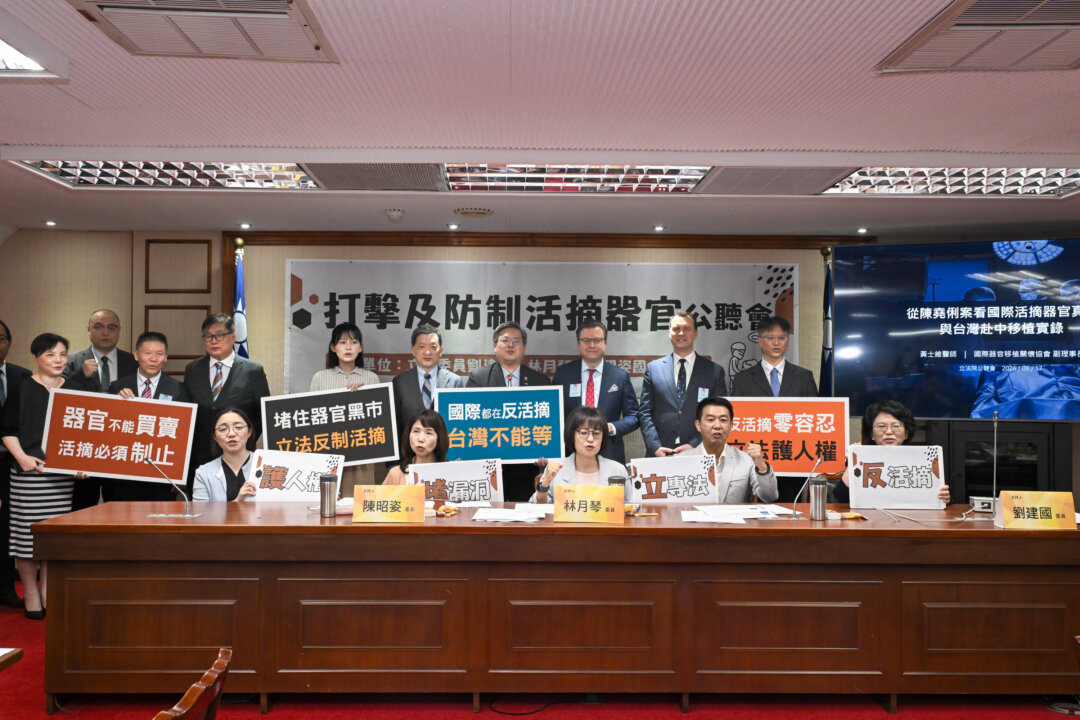
TAIPEI, Taiwan—Taiwan lawmakers convened a parliamentary hearing on June 17 to examine the need for new legislation to strengthen the island’s legal framework against forced organ harvesting, aligning with international efforts to combat illicit organ transplantation and transplant tourism linked to China.Chen Gau-tzu, a legislator of the opposition Taiwan People’s Party (TPP), told the hearing that organ transplants sourced from unidentified origins or from prisoners of conscience cross an ethical red line. As a result, she said, Taiwan’s healthcare system must not inadvertently facilitate illicit overseas organ transplants.“International concern over cross-border organ transplants, transplant tourism, and forced organ harvesting has grown significantly in recent years,” Chen Gau-tzu said.“That reminds us that having laws on the books does not necessarily mean the system is complete, nor does regulation guarantee there are no loopholes in implementation.”Chen Gau-tzu is one of the co-chairs of the Inter-Parliamentary Alliance on China, a global network of nearly 300 lawmakers from more than 40 legislatures whose mission is to address challenges posed by the Chinese Communist Party (CCP).At the 2025 summit in Brussels, the alliance’s lawmakers pledged to advance legislation to prevent complicity in the Chinese regime’s state-sanctioned practice of forced organ harvesting.In Taiwan, the issue of forced organ harvesting drew renewed attention earlier this month, when Chen Yao-li was sentenced to two years in prison, suspended for five years, and had his medical license revoked. He was indicted in 2024 for violating the island’s Human Organ Transplant Act by illegally brokering patients to China for liver and kidney transplant surgeries.This case marks the first time in Taiwan that a physician’s medical license has been revoked for illegally referring patients to China for organ transplantation.Chen Yao-li was once a well-known liver transplant doctor in Taiwan, having worked at Chung Shan Medical University Hospital and Changhua Christian Hospital’s organ transplant center.Chen Gau-tzu, a legislator, takes part in a legislative hearing on combating and preventing forced organ harvesting, in Taipei, Taiwan, on June 17, 2026. Sung Pi-lung/The Epoch TimesCurrent LimitationsThe case against Chen Yao-li was discussed at length during the hearing.Chang Shang-wen, a spokesperson for Taiwan’s Changhua Christian Healthcare System, which represents institutions including Changhua Christian Hospital, told the hearing how the case against Chen Yao-li might have come to light much earlier if Taiwanese officials had taken action sooner.“Between 2008 and 2010, there were already cases in which patients who had undergone organ transplants in China arranged by Mr. Chen died shortly after returning [to Taiwan], having paid a hefty price. At that time, the families reported the matter to the Changhua County Public Health Bureau,” Chang said.The health bureau set up a disciplinary committee in response, Chang said. However, he said that, to his knowledge, no disciplinary action was ultimately taken.Chang also highlighted Taiwan’s Human Organ Transplant Act, which requires patients who received organ transplants abroad to submit written details—including the transplant hospital and physician involved—to Taiwanese hospitals when seeking post-transplant follow-up care.However, Chang said hospitals have no effective way to verify the authenticity of the information and called for closer coordination with immigration authorities to help deter violations.Chen I-sheng, a lawyer and a legal counsel to the Taiwan Association for International Care of Organ Transplants, told the hearing that the Human Organ Transplant Act is confined to regulating organ trade, economic wrongdoing, and domestic healthcare governance, as illustrated by the Chen Yao-li case, in which prosecutors sought a six-year sentence but the court imposed a two-year term.The current law fails to address crimes against humanity carried out by a foreign state, where evidence of organ sourcing is deliberately destroyed, Chen I-sheng said.“Our legal system is completely powerless against transnational atrocities,” Chen I-sheng said, adding that new legislation is needed to combat and prevent forced organ harvesting.Lin Yueh-chin, a legislator, takes part in a legislative hearing on combating and preventing forced organ harvesting, in Taipei, Taiwan, on June 17, 2026. Sung Pi-lung/The Epoch TimesLin Yueh-chin, a legislator of the ruling Democratic Progressive Party (DPP), recommended at the hearing that the Taiwanese government should establish an organ source verification system and an inter-ministerial reporting mechanism to address forced organ harvesting, which she described as a violation of universal human rights.ChinaAt the hearing, Jan Jekielek, senior editor at The Epoch Times and host of EpochTV’s “American Thought Leaders” program, spoke about how organ procurement in China “functions as the exact reverse of an ethical transplantation system.”“In any ethical system, vital organs typically come from catastrophic accidents. To reduce the chance of rejection, blood type and histology are also matched. Supply is a lot less than the demand,” Jekielek said.“So because of an accident, a possible donor appears with many possible organ recipients in waiting. In the U.S., an algorithm is used to decide who gets to the front of the line,” Jekielek said.“In China, wait times are measured not in years or months, but in weeks or days. Heart transplants can be scheduled.”(center L) Jan Jekielek, senior editor at The Epoch Times, takes part in a legislative hearing on combating and preventing forced organ harvesting, in Taipei, Taiwan, on June 17, 2026. Courtesy of Jan JekielekJekielek detailed the issue in his book “Killed to Order,” which was published in March and became a New York Times bestseller.“Killed to Order” examines the Chinese regime’s on-demand organ-harvesting industry, drawing on evidence from 20 years of independent investigations, and explores how it became an estimated $9 billion industry through the targeting of prisoners of conscience.One principal victim group is practitioners of Falun Gong, a spiritual discipline consisting of meditative exercises and moral teachings based on the principles of truthfulness, compassion, and forbearance. First introduced to the public in China in 1992, the practice quickly spread by word of mouth to reach an estimated 70 million to 100 million practitioners by 1999.The CCP, fearing that Falun Gong’s popularity threatened the regime’s power, began persecuting the spiritual group in July 1999. Since then, practitioners have faced widespread detention in prisons, labor camps, and brainwashing centers, where forced labor, torture, and deaths have been reported.Dr. Andreas Weber, a surgeon and Germany-based representative of Doctors Against Forced Organ Harvesting, also attended the hearing. He said any new Taiwanese legislation aimed at combating China’s forced organ harvesting should require transparency in cross-strait transplant cooperation, examine potential complicity of hospitals and medical schools, and explicitly identify Falun Gong as a victim group to highlight the issue’s human rights implications.The hearing came on the same day that the U.S. Senate Foreign Relations Committee advanced the Falun Gong and Victims of Forced Organ Harvesting Protection Act. If enacted, it would allow U.S. sanctions against perpetrators of state-sponsored forced organ harvesting in China.A version of the bill, the Falun Gong Protection Act, passed the U.S. House of Representatives in May 2025.In an X post on June 18, Weber urged the Senate bill to be enacted into law.“This is a great leap to protect [vulnerable] minorities in China and others from forced organ harvesting! Their organs are sold to tourists all over the world!” Weber wrote.TaiwanLast year, a cross-party group of legislators proposed a draft bill titled “Act on Combating and Preventing Forced Organ Harvesting.”One of the provisions would punish crimes—including transplanting harvested organs or tissues from one person to another, and acting as a broker while knowing that the organs or tissues come from forced organ harvesting—with a sentence of at least five years and up to 12 years in prison, and a fine of between NT$ 1 million and NT$ 10 million (about $31,000 to $310,000).Hsu Chih-chieh, a legislator, takes part in a legislative hearing on combating and preventing forced organ harvesting, in Taipei, Taiwan, on June 17, 2026. Sung Pi-lung/The Epoch TimesThe Taiwanese bill was proposed by Chen Gau-tzu, DPP legislator Hsu Chih-chieh, and Lin Szu-ming, a legislator of the opposition Kuomintang (KMT). Other legislators who signed on to the bill included DPP legislators Wang Cheng-hsu and Liu Chien-kuo.Liu chaired the hearing on Wednesday. Representatives from several Taiwanese government agencies also participated in the event.After the hearing, Liu said in a Facebook post that he would request several Taiwanese agencies—including the Ministry of Health and Welfare, the Ministry of Justice, and the Ministry of the Interior—to study legislation to combat and prevent forced organ harvesting, as well as related issues such as increasing criminal penalties, confiscation of criminal proceeds, and extraterritorial jurisdiction. These agencies would be required to submit a written report on these matters within three months, Liu said.Liu Chien-kuo, a legislator, takes part in a legislative hearing on combating and preventing forced organ harvesting, in Taipei, Taiwan, on June 17, 2026. Chang Huai-jen/The Epoch Times“Taiwan is a rule-of-law, free, and democratic country. Therefore, we should strengthen our legal framework to better deter such practice [of forced organ harvesting] from happening,” Liu told The Epoch Times’ sister media NTD at the hearing.In an X post after the hearing, Hsu expressed hope that improving the legal framework would “ensure that Taiwan stands on firmer grounds in medical ethics and human rights protection.”Wang Cheng-hsu, a legislator, takes part in a legislative hearing on combating and preventing forced organ harvesting, in Taipei, Taiwan, on June 17, 2026. Chang Huai-jen/The Epoch TimesSpeaking to NTD at the hearing, Wang expressed hope that legislation dedicated to combating and preventing forced organ harvesting would better protect the public.“We must protect patients who need organ transplants,” Wang told NTD at the hearing.Eva Fu and Chang Huai-jen contributed to this report.









Ohio State Agrees to $2.1 Million Federal Settlement Over Undisclosed China Research Ties
Ohio State University has agreed to pay $2.1 million to resolve federal...

Chinese Scientists Flagged Glacial Flood Danger One Year Before Nepal Catastrophe
More than a year before the catastrophic flash flood devastated the China–Nepal...

Chinas Humanoid Robot Companies Face Reality Check
China is showcasing humanoid robots as symbols of its technological ambitions. However,...



Iceland Focuses on Security Partnerships After Voters Reject Opening EU Membership Talks
Icelandic Minister for Foreign Affairs Thorgerdur Katrin Gunnarsdottir attends a press conference...
