China runs three signals-intelligence facilities in Cuba, while Chinese and Russian intelligence personnel on the island have tripled over the past three years, according to a new State Department report.The report, released on July 20, also says that Havana funnels information and intelligence gathered by its agents in the United States to China, Russia, Iran, and North Korea—giving Beijing access to both electronic collection near Florida and intelligence obtained from inside American institutions.Cuba is located about 90 miles south of Florida. Electronic-collection sites on the island are within range of U.S. Southern Command, U.S. Central Command, Naval Air Station Key West, Cape Canaveral, the Kennedy Space Center, and other military and space installations across the Southeast, according to congressional testimony on China’s surveillance presence in Cuba.One of the most visible signs of the buildup is a newly completed 32-antenna array at Bejucal, southwest of Havana. The Center for Strategic and International Studies (CSIS) said in a June satellite-imagery assessment that the system had “very likely begun operations.”The State Department did not identify the three facilities it says China operates. CSIS has separately tracked four Cuban sites—Bejucal, Wajay, Calabazar, and El Salao—that may support Chinese intelligence collection.Bejucal Array Appears OperationalSignals intelligence, or SIGINT, is collected from radio traffic, radar emissions, satellite links, telemetry, and other electronic transmissions.Even when communications are encrypted, their origin, direction, frequency, and volume can expose military exercises, deployments, command activity, weapons tests, and changes in readiness.Commercial satellite images show that an antenna field at Bejucal was converted over two years into a circularly disposed antenna array, or CDAA. The completed system consists of 19 antennas in an outer ring and 13 in an inner ring, CSIS said.CDAAs are used primarily to intercept and locate high-frequency radio transmissions. A May 2025 CSIS assessment said such systems can locate signals originating between 3,000 and 8,000 miles away, depending on operating conditions and configuration.From Bejucal, the array could improve the ability of Cuba—or a foreign intelligence partner—to monitor air and maritime activity in the Caribbean, the Gulf of Mexico, the western Atlantic, and the southeastern United States.CSIS said Bejucal is likely among the three facilities U.S. officials assess are operated by China. Commercial imagery, however, can establish the presence and capabilities of collection equipment more readily than the identity of the personnel controlling it.The other three sites have developed differently.Wajay, near Havana, contains several types of antennas suited primarily to terrestrial signal interception. Calabazar contains dish, vertical, and horizontal antennas and appears capable of collecting several kinds of intelligence, including transmissions involving satellites in geosynchronous orbit, according to CSIS’s 2024 site analysis.El Salao, near Santiago de Cuba, had been prepared for another circular array. The latest satellite images showed no antennas installed and construction largely stalled.Intelligence Gathered Inside the USThe electronic sites offer Beijing a collection position near U.S. territory. Cuba’s intelligence service has also recruited agents with access inside the American government.The State Department report describes Cuban penetrations of the Pentagon, State Department, National Security Council, and U.S. intelligence agencies, some of which continued undetected for decades.Ana Belén Montes, a senior Cuba analyst at the Defense Intelligence Agency, pleaded guilty in 2002 to spying for Havana.The State Department report says Montes disclosed the existence of a secret, multibillion-dollar U.S. satellite program used to gather intelligence on China, Russia, and Iran.Victor Manuel Rocha, a former U.S. ambassador and National Security Council official, pleaded guilty in 2024 to secretly serving Cuba for decades. His government career included posts that gave him access to classified information and senior U.S. policymaking.Former State Department official Walter Kendall Myers and his wife, Gwendolyn, in 2009 admitted working for Cuban intelligence for roughly 30 years.The State Department now says Cuba sends intelligence collected in the United States to Beijing and other governments hostile to Washington.Security Ties BroadenChina and Cuba have steadily expanded cooperation in cybersecurity, data security, law enforcement, military exchanges, technology transfer, and Communist Party coordination.A September 2025 joint statement said the two sides would deepen cooperation in cybersecurity, digital transformation, data security, the digital economy, and technology-transfer projects. It also said they signed documents involving Beijing’s Belt and Road and Global Security initiatives and would strengthen exchanges between the Chinese Communist Party and the Communist Party of Cuba.The security relationship extends beyond diplomatic language. China’s public-security minister, Wang Xiaohong, met Cuban Interior Minister Lázaro Alberto Álvarez Casas in Beijing in August 2025 and called for deeper cooperation in law enforcement, personnel exchanges, and security capacity building, according to an official Chinese government account.An earlier 2022 joint statement also placed cybersecurity inside the countries’ Belt and Road cooperation and endorsed Beijing’s Global Data Security Initiative.Those public documents describe a widening political, digital, police, and security partnership.Years of US WarningsThe new report follows several years of U.S. government warnings and congressional scrutiny over Chinese collection activity in Cuba.The U.S.–China Economic and Security Review Commission said in its 2023 report to Congress that Chinese access to electronic-intelligence facilities in Cuba could help Beijing monitor—and potentially disrupt—U.S. military deployments and supply movements during a conflict.At a May 2025 House Homeland Security hearing, CSIS Americas Program Director Ryan Berg told lawmakers that the four sites identified through satellite imagery were highly likely to support Chinese intelligence operations targeting the United States.Berg said facilities in Cuba could place about 20 military and sensitive installations in Florida within collection range, including MacDill Air Force Base, Naval Air Station Key West, Cape Canaveral, and Southern Command.Congress has previously considered sanctions aimed at people and entities supporting Chinese military or intelligence facilities in Cuba. The CEASE Act, introduced in 2023, would have required asset-blocking and visa sanctions against foreign persons providing material support to such facilities, but it did not become law and has not been reintroduced in the current Congress.

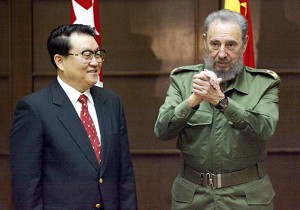
State Department Says China Runs 3 Intelligence Sites in Cuba








Related Articles
China Business & EconomyChina NewsChina Technology
China Tech Index Plunges More Than 40 Percent From July Peak
China’s technology-heavy STAR 50 index has fallen by more than 40 percent...
China Military NewsChina NewsChinese RegimeInside CCP OfficialdomSpecial TopicsZhang Youxia
Xi Opens CCP Plenum Amid Sweeping Purges, Record-Low Attendance Forecast
Chinese Communist Party leader Xi Jinping opened a four-day meeting of senior...
China Business & EconomyChina NewsChinese RegimeFinance & Business TiesInside CCP OfficialdomSpecial Topics
Chinas Economic Woes Deepen as CCP Plenum Focuses on Political Control
The Chinese Communist Party (CCP) opened a four-day leadership meeting in Beijing...


China NewsEuropeGlobalUK NewsWorld News
UK Must Be Ready for War in 1,000 Days, Says British Defense Secretary
British Defense Secretary Wes Streeting has said the country must be ready...
