Local authorities in the Chinese city of Hefei carried out a large-scale overnight demolition operation this week, tearing down homes without formal compensation agreements or relocation documents.Multiple residents spoke to The Epoch Times on condition of anonymity out of fear of reprisal. The demolitions, which residents said took place in the early hours of May 16 in a community in Hefei’s Yaohai District, have reignited longstanding tensions in China over forced evictions, disputed property rights, and redevelopment projects tied to urban expansion.They described security personnel arriving in the middle of the night, forcibly removing people from their homes, and demolishing buildings that some families had occupied for more than two decades.Residents said many of the homes were built between 2004 and 2005, during a period when the area was still largely rural. While some homeowners eventually obtained property documentation, others said their applications stalled years ago amid sweeping changes to local land and housing policies.Local authorities now classify many of the homes as unauthorized or lacking full permits, residents said. Homeowners argue the situation reflects unresolved historical and administrative bureaucracy rather than illegal construction.Late-Night OperationOne resident told The Epoch Times that hundreds of security personnel entered the area late on the night of May 15.“About four hundred people came last night, all outside security guards,” he said. “They only said they were from a security company … and then all our houses were demolished.”According to the resident, teams broke into homes while people were asleep.“They forced open doors and dragged people out of the houses,” he said. “There were so many of them that residents had no way to resist.”Another resident, a woman living in the neighborhood, told The Epoch Times the operation began around 1 or 2 a.m. on May 16.She estimated that at least seven buses carrying personnel and local community officials arrived at the site.“They surrounded the entire area,” she said.She said that residents living in homes with valid permits were temporarily confined inside their buildings while structures deemed inadequately documented were targeted for demolition.“They locked the doors from both inside and outside so people couldn’t get out or come in,” she said.The woman said some occupied homes were demolished immediately after residents were removed.“There was still an elderly person staying in our house,” she said. “They used an excavator to move a car out and then flattened the entire house.”She said appliances and personal belongings, including refrigerators, washing machines, and air conditioners, remained inside the building when it was demolished.Homes Built During Rapid Urban ExpansionResidents said the affected properties are located in an area that has undergone rapid urbanization over the past two decades.According to residents, the land was originally acquired around 2003, when the district was still governed more like a village community than an urban neighborhood. At the time, villagers commonly bought land and built homes through approvals issued at the village level.Several residents said they completed at least part of the required registration process, obtaining documents such as land-use certificates or partial ownership paperwork. Others said their applications were interrupted when local authorities later froze permit processing amid large-scale redevelopment plans.The female resident who spoke to The Epoch Times said her family’s house was approved by the village committee before construction began in 2004.“The village committee signed and stamped the documents,” she said. “But later, when Hefei city started large-scale demolition and redevelopment, all the land and planning procedures were frozen.”As a result, she said, her family was unable to complete the final stages of registration.“By now the house has existed for 21 years,” she said. “We’ve lived here the entire time with normal water and power service.”The residents argued that authorities are now retroactively labeling homes as illegal despite years of tacit acceptance by local officials.Compensation Disputes Residents said local authorities began discussing redevelopment plans around November last year, but never provided formal planning documents, compensation agreements, or relocation policies.The male resident who spoke to The Epoch Times said officials verbally indicated that homes lacking full documentation would receive significantly reduced compensation compared with fully certified properties. However, the owners were never given written agreements.“How can we agree to anything if you don’t produce official documents?” he said.The female resident said her family’s property totaled roughly 500 to 600 square meters (approx. 5,400 to 6,500 sq. ft.), but the relocation offer discussed verbally was far below the home’s actual size.She also said residents would still be required to pay additional fees for replacement apartments.“The key issue is that none of this was ever put in writing,” she said.Residents also said authorities never produced formal documentation showing that the homes had been legally designated as illegal structures.“Now that they want the land, suddenly they say our homes are illegal,” the woman said. “If that’s the case, they should show official certification from the relevant departments.”Residents said the demolitions followed months of escalating pressure tactics aimed at forcing people to leave.The woman recalled that authorities first sealed off parts of the neighborhood in February during another late-night operation involving large numbers of security personnel carrying shields.Many of the buildings contained ground-floor storefronts and storage spaces, with residential units upstairs. She said businesses became increasingly difficult to operate after access routes were restricted.She also accused local personnel of repeatedly visiting tenants late at night and warning them that demolition was imminent.“They kept harassing tenants after 9 p.m., telling them to move out because the area would soon be demolished,” the woman said.After many renters left, she said local authorities dug up the neighborhood’s remaining access road in mid-April, again during nighttime hours.Residents called the police and argued that the blocked route was the community’s only access point for daily life and emergencies.“Elderly people and children were living inside,” the woman said. “How were we supposed to live if the only road was blocked?”The male resident said similar incidents had occurred multiple times over the past two years.Residents Say Petition Efforts FailedSome residents said they had traveled to Beijing to file petitions with central regime authorities before the demolitions took place, a common practice in China when people believe local governments have mishandled disputes.The female resident said local officials persuaded petitioners to return home after promising negotiations.“We didn’t want the conflict to become too extreme, so we trusted them and came back,” she said. “But after we returned, they immediately changed their attitude and maintained their previous position.”She said residents expected local authorities to provide an answer later this month.“Instead of waiting for the scheduled response, they suddenly launched this large-scale operation overnight,” she said.A 2021 notice published on the Yaohai District government website acknowledged longstanding problems with property certification in parts of the district, including disputes related to historical land ownership and administrative restructuring.Xu Yiyang and Gu Xiaohua contributed to this report.

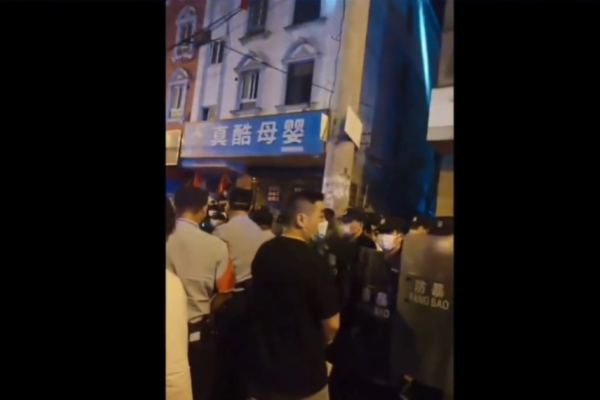
Overnight Demolitions in Eastern China Spark Claims of Forced Evictions, Intimidation









Related Articles

China Business & EconomyChina NewsChina Technology
China Tech Index Plunges More Than 40 Percent From July Peak
China’s technology-heavy STAR 50 index has fallen by more than 40 percent...
China Military NewsChina NewsChinese RegimeInside CCP OfficialdomSpecial TopicsZhang Youxia
Xi Opens CCP Plenum Amid Sweeping Purges, Record-Low Attendance Forecast
Chinese Communist Party leader Xi Jinping opened a four-day meeting of senior...

China Business & EconomyChina NewsChinese RegimeFinance & Business TiesInside CCP OfficialdomSpecial Topics
Chinas Economic Woes Deepen as CCP Plenum Focuses on Political Control
The Chinese Communist Party (CCP) opened a four-day leadership meeting in Beijing...



China NewsEuropeGlobalUK NewsWorld News
UK Must Be Ready for War in 1,000 Days, Says British Defense Secretary
British Defense Secretary Wes Streeting has said the country must be ready...
