
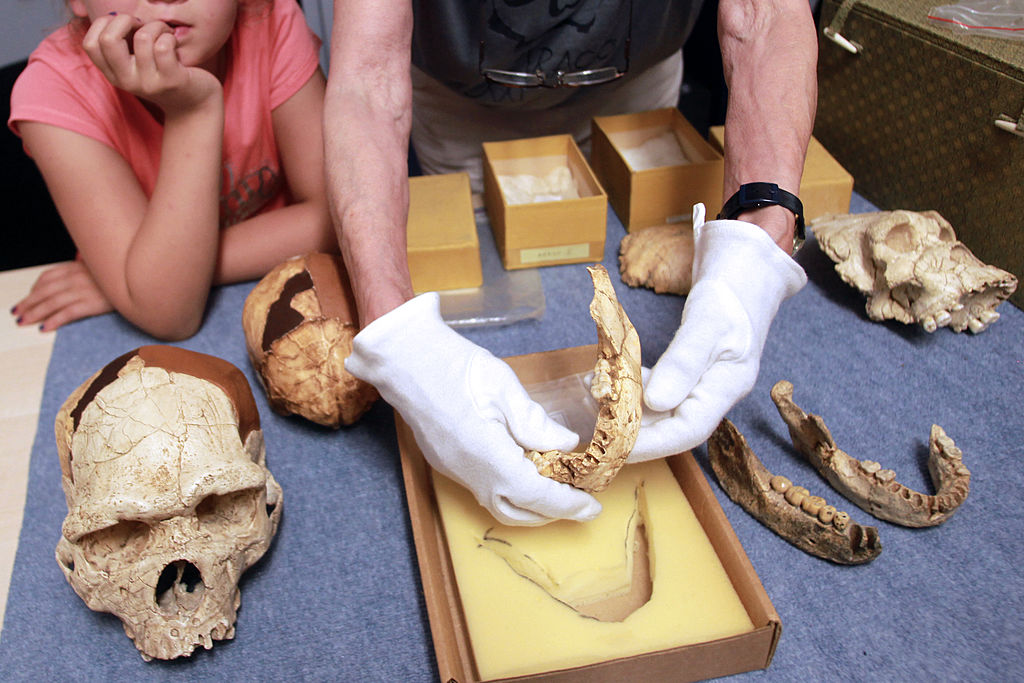
The now-extinct Homo erectus survived for 1.5 million years in extremely dry conditions.
An early ancestor of our species, Homo erectus, was a lot tougher and more adaptable than was long believed, a new study has revealed.
In an international effort, researchers from the University of Queensland School of Social Science and the Australian Research Centre for Human Evolution (ARCHE) at Griffith University, alongside scientists from Canada, Spain, Tanzania, Ethiopia, Germany, and the United States, examined early hominins.
“Now extinct, Homo erectus existed more than an estimated 1.5 million years, marking them as a success in the human evolution story when compared with our own estimated existence of around 300,000 years to date,” said Professor Michael Petraglia, Director of ARCHE.
Homo erectus was the first of our relatives to have human-like proportions and the first known early human to migrate out of Africa.
The study now suggests that the species successfully navigated harsher and more arid terrains in Eastern Africa for longer than previously thought.
There has been much debate about when early hominins developed the ability to survive in extreme environments, such as deserts and rainforests.
Related Stories


“Traditionally, it was thought that only Homo sapiens was able to survive in such ecosystems for long periods of time, while archaic hominins were considered to be restricted to smaller areas,” explained Abel Shikoni of the University of Dodoma in Tanzania.
Early modelling, which has prevailed until now, thought that all precursors to Homo sapiens were highly sensitive to environmental variability and had a narrow ecological range.
This sensitivity has been taken as evidence that these species lacked the broad adaptability needed to thrive in diverse ecosystems.
However, analysis of evidence from Engaji Nanyori in Tanzania’s Oldupai Gorge revealed that Homo erectus thrived in extremely dry landscapes one million years ago—well before Homo sapiens emerged.
How Homo Erectus Thrived in Arid Landscapes a Million Years Ago
Semi-desert conditions prevailed in the area between approximately 1.2 million and 1 million years ago. With Homo erectus living from 2 million to 140,000 years ago, they were exposed to those conditions.
Despite these challenges, Homo erectus regularly lived in landscapes shaped by rivers and streams, using these water sources to reduce risks such as drought and food shortages.
“The evidence we analysed suggests early Homo had the ability to adapt to diverse and unstable environments from the East African Rift floor and Afromontane areas as early as two million years ago,” Petraglia said.
That means Homo erectus was much more like us than was previously assumed.
“That success came down to their ability to survive over a long period marked by many changes to the environment and climate,” noted the lead author, Professor Julio Mercader of the University of Calgary.
Professor Paul Durkin of the University of Manitoba added that this adaptability redefined Homo erectus as ecological generalists, capable of thriving in some of the harshest landscapes.
“This resilience in arid zones positions Homo erectus as the first hominin to transcend environmental boundaries on a global scale,” he said.
Early African Homo erectus fossils are the oldest of our ancestors known to have possessed modern human-like body proportions, with relatively elongated legs and shorter arms compared to the size of the torso.
These features are considered adaptations to a life lived on the ground, indicating a shift away from tree-climbing adaptations, and suggesting that Homo erectus could walk and possibly run long distances.
Compared to earlier fossil humans, Homo erectus had a larger brain relative to the size of the face, suggesting greater intelligence than their predecessors.
The most complete fossil of this species is known as the Turkana Boy.
This well-preserved skeleton, though lacking most hand and foot bones, is dated to around 1.6 million years ago. He grew at a growth rate similar to that of a great ape.
There is also fossil evidence that this species cared for elderly and weakened individuals.
Additionally, Homo erectus is often associated with the earliest handaxes, marking the first major innovation in stone tool technology.









Chinese Scientists Flagged Glacial Flood Danger One Year Before Nepal Catastrophe
More than a year before the catastrophic flash flood devastated the China–Nepal...

Iceland Focuses on Security Partnerships After Voters Reject Opening EU Membership Talks
Icelandic Minister for Foreign Affairs Thorgerdur Katrin Gunnarsdottir attends a press conference...
Italy, Spain Extend Tit-for-Tat Border Curbs After Ceuta Illegal Immigrant Crisis
Immigrants gather on a hill as they attempt crossing from the border...



Vaccine Maker Halts Trial on mRNA Cancer Shot
A pharmacist administers the Pfizer-BioNTech vaccine in Los Angeles, Calif., on October...
