

François Bayrou has outmaneuvered a deeply divided parliament, securing a lifeline from both the Socialists and the National Rally.
After French Prime Minister François Bayrou survived two no-confidence votes in parliament, the French Senate approved the 2025 budget on Feb. 6, sending it to the Constitutional Council for review.
Centrist Bayrou made use of special constitutional powers to advance the delayed budget, which aims to reduce the deficit by trimming spending and raising taxes.
The country’s debt increased by 71.7 billion euros to 3.3 trillion euros by the end of 2024, representing more than 113 percent of its gross domestic product (GDP), statistics from the French National Institute of Statistics and Economic Studies showed. It is far above the 60 percent cap on public debt set by the EU’s fiscal rules.
The budget involves 60 billion euros (about $62.6 billion) of spending cuts as well as tax hikes in a bid to reduce its fiscal deficit.
No-confidence votes were called on Jan. 5 by an anti-austerity left-wing coalition in protest of the use of the constitutional powers and comments Bayrou made about immigration.
Both motions failed after the right-wing National Rally and left-wing Socialists did not back them.
Related Stories
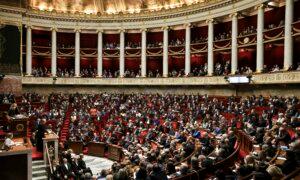

The Socialists, part of the New Popular Front, and Marine Le Pen’s National Rally signaled ahead of the vote that they wouldn’t support it.
The no-confidence votes were called by three of the country’s four main left-wing forces—the Greens, the Communists, and Jean-Luc Mélenchon’s France Insoumise (France Unbowed) movement—which have an agreement to run under a shared manifesto as the New Popular Front.
In total, 128 lawmakers voted in favor of the first motion and 122 for the second motion, short of the 289 votes needed for either to pass.
Speaking to La Tribune Dimanche on Feb. 2, Bayrou said he would use a controversial constitutional tool called Article 49.3 to pass legislation without a parliamentary vote.
“Now we have to go straight to adoption,” Bayrou said. “A country like ours cannot be without a budget. The only way to do that is to make the government responsible.”
The tool was written into the French Constitution to bypass deadlocks on important matters, but it also allows opposition parties to table motions of no confidence.
Austerity
Mathilde Panot, president of the La France Insoumise group in the National Assembly, on Feb. 6 told the French TV channel BFMTV that those who did not participate in the no-confidence vote “are enabling the implementation of the most violent and austere budget of the 21st century.”
“11 million families will see their electricity bills soar. Civil servants will see their sickness benefits drop,” she said.
Last week, the French budget talks hit a roadblock after Socialist Party officials suspended negotiations in protest of remarks Bayrou made about immigration.
In a television interview with French news channel LCI on Jan. 27, Bayrou said the country is at risk of feeling overwhelmed by immigration.
“I think that the meeting of cultures is positive,“ he said. ”But as soon as you have the feeling of a submersion, of no longer recognizing your country, of no longer recognizing the ways of life or culture, from that moment on, you have rejection.”
Bayrou repeated his immigration comments in the French Senate on Jan. 29, with Socialist parliamentary leader Boris Vallaud accusing him of embracing far-right rhetoric.
“If you govern with the prejudices of the far-right, we will end up being governed by the far-right, and you will have been its accomplice,” Vallaud said.
In December 2024, French President Emmanuel Macron said his decision to call early parliamentary elections in June 2024 had created more instability than peace.
The collapse of the previous government in early December 2024 meant France was unable to pass the budget before the year-end deadline.
Former Prime Minister Michel Barnier also invoked Article 49.3 and was subsequently punished by the left and the right and voted out by a no-confidence vote.
Guy Birchill, Reuters, and The Associated Press contributed to this report.