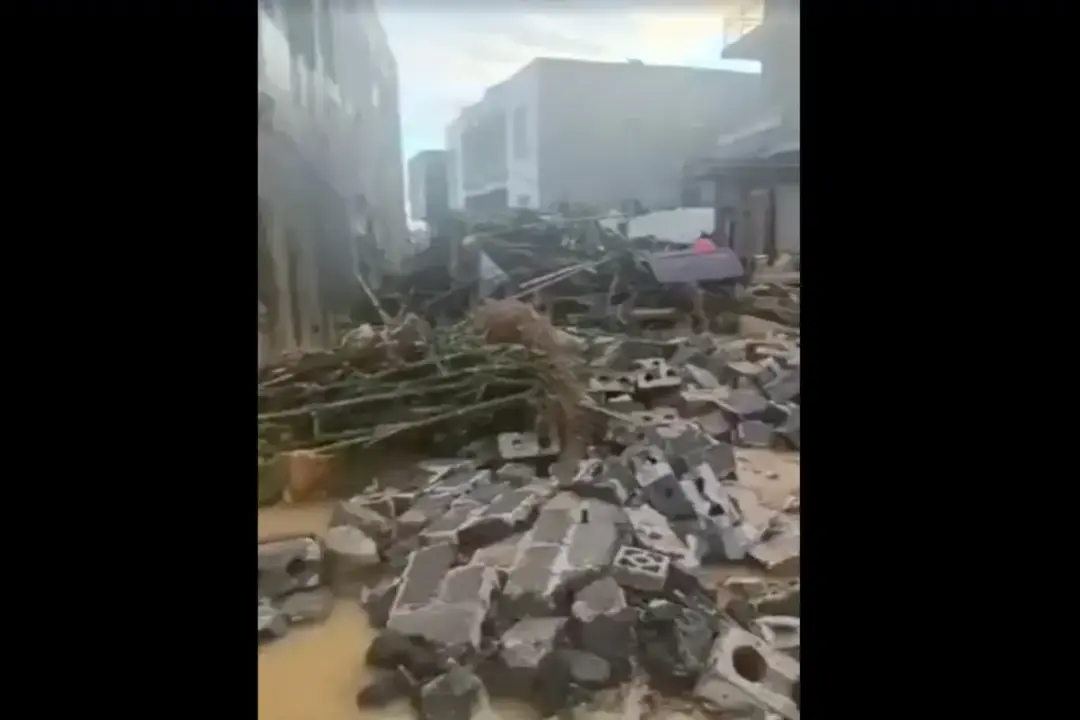
Residents trapped by catastrophic flooding in southern China’s Guangxi region survived for days on rainwater and tree leaves after reservoir failures unleashed torrents that destroyed villages, while volunteer rescuers say relief efforts have been hampered by impassable roads and shortages of supplies.Several volunteers who participated in rescue operations in some of the hardest-hit areas told The Epoch Times that entire communities were cut off from the outside world after flooding washed away roads and bridges. They also questioned how public donations were being distributed, saying grassroots relief kitchens continued to face shortages weeks after the disaster. They spoke on condition of anonymity out of fear of reprisal.The flooding followed days of torrential rain between July 4 and July 6 that triggered widespread flooding across Guangxi, including the cities of Nanning, Hengzhou, and Guigang. The heavy rainfall caused multiple reservoirs, including Liulan and Yunbiao, to overflow and breach, sending floodwaters into downstream communities.Village Devastated After Reservoir FailuresAmong the worst-hit areas was Yabi Village in Yunbiao Township, located downstream from the Liulan Reservoir. Home to more than 2,000 residents, the village lost electricity and communications after the flooding, leaving it completely isolated.A local volunteer who spent days participating in rescue operations said floodwaters from two reservoirs converged on the village.“The water from both reservoirs hit Yabi directly,” he told The Epoch Times. “Large numbers of houses were swept away. It was the worst-hit village in Yunbiao Township.”Residents had little time to escape, the volunteer said.“Those who reacted quickly ran into the mountains or climbed onto rooftops. Those who were slower were simply swept away by the flood.”He said that, according to information he gathered locally, 28 people remained missing in one section of the village that had 73 households.Official figures released by the Chinese regime and cited by state media Xinhua News Agency on July 9 reported 39 deaths and nine missing across Guangxi.Survivors Ate Tree Leaves While Waiting for RescueWith roads washed away, rescue teams were unable to reach many communities for several days.“The villagers had nothing to eat for two days and three nights,” the volunteer said. “The people who escaped into the mountains survived by eating tree leaves.”When volunteers finally arrived with supplies, desperate residents rushed for the aid.Road access was not restored until July 9 or 10, according to the volunteer. When he entered the village, the destruction left him in tears.“The whole place was covered with debris. So many homes had been washed away. The villagers were covered in mud from head to toe,” he said.Floodwaters had also carried away numerous victims, he added.“I personally saw one body wrapped in debris. There were also the carcasses of pigs and other animals,” he said.Since so many buildings collapsed, authorities have postponed clearing parts of the village until damaged structures can be assessed. Residents whose homes were destroyed are expected to be relocated temporarily to a local middle school.The volunteer, who lives in Song Village in Hengzhou and was himself affected by the flooding, said he has remained on the front lines of relief work since the disaster began.Mountain Communities Left Completely Cut OffWhile villages downstream from the reservoirs suffered catastrophic flood damage, residents in the mountainous township of Zhenlong faced a different crisis—total isolation.A second volunteer rescuer who spent five consecutive days working at a community relief kitchen in Zhenlong Township told The Epoch Times the disaster was unlike anything he had witnessed.“I don’t even know how to describe it,” he said. “As someone born and raised in Guangxi, this is the worst disaster I’ve ever seen.”The second volunteer said the destruction went beyond ordinary flooding.“This wasn’t just heavy rain,” he said. “The reservoirs collapsed. The floodwaters swept through the downstream villages and continued all the way to Guigang.”After the water receded, many residents returned to find nothing left of their homes.“It’s like their entire lives have been reset to zero,” the second volunteer said.Unlike villages that were destroyed outright, many mountain communities remained standing but became inaccessible after landslides destroyed roads and bridges.“The road has only been reopened as far as the township center,” he said. “The roads leading from town into the villages are still blocked.”Without electricity, cellular service, or internet access, some villages remained completely isolated.“The elderly, children, and women survived by drinking rainwater,” the second volunteer said. “All the water in the village had turned into muddy water, so they collected rainwater whenever it rained. They held on for three days before supplies finally reached them.”Because heavy equipment could not reach many mountain communities, relief supplies had to be carried in by volunteers on foot.“The only way was for hiking volunteers to carry everything little by little,” the second volunteer said.He estimated that roads to at least seven or eight villages remain impassable, with the most remote requiring a seven- to eight-hour hike.The journeys have proven dangerous.The second volunteer said one volunteer died while attempting to deliver supplies.“We keep telling people not to push beyond their limits,” he said. “Even those of us who regularly hike in the mountains struggle. This isn’t something to take lightly.”To reduce the burden, villagers who were able to leave isolated communities sometimes met volunteers along mountain trails to carry supplies back themselves.Relief Kitchens Face Food ShortagesBehind the front lines, volunteers established community kitchens to prepare meals for rescue workers and displaced residents.The second volunteer said they organized seven or eight kitchens after reports emerged that rescue personnel had difficulty obtaining hot meals.“Each kitchen prepares between 8,000 and 10,000 meals a day,” he said.He said limited resources forced volunteers to prioritize serving meals, beginning with People’s Liberation Army personnel deployed to assist rescue operations. Disaster survivors were served only after military personnel had been fed, he said.“We have to feed the People’s Liberation Army troops first,” Ye said. “Only after that, if there are meals left over, do the disaster victims receive them.”Weeks after the flooding, volunteers operating one of the remaining community kitchens said they are struggling to continue because of dwindling supplies.One kitchen worker who runs a volunteer kitchen in Yunbiao Township told The Epoch Times that nearly every other independently organized relief kitchen has already shut down.“Right now, I’m the only one still operating in the entire Hengzhou area,” the worker said. “Everyone else has already done everything they could.”He said the most urgent shortages are meat and disposable food containers, both essential for preparing and distributing meals.The worker said he sought assistance from the Yunbiao township government but was told independently organized kitchens were not eligible to receive official relief supplies.“Government staff said they have their own rules and procedures,” he said. “Rice, cooking oil, and meat won’t be distributed to volunteer-run kitchens.”According to the worker, officials told him relief materials are distributed through designated government channels, while volunteer organizations fall outside that system.He also said he had no information about how public donations were being allocated.“Billions of yuan may have been donated, but how much actually reached Yunbiao is not something we know,” he said.A third volunteer, who previously worked at the Yunbiao relief kitchen, told The Epoch Times that donations from the public had not reached the volunteer-run kitchen.“The kitchen was established by volunteers, not the government,” he said. “Now we’re short of vegetables and meat, but we’re still expected to prepare 10,000 meals every day. We don’t know where the donated money ended up.”Li Jing and Gu Xiaohua contributed to this report.

Flood Survivors in Southern China Describe Days of Hunger as Volunteers Struggle to Deliver Aid
Flood Survivors in Southern China Describe Days of Hunger as Volunteers Struggle to Deliver Aid








Related Articles

China Business & EconomyChina NewsChina Technology
China Tech Index Plunges More Than 40 Percent From July Peak
China’s technology-heavy STAR 50 index has fallen by more than 40 percent...
China Military NewsChina NewsChinese RegimeInside CCP OfficialdomSpecial TopicsZhang Youxia
Xi Opens CCP Plenum Amid Sweeping Purges, Record-Low Attendance Forecast
Chinese Communist Party leader Xi Jinping opened a four-day meeting of senior...

China Business & EconomyChina NewsChinese RegimeFinance & Business TiesInside CCP OfficialdomSpecial Topics
Chinas Economic Woes Deepen as CCP Plenum Focuses on Political Control
The Chinese Communist Party (CCP) opened a four-day leadership meeting in Beijing...



China NewsEuropeGlobalUK NewsWorld News
UK Must Be Ready for War in 1,000 Days, Says British Defense Secretary
British Defense Secretary Wes Streeting has said the country must be ready...
