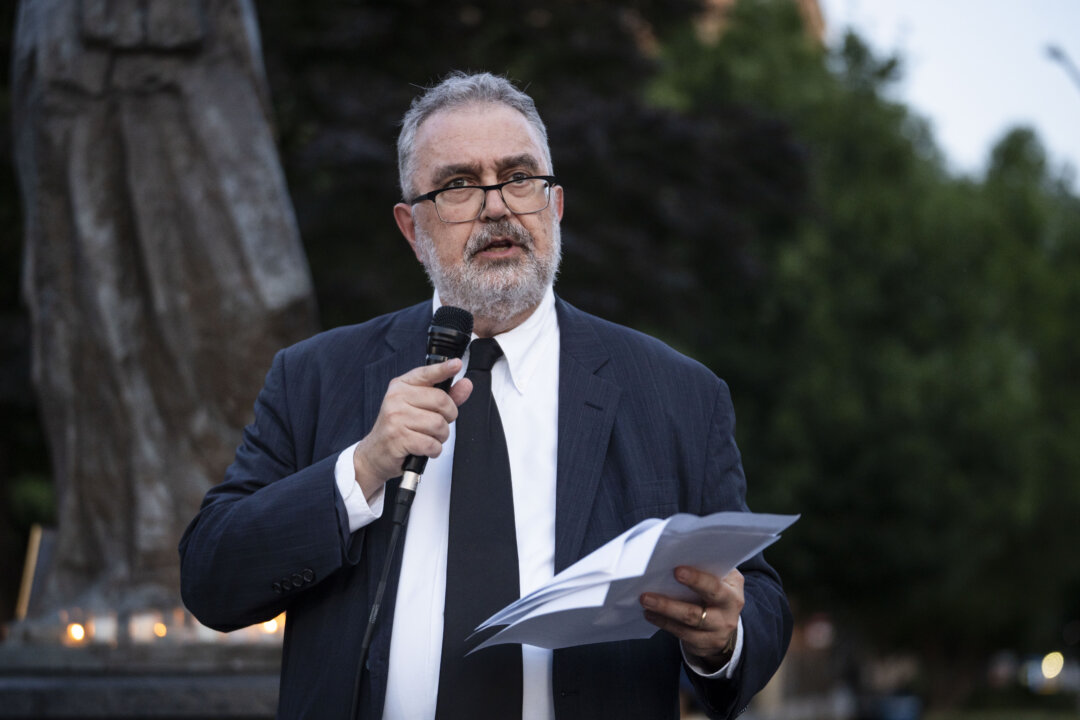
Piero Tozzi, senior director for China Policy and America First Policy Institute, speaks during the Tiananmen Square Massacre candlelight vigil held at the Victims of Communism Memorial in Washington on June 4, 2026. Madalina Kilroy/The Epoch TimesHuman rights experts and analysts are urging European governments to move quickly from policy to action following the European Parliament’s recent resolution on transnational repression, saying the measure should serve as a blueprint for countering foreign governments that intimidate dissidents and diaspora communities abroad.International human rights lawyer David Matas called the resolution “a warning” and “a loud wake-up call,” while China policy expert Piero Tozzi said the European Parliament’s vote was only the first step and must be followed by stronger enforcement, greater public awareness, and prosecutions.The European Parliament adopted the nonbinding resolution on June 16, calling on the European Union and its member states to take a “zero-tolerance” approach toward transnational repression through stronger enforcement, legal reforms, and targeted sanctions. The measure, which passed with 434 votes in favor, 128 against, and 104 abstentions, described China as carrying out what it called the world’s largest and most systematic campaign of transnational repression.Experts Call for Swift ImplementationMatas said the significance of the resolution lies not only in its condemnation of transnational repression but also in the practical roadmap it offers governments seeking to counter it.“The text is comprehensive, identifying the problem of transnational repression in detail and advocating a host of specific solutions,” Matas told The Epoch Times. “The resolution is exemplary, providing an action plan for any state, member of the European Union or not, which takes transnational repression seriously and wants to do something about it.”He said European governments should implement all of their recommendations and that the EU Council should take further action.Piero Tozzi, senior director for China policy at the Washington-based America First Policy Institute, said the Parliament’s vote reflects growing recognition in Europe of what he described as the Chinese Communist Party’s (CCP’s) “long-arm” repression.He pointed to a recent UK court ruling involving a senior official at Hong Kong’s London Economic and Trade Office accused of targeting exiled dissidents as another sign that European governments are becoming more aware of the issue.Still, Tozzi argued that significant gaps remain.“Overall, there has been a lack of awareness of malign activities conducted by [China’s] Ministry of State Security agents and United Front operatives, from harassing Shen Yun performances to physically attacking dissidents,” he said. “This vote is a first step, but the next involves educating law enforcement and prosecutors on the national and local level, as well as political and community leaders and the general public, on how to recognize transnational repression, and to provide tools to report it so that it can be stopped and prosecuted.”David Matas at a Shen Yun performance in Vancouver, Canada, on April 11, 2026. NTDResolution Calls for Coordinated ResponseThe European Parliament’s resolution characterizes transnational repression as a form of foreign interference in which governments or state-linked actors intimidate, coerce, silence, or otherwise harm individuals beyond their national borders.Lawmakers said such practices violate fundamental rights protected under EU law, undermine democratic values, and threaten the sovereignty and internal security of member states.The resolution identifies China, Russia, Iran, and Belarus as among the principal perpetrators of transnational repression. It alleges that the CCP has developed a global infrastructure involving diaspora organizations, student associations, media outlets, and so-called overseas police stations to monitor and pressure people living abroad.According to the resolution, those activities include surveillance, legal and economic coercion, misuse of international law enforcement mechanisms, pressure on family members in China, and efforts to force targeted individuals to return.The document also cites reports alleging that covert Chinese police stations have operated in parts of Europe and that proxy actors have been used to conduct surveillance and intimidation.It further argues that Hong Kong’s 2020 National Security Law and China’s 2024 Safeguarding National Security Ordinance have been used extraterritorially to target activists, academics, and politicians overseas through arrest warrants, legal threats, and extradition requests.The resolution urges EU institutions and member states to adopt a coordinated response, including stronger legal frameworks, improved monitoring and reporting of transnational repression, greater engagement with vulnerable diaspora communities, specialized training for law enforcement and judicial officials, and expanded use of the EU Global Human Rights Sanctions Regime against individuals and entities involved in such activities.The “Fujian Police Overseas Service Station” in Barcelona, Spain. WeChat: Fuzhou PoliceEU Monitoring the IssueAn EU spokesperson told The Epoch Times that transnational repression violates international human rights law and that maintaining public safety remains primarily the responsibility of member states.“The EU is increasingly monitoring these activities around the world and mobilising its human rights toolbox to combat this phenomenon,” the spokesperson said.

Experts Urge EU to Turn Zero-Tolerance Resolution Into Action Against Transnational Repression
Experts Urge EU to Turn Zero-Tolerance Resolution Into Action Against Transnational Repression









Related Articles
China Business & EconomyChina NewsChina Technology
China Tech Index Plunges More Than 40 Percent From July Peak
China’s technology-heavy STAR 50 index has fallen by more than 40 percent...
China Military NewsChina NewsChinese RegimeInside CCP OfficialdomSpecial TopicsZhang Youxia
Xi Opens CCP Plenum Amid Sweeping Purges, Record-Low Attendance Forecast
Chinese Communist Party leader Xi Jinping opened a four-day meeting of senior...
China Business & EconomyChina NewsChinese RegimeFinance & Business TiesInside CCP OfficialdomSpecial Topics
Chinas Economic Woes Deepen as CCP Plenum Focuses on Political Control
The Chinese Communist Party (CCP) opened a four-day leadership meeting in Beijing...



China NewsEuropeGlobalUK NewsWorld News
UK Must Be Ready for War in 1,000 Days, Says British Defense Secretary
British Defense Secretary Wes Streeting has said the country must be ready...
