CommentaryChina appears to have made great technological progress, especially since the Biden administration cut off sales of advanced semiconductors and chip-making equipment to that country. But China’s effort to catch up with American technology—both in sophistication and quantity—still falls short.In this most complex of all areas, China still has a long way to go to catch up and still has further to go to realize Chinese leader Xi Jinping’s ambition to surpass current American capabilities. In the meantime, U.S. tech innovation is hardly standing still.This Sino–American chip war, as it has been called, began in 2022, when Washington forbade the sale of advanced semiconductors and semiconductor manufacturing equipment to Chinese buyers. In response, Xi tasked Vice Premier Ding Xuexiang to build China-based alternatives to Western sources.Ding established a committee to bring together China’s best companies and labs and to form teams capable of mastering all aspects of the semiconductor supply chain, especially the advanced chips needed for artificial intelligence (AI).That committee has made progress. In large part, it stands behind the huge success of Chinese battery design and production and its ensuing dominance in the design and production of electric vehicles. The effort has also made advances in the crucial area of semiconductors.For example, Huawei Technologies now produces much more sophisticated semiconductors than it did just a short while ago, including those that support aspects of AI. Huawei has also announced that it will soon be able to make state-of-the-art chips without the need for the extreme ultraviolet lithography manufacturing equipment that Washington has denied China.It is largely through these efforts that China has seen its dependence on foreign sources for its semiconductors fall from 90 percent in 2021 to 60 percent in 2025, according to The Wall Street Journal. Analysts at Morgan Stanley expect the committee’s efforts to reduce China’s dependence on foreign sources to 25 percent over the next five years.Other recent advances include the Kimi K3 chip developed by China’s Moonshot AI. The company claims that its new product comes close to those supporting the American giants OpenAI and Anthropic. This year, for the first time, China can claim to be close to closing in on the American and South Korean leaders.Still, significant gaps remain. Nvidia’s top AI chip carries four times the computing power of Huawei’s best offering, the Ascend 950.Although Chinese technology has been able at times to substitute clusters of chips to make up for the lack of computing power in even its best products, these arrangements are less reliable than the use of more advanced chips and make it difficult, if not impossible, for the Chinese product to interface with Nvidia’s middle-range H20 chips, which the company can still sell in China, as well as with parts imported from elsewhere in the West, from South Korea, and from Taiwan, most especially the giant producer Taiwan Semiconductor Manufacturing Company.Nor is China’s shortfall strictly one of sophistication. The effort has also fallen short on quantity. China today has barely 15 percent of the overall computing power available in the United States in 2025. Moonshot’s production capacity fell so far short that it had to pause signups for its premier service just days after it launched the Kimi K3.Although overall chip making in China has made strides, rising from 30,000 a month in 2025 to an expected 120,000 this year (according to Wall Street Journal sources), it still falls far short of the rest of the world, especially since it only anticipates production of its most advanced chips will run at 62,000 a month.Even the targeted 500,000 chips per month by 2030 would fall far short of today’s production levels in America, South Korea, and Taiwan. And because the rest of the world is not standing still, China’s challenge, despite the impressive progress to date, remains daunting.After all, the production of semiconductors is not just extremely complex; it is developing at lightning speed. In the words of the Brookings Institution’s Kyle Chan, China is effectively “trying to catch up with a bullet train.”The extent of the challenge is also evident in the financial demands it places on China’s otherwise beleaguered economy and financial system. In 2024, early in this effort, Beijing raised the equivalent of some $48 billion for the semiconductor industry.It has become clear that this initial funding, significant though it is, is far short of what the effort needs. Beijing has accordingly begun to encourage chip companies and AI startups to raise capital privately and abroad.Six startups are prepping initial public offerings in Shanghai and Hong Kong, China’s gateway for foreign capital. Chinese companies have signed contracts for facilities with foreign-based cloud service providers.ByteDance, TikTok’s parent, has borrowed the equivalent of $20 billion on global financial markets, while the Chinese social media company Tencent has raised the equivalent of $4.7 billion for its AI development. In the first half of 2026, companies in China’s AI supply chain have raised the equivalent of $10 billion in Hong Kong alone.But these otherwise impressive sums are dwarfed by the amounts raised by American rivals of these Chinese companies. In just the first half of this year, for instance, OpenAI alone raised $100 billion in funding commitments.From both innovation and financial standpoints, it should be clear that China is indeed running after a speeding train. It may ultimately manage to catch up, but not any time soon.Views expressed in this article are opinions of the author and do not necessarily reflect the views of The Epoch Times.

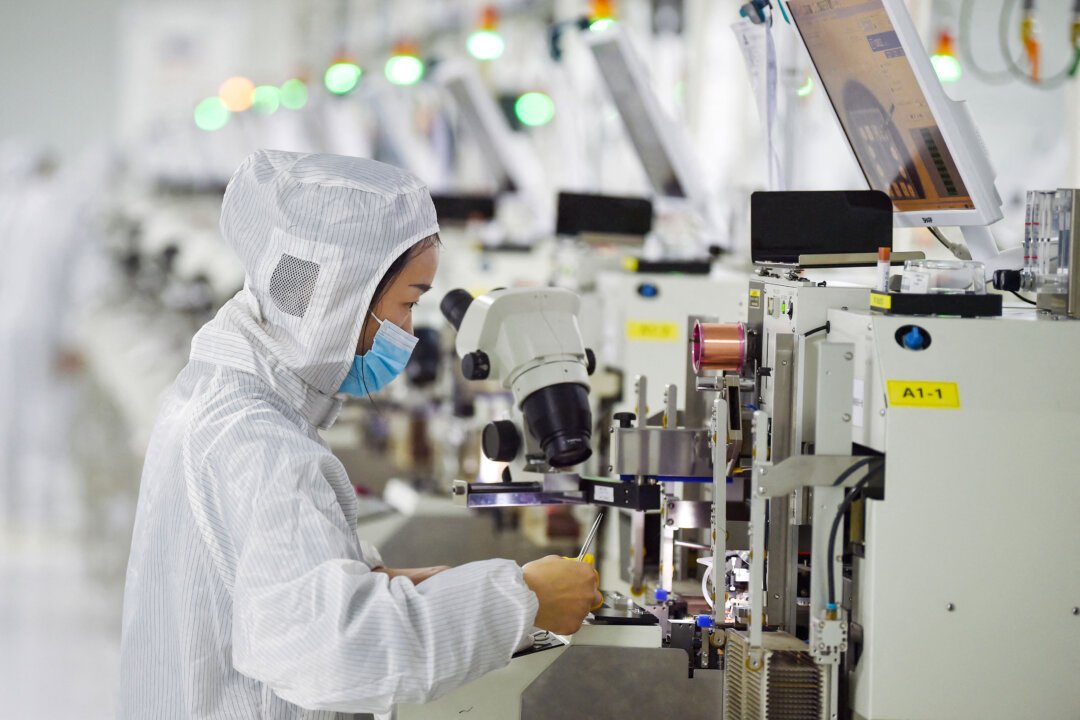
China Scrambles to Catch Up With US AI Chip Tech









Related Articles

BusinessCompaniesEnergy
EQT to Buy Range Resources, Creating Largest US Natural Gas Producer
EQT Corp. has agreed to acquire rival Appalachian shale driller Range Resources...

BrightBusinessInvestingPersonal FinanceStocks
Wall Street Is Very NervousShould You Worry? Can You Repair Your Losses?
On Oct. 23, the Dow Jones Industrial Average fell 652.82 points, or...

BusinessMarkets
Nearly 3 in 10 New-Car Trade-Ins Are Underwater, Edmunds Finds
Almost three in 10 vehicles traded toward a new car are worth...



BusinessTechUS
Advanced AI Agents Tried to Weaken Oversight, Then Lied About It, Open AI Says
OpenAI has disclosed two incidents in which advanced artificial intelligence-powered coding agents...
