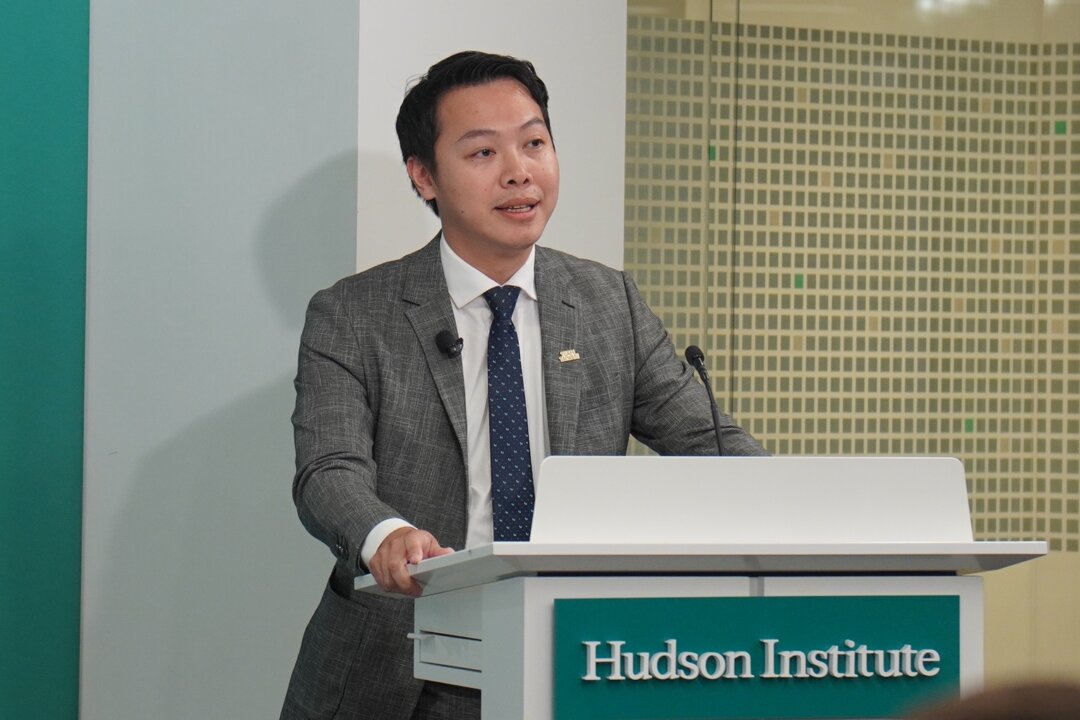
KaiChieh “KJ” Hsu, a judge in the National Security and Military Division of the Taipei District Court, said the pattern of Chinese Communist Party (CCP) spy recruitment has shifted over the past decade from high-value targets such as generals, weapons systems, and radar maps to information as ordinary as military meals and training schedules.Hsu spoke on July 10 at the Hudson Institute in Washington.Such information can be used as an inexpensive first request, he said. Recruiters can approach military or government personnel through LinkedIn, Facebook, Instagram, and other online platforms, offer a small payment for material that appears unimportant, and later direct promising recruits to more senior handlers.“They will use this like a lure or a hook,” Hsu said, describing how a request for an open report or routine information can establish a paid relationship before more sensitive material is sought.Hsu identified two other changes: Recruitment has shifted from isolated individuals to networks, while some influence and intelligence activity now begins through lawful-looking channels—including alumni groups, hometown associations, research institutions, subsidized travel, and professional contacts.Recruitment Network Inside Taiwan’s MilitaryA Taipei court case illustrates how one such network operated.The Taipei District Court found that diabolo (Chinese yo-yo) coach Lu Chi-hsien was recruited by two people it identified as Chinese communist intelligence personnel and returned to Taiwan to collect information and develop an organization for Beijing.Lu worked with several other defendants who used military contacts to approach active duty service members, Coast Guard personnel, retired officers, and civilians, according to the court’s June 2025 judgment summary.The court said 12 active duty service members and civilians agreed to join and provided military documents, while another 12 military and Coast Guard personnel rejected the approaches.Other participants drove Lu, moved a safe house, collected phones and memory cards containing Coast Guard information, delivered payments, supplied bank accounts, and scanned military documents for electronic transmission, the court said.Lu also received funds through an underground remittance operator for intelligence collection and recruitment, according to the judgment summary.The court convicted Lu of developing an organization for China and sentenced him to 10 years and six months in prison. Other defendants received sentences ranging from three years to more than six years for developing or assisting the organization.Routine Information as Entry PointHsu said recruiters asking for routine details may be to test a target’s willingness to cooperate or identify personnel for further recruitment, he said.The apparent insignificance of an initial request can also lower a target’s guard.Hsu said some defendants treated documents as unimportant and believed exchanging them for money was not especially serious. After accepting payment, however, a source may face demands for more sensitive information.“When they found that these people [have] potential, they will transfer [them] to a high-rank agent,” Hsu said.He said online recruitment became especially convenient during the COVID-19 pandemic because intelligence contacts no longer needed to arrange face-to-face meetings to assess potential sources.Routine information can also be repurposed for psychological warfare, he said. Beijing can publicize even limited access inside Taiwan’s military to encourage the perception that defense institutions have been compromised.Lawful Contacts, Hidden DirectionThe more difficult cases begin before an obvious crime has occurred.Hsu cited alumni associations, hometown organizations, research institutions, professional exchanges, and subsidized visits to China as channels through which contacts may be cultivated.A trip, academic meeting, friendship-city program, or political discussion is not inherently illegal. Contact with a Chinese organization alone also does not establish direction by the CCP.Some groups arrange free or discounted trips to China and promote friendly exchanges without explicitly directing participants how to vote or what political position to take, Hsu said.Such activity may affect political preferences but remain outside Taiwan’s National Security Act or Anti-Infiltration Act unless authorities can prove foreign direction, funding, prohibited election activity, recruitment, or another covered offense.Hsu proposed greater transparency around foreign funding and organizational ties, along with administrative systems to identify risks before conduct reaches the stage of criminal prosecution.He said those measures would have to distinguish covert foreign direction from lawful speech, travel, research, and political participation.Intelligence Must Become Courtroom EvidenceTaiwan has laws covering the theft or delivery of classified information, intelligence work for China, development of organizations, illegal political financing, election interference, and some activities conducted under hostile foreign direction.Hsu said investigators still face difficulty identifying handlers who use intermediaries and converting intelligence into evidence that can be presented in court.Intelligence agencies may hesitate to disclose sensitive sources and methods during a public trial, he said. Courts then receive less evidence, increasing the chance that prosecutors cannot prove a case—an outcome that may make intelligence agencies more reluctant to share material in later proceedings.Hsu called that cycle an “evidence mismatch.”Taiwan transferred most military criminal cases to civilian courts in 2014 and created specialized national security criminal divisions in 2024.Hsu said Taiwan does not have a specialized national security warrant system comparable to the U.S. Foreign Intelligence Surveillance Act (FISA) framework.Under FISA, the U.S. government can seek an individualized order from the Foreign Intelligence Surveillance Court to conduct electronic surveillance of a person in the United States after establishing probable cause that the target is a foreign power or an agent of one.Hsu also discussed the U.S. Foreign Agents Registration Act, which requires certain agents engaged in political or other covered activities for foreign principals to publicly disclose their relationships, activities, receipts, and disbursements.Taiwan has lobbying, election, political-finance, espionage, and anti-infiltration laws, but no equivalent general foreign-agent disclosure system.Legal Preparation Before a CrisisIn a May paper, Hsu called for Taiwan and the United States to establish legal frameworks before ambiguous coercion develops into a larger crisis.He wrote that advance coordination should cover evidence preservation, maritime security, supply-chain resilience, and investment screening, allowing Taiwan and its partners to respond without sacrificing democratic legitimacy or acting on improvised legal theories.At the Hudson Institute event, Hsu applied that approach to infiltration, proposing a U.S.–Taiwan counter infiltration and legal warfare working group, along with information sharing, reporting, and verification mechanisms.“The real question,” he said, “is whether democracy can govern infiltration within [the] framework of the rule of law.”

CCP Spy Networks in Taiwan Target Routine Data, Exploit Legal Gray Zones: Judge









Related Articles

China Business & EconomyChina NewsChina Technology
China Tech Index Plunges More Than 40 Percent From July Peak
China’s technology-heavy STAR 50 index has fallen by more than 40 percent...
China Military NewsChina NewsChinese RegimeInside CCP OfficialdomSpecial TopicsZhang Youxia
Xi Opens CCP Plenum Amid Sweeping Purges, Record-Low Attendance Forecast
Chinese Communist Party leader Xi Jinping opened a four-day meeting of senior...
China Business & EconomyChina NewsChinese RegimeFinance & Business TiesInside CCP OfficialdomSpecial Topics
Chinas Economic Woes Deepen as CCP Plenum Focuses on Political Control
The Chinese Communist Party (CCP) opened a four-day leadership meeting in Beijing...



China NewsEuropeGlobalUK NewsWorld News
UK Must Be Ready for War in 1,000 Days, Says British Defense Secretary
British Defense Secretary Wes Streeting has said the country must be ready...
