A ship sails off the coast of Ajman, United Arab Emirates on July 10, 2026. Shipping traffic through the Strait of Hormuz has fallen sharply following attacks on vessels earlier in the week and renewed military strikes between the United States and Iran. AFP via Getty ImagesThe U.S. military command overseeing Middle East operations on Sunday said that “traffic is flowing” through the Strait of Hormuz after claims from Iran that the strategic waterway was shut down amid renewed fighting in the region.“The Strait of Hormuz is open to all vessels seeking to lawfully transit the international waterway,” said the U.S. Central Command (CENTCOM) in a social media post on Sunday. “U.S. forces are positioned and prepared to ensure that freedom of navigation remains available despite unwarranted Iranian aggression, harassment, threats, and arbitrary declarations. Iran does not control the strait. Traffic is flowing.”Separately, the command denied claims from Iran’s Islamic Revolutionary Guards Corps (IRGC) that it controls the strait, a waterway that connects the Persian Gulf with the broader ocean and allows for the transit of about a fifth of the world’s traded oil supply on a normal day. The IRGC had said that no foreign-owned vessels may travel through the strait, which CENTCOM said is false.“Iran does not control the Strait of Hormuz. It remains an international waterway. U.S. forces are positioned and prepared to keep it that way,” it said.The statements came from the Iranian regime’s so-called Persian Gulf Strait Authority, which was created during the U.S.–Iran conflict earlier this year, said that travel through the strait “is currently not possible” due to movements from the U.S. military in the Middle East, according to state-run PressTV.“As soon as stability and calm are restored, all requests will be reviewed according to scheduling and the necessary permits will be issued,” the organization said.The U.S. military said it struck around 140 targets in Iran such as missile and drone launch sites, ammunition dumps, communication equipment, and other military sites. It said the new attacks, heavier than during recent days, would weaken Iran’s ability to threaten transit in the strait.The new wave of strikes from American forces was triggered by Iran having launched attacks on commercial vessels in the region, while U.S. President Donald Trump on July 10 said that a temporary ceasefire that was established under a memorandum of understanding signed by both sides was effectively over. But Trump left open the door for more negotiations between Tehran and Washington.With the latest attacks, Trump told NBC’s “Meet the Press“ on Sunday that the United States ”bombed the hell out of them last night.”Smoke rises at an unknown location following what U.S. Central Command says is a new wave of strikes against Iran on Tuesday after three tankers were hit by projectiles in the Strait of Hormuz, in this still image taken from video released July 7, 2026. U.S. Central Command/Handout via Reuters“They’re very, very evil and sick people,” Trump told the outlet on Sunday. “We had meetings with them. They agreed to a deal yesterday, a perfect deal for us. No nuclear, no this, no that, no nothing. They gave up everything. And then after that, they left the room. And then within an hour, they launched a drone at a ship.”Iran retaliated by attacking its neighbors in the region that host U.S. military forces and sites, officials in Tehran said through state-run media. Meanwhile, the IRGC said in comments carried by the semi-official IRNA agency on Sunday that it attacked U.S. logistics support centers and fueling locations used by American forces in the region, although the U.S. military has not yet confirmed those claims.“The era of one-sided deals is OVER,” Mohammad Bagher Ghalibaf, the speaker of Iran’s parliament and a main negotiator, wrote in a post on X early Sunday. “We told you: keep your word or pay the price. Reality is knocking.”The Associated Press contributed to this report.

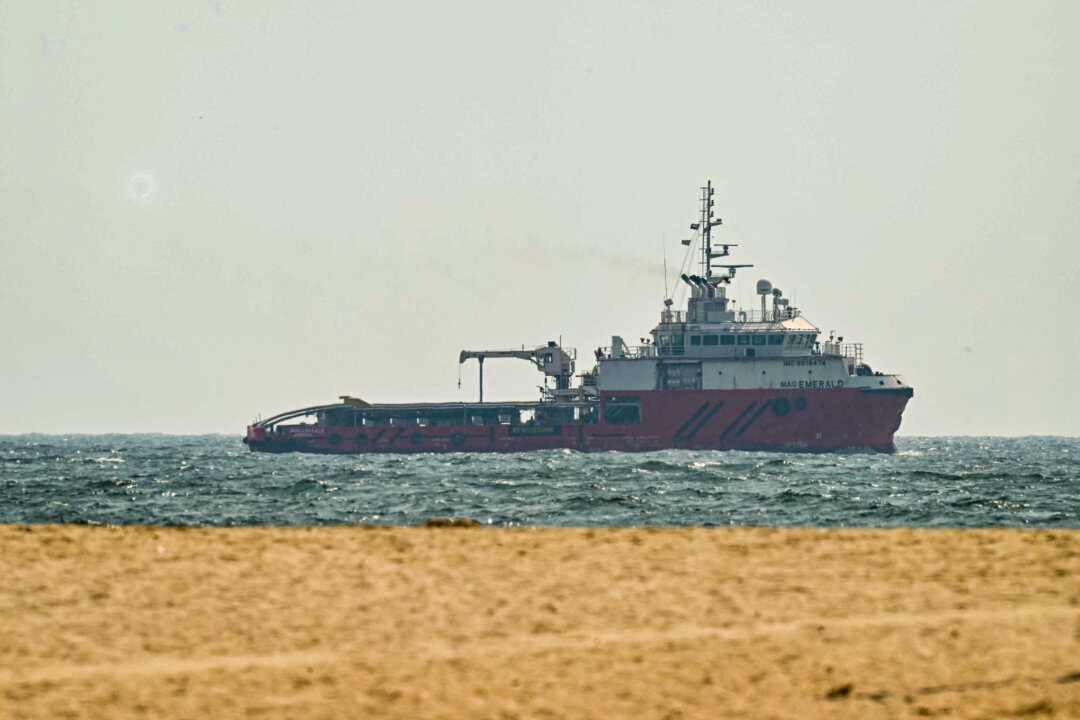
US Says Strait of Hormuz Is Open and Traffic Is Flowing Despite Iran Claims









Related Articles

China NewsEuropeGlobalUK NewsWorld News
UK Must Be Ready for War in 1,000 Days, Says British Defense Secretary
British Defense Secretary Wes Streeting has said the country must be ready...

China NewsEuropeGlobalUK NewsUK Top NewsWorld News
UK Prime Minister Says He Agrees With Principle of Migration Reform
British Prime Minister Andy Burnham said on Oct. 26 that he agreed...

China NewsEuropeGlobalWorld News
Serbian President Concedes Election Defeat to Student-Led Coalition
Serbian President Aleksandar Vucic has conceded defeat in the Oct. 25 election...



Asia & PacificChina NewsEuropeInternational RelationsNational SecurityPolicies & ImpactsUSUS NewsUS-China RelationsWorld News
Japan Defense Academy Chief Calls for 3 Red Lines in Competition With China
Japan’s former top uniformed military officer has called for establishing three “red...
