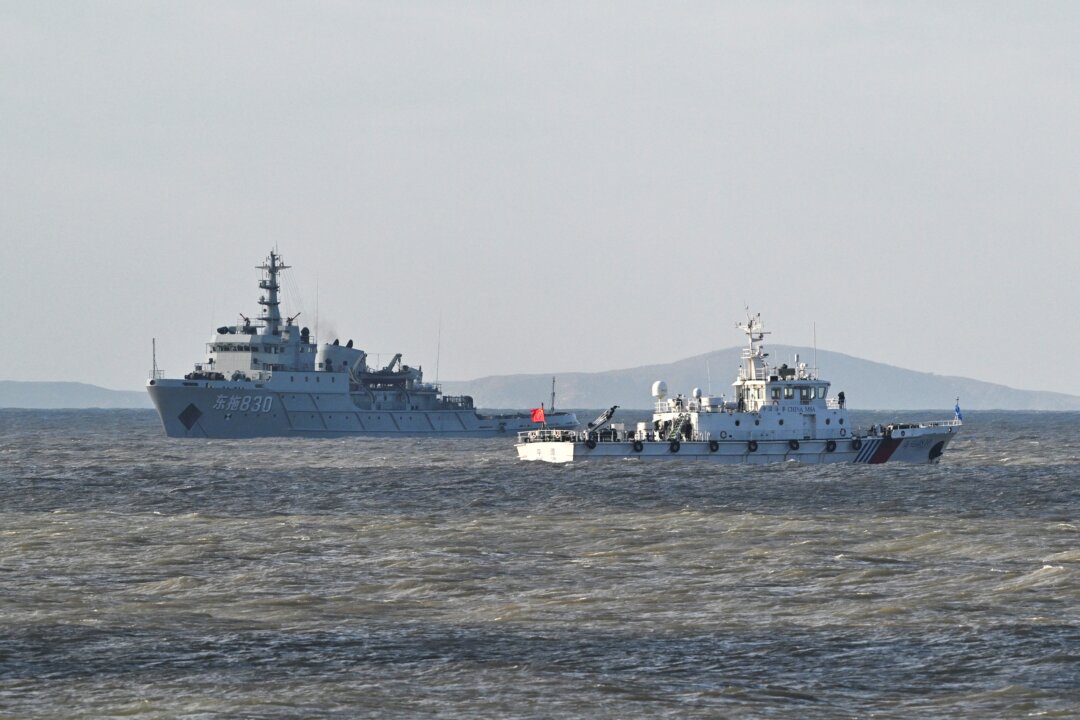
The Chinese regime is set to widen its war games and may even confront Taiwanese vessels head-on to tighten its hold on Taiwan’s surrounding seas before the Communist Party’s leadership conclave and the island’s presidential election, analysts warn.China’s Coast Guard said on Oct. 31 that its ships carried out “routine law enforcement patrols” in waters east of Taiwan, according to China’s official Xinhua News Agency.Taiwan’s Coast Guard Administration rejected the claim on Nov. 3, calling the move “fake law enforcement, real harassment” and a propaganda ploy.The operation was not the first, as the regime staged at least five similar exercises between June and September.Pai Pang-ting, specialist at Taiwan’s Ocean Affairs Council—which oversees the Coast Guard Administration—said at an Oct. 31 meeting that Taiwan must prevent Beijing from turning its repeated incursions into an administrative norm, Taiwan’s national media outlet Central News Agency reported.“China will keep testing how far it can go along the edge of Taiwan’s restricted waters,” Arthur Zhin-sheng Wang, secretary general of the Asia-Pacific Elite Interchange Association, told The Epoch Times.Taiwan is a self-governed democracy that the Chinese Communist Party (CCP) has never controlled but has vowed to annex by force.Wang said that in the coming months, Taiwan could face the same deliberate clashes the regime has repeatedly provoked with Philippine ships in the South China Sea—a strategic waterway where several countries have overlapping claims to reefs and shoals.“The harassment Taiwan already faces will keep escalating, wearing down its coast guard and stretching it thin,” he said.“In 2027, the year before Taiwan picks its next president, China will use these confrontations to meddle aggressively in the race.”Taiwan’s presidential election is set for January 2028. President Lai Ching-te, whose firm stand against the regime’s annexation threat has led Beijing to label him a “diehard separatist,” may seek reelection.Lin Ting-hui, former deputy secretary-general of the Taiwan Society of International Law, said that in the run-up to the CCP’s 21st Party Congress, Beijing will likely ramp up military drills where the waters of Taiwan, Japan, and the Philippines meet.The 21st Party Congress, set for the second half of 2027, is the CCP’s leadership conclave, where it reshuffles its top ranks. The party holds such a congress every five years.Stepped-up exercises there would threaten Indo-Pacific security, Lin said.“Every serious clash at sea so far has come around a party congress, because commanders must deliver results to earn a seat on the Party’s Central Committee,” Lin said.China’s Strategic Goals Lin said Beijing’s operations off Taiwan’s east coast are not just a political show of authority but preparation for a possible invasion.A Taiwan Coast Guard vessel patrols around Taiwan’s Kinmen islands with the Chinese coast visible in the background, on July 9, 2026. Ben Blanchard/Reuters“To carry out its anti-access strategy in a war over Taiwan, China must first map how U.S. and Japanese forces would operate underwater in these waters,” he said.“The regime calls the patrols ‘law enforcement,’ but they really provide cover for charting the currents and seabed in an area well suited to submarines.”China’s anti-access/area-denial strategy is a combination of missiles, submarines, sensors, and air defenses, designed specifically to block and disrupt the United States and its allies across air, sea, space, and cyber domains.Wang said the incursions are part of China’s gray-zone operations—aggressive and coercive actions that are designed to intimidate an opponent yet remain below the threshold of warfare—and are tightening the squeeze on Taiwan’s doorstep.“In the past, most of China’s actions against Taiwan centered on outlying islands such as Kinmen, Matsu, and Pratas,” Wang said.“Now China’s research vessels, fishing boats, and coast guard ships have reached the waters off Taiwan’s east coast, a sign it is preparing for the transition from peacetime to wartime.”Taiwan administers the Kinmen and Matsu islands off China’s Fujian province, as well as the Pratas Islands in the South China Sea.The concept of transitioning from peacetime to wartime refers to the rapid shift of administrative systems and military equipment from regular operations to active combat readiness. For example, patrol ships built for policing could be converted into missile boats.Undersea Cable Sabotage Beijing’s persistent harassment may also include spying on Taiwan’s undersea cables, the Japanese media outlet The Yomiuri Shimbun reported on Nov. 1.An undersea fiber optic cable is attached to a rope at Arrietara beach near the Spanish Basque village of Sopelana on June 13, 2017. Ander Gillenea/AFP via Getty ImagesFour Chinese survey ships have moved in unusual patterns near Taiwan since May, according to ship-tracking data cited in the report.They have repeatedly slowed or stopped where international undersea cables run, in waters off Taiwan’s north, east, and south and on repeated loops around the main island.Taiwan’s government data show the island experiences an average of seven to eight undersea cable cuts per year, some allegedly caused by Chinese-flagged vessels.Lin said Beijing would certainly target the cables in a war, and the voyages laid the groundwork for taking them out.“These cables are Taiwan’s key links to the world, tying it into trans-Pacific networks and communications across Northeast and Southeast Asia,” he said.“The point of these voyages is to work out which ships to send and how to cut them.”Wang said severing the cables would leave Taiwan in a communications blackout.“During an invasion, that could set off another wave of panic across the island,” he said.Wang said that even in peacetime, Beijing could use underwater drones to tap the cables and spy on the data flowing between Taiwan and the world.“With that intelligence, China could easily launch a surprise attack on critical infrastructure in wartime—a very real risk,” he said.Wang said the regime will combine its coast guard incursions and spying on undersea cables with propaganda to split Taiwan from within and blame the threat of war on Taiwanese who reject “peaceful unification.”“Beijing wants to trap Taipei in a no-win situation, so that fear and turmoil keep growing on the island in the months to come,” he said.

Beijing Poised to Escalate Drills, Clashes in Push to Control Taiwans Waters: Analysts





Related Articles
China NewsChinese Regime
China Indicts Former Politburo Member in Widening Purges
A former Politburo member of the Chinese regime has been indicted on...
CCP VirusChina News
Chinese Court Hears Wuhan Labs COVID Defamation Suit Against Missouri
The Wuhan lab at the center of questions about COVID-19’s origin says...
China NewsEuropeGlobalRussia-Ukraine WarUSUS NewsWorld News
Zelenskyy Awards Melania Trump Ukraines Highest Honor for Women
Ukrainian President Volodymyr Zelenskyy has awarded U.S. First Lady Melania Trump a...



China NewsEuropeGlobalRussia-Ukraine WarWorld News
Peace Talks With Russia to Focus on Broader Security Architecture in Europe: Kushner
Ukrainian President Volodymyr Zelenskyy, U.S. special envoy Steve Witkoff, and Jared Kushner...
