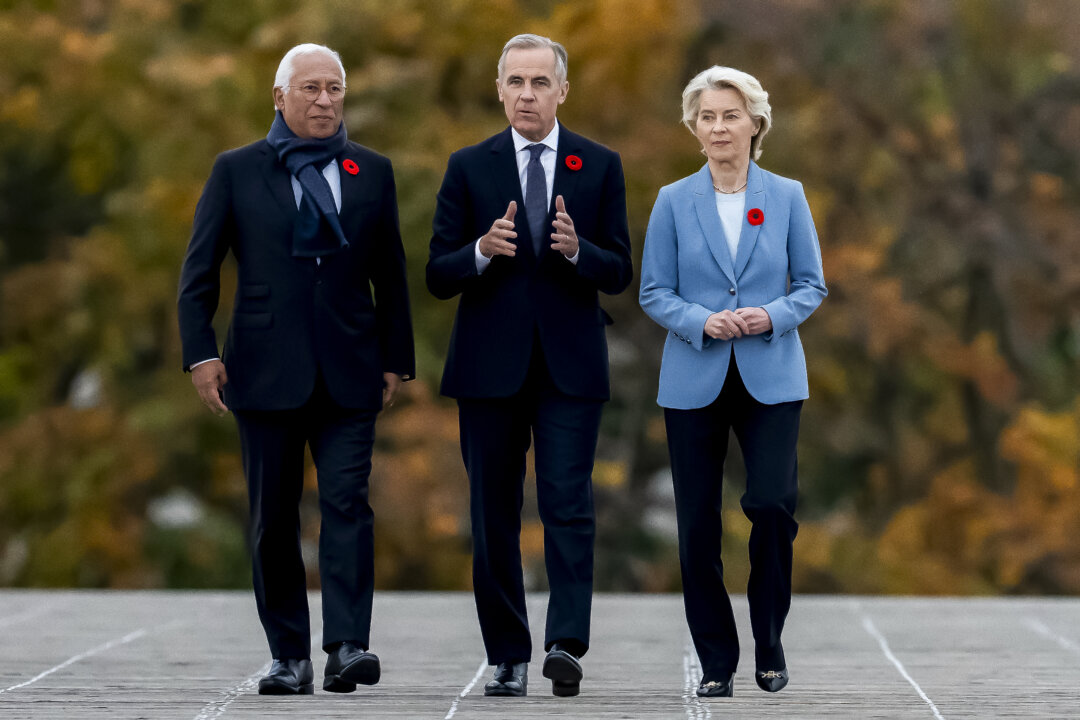
News AnalysisCanadian and European leaders say the new Canada-EU “Alliance for the Future,” or “association membership,” will deepen cooperation on energy, trade, defence, and other areas, bringing economic, social, and national security benefits to both sides.So far, there have been few details released on what the proposed partnership would involve, other than that it would be anchored in closer alignment on policies, programs, and governance. Some examples of programs announced include Canada accessing some EU research initiatives, the two sides working on a joint digital trade infrastructure, and deeper security and defence cooperation.The government has said the new partnership will bring more economic opportunity and prosperity for Canadians and aligns with Ottawa’s goal to diversify trade destinations. The government hasn’t said what the potential costs of the partnership could be when questioned by the opposition and reporters, saying details are to be developed in the coming months.Deeper TiesA joint statement emerging from the Canada-EU Summit held Oct. 29 to 30 in Montreal between Prime Minister Mark Carney, European Commission President Ursula von der Leyen, and European Council President António Costa, outlined 46 points of cooperation across six broad areas, building on the existing Canada-EU Comprehensive Economic and Trade Agreement (CETA).The prospect of Canada becoming an “associate member” of the EU was also discussed at the summit by von der Leyen and Carney, although the exact legal meaning of the term, financial obligations, and decision-making authority that such a category could include have not yet been publicly announced. Some EU members, such as Germany and France, are opposed to the term, saying it’s reserved for European countries that are on the cusp of becoming full members.Among the specific proposals announced in the joint statement include increasing Canada’s participation in the EU’s research funding program Horizon Europe and the EU’s Erasmus+ student and career exchange program, as well as granting Canada access to financing from the European Investment Bank (EIB).The two sides also said that they have concluded negotiations on a digital trade agreement aimed at simplifying e-commerce, cross-border transactions, and electronic payments, and that they are working toward closer integration of financial services and defence industries.“Over the coming months, we will determine the full substance, scale, and scope of this new form of membership,” Carney said on Oct. 30.Von der Leyen, meanwhile, said last week that Canada and the EU intend to “consult each other at all stages, so from inception to implementation,” and that Ottawa and Brussels particularly wish to more closely align their energy, climate change, artificial intelligence, and national security policies and programs.Prime Minister Mark Carney and European Commission President Ursula von der Leyen attend an expanded meeting with Canadian and European Union delegates during the EU-Canada summit in Montreal on Oct. 30, 2026. The Canadian Press/Christinne MuschiPotential Benefits for CanadaAmong the positives being cited about the proposed partnership are access to more export markets and more opportunities in cutting-edge research activities.Kurt Huebner, professor of political science at the University of British Columbia, said deeper ties with the EU could give Canada more leverage in trade negotiations with the United States.“If a country has more options, this can put away some of the pressure,” he said in an interview.U.S. President Donald Trump has said that if the EU’s offer of associate membership to Canada is meant as a hostile act against Washington, he would respond with tariffs on the bloc. Carney has said a “more independent” Canada would also be a better partner to the United States, while von der Leyen said the partnership is “not against anyone else, but for our common strength.”Huebner added that the proposed Canada-EU digital trade agreement could bring a potentially significant upgrade to existing e-commerce and electronic payment systems between the EU and Canada.He contrasted this with major infrastructure projects such as the potential construction of pipelines and greater export capacity needed to increase Canadian liquefied natural gas shipments to Europe, which he said could take years to complete.Proposed expansion of research cooperation between Canada and the EU as well as Canadian access to EIB funding could also prove a major boost to Canadian businesses working to innovate and develop new technology, Huebner said, adding that it would give them more options than being exclusively dependent on private venture capital.Amy Verdun, professor of political science at the University of Victoria, emphasized the potential benefits of expanded trade and deeper research ties, as well as enhanced opportunities for joint infrastructure and research investment and greater opportunities for young Europeans and Canadians to more easily study and work abroad.“For Canada and the EU, it is easy to build on agreements that are already there. They have a strong trading relationship and they can work on the details to get it better,” Verdun told The Epoch Times.“There is also an interest in having European Union funds to invest in Canadian infrastructural projects” as well as more potential for defence and security cooperation, she added.International Trade Minister Maninder Sidhu says that while Canada and the EU have historically been close, now the two sides want to bring the “partnership to the highest possible level.” In an interview with CTV, he also cited other overall activities with the EU before the latest announcements, including Canada’s participation in the Security Action for Europe military procurement and industrial cooperation program.“That’s unlocking about $200 billion of procurement opportunities for our defence companies,” he said.So far, Carney has most vocally promoted the opportunities that the pact could bring to Canadian students and researchers taking part in European programs and to businesses having access to more customers, sharing on social media on Nov. 4 remarks that he had made last week on these aspects.“This alliance is built for people: the student in Edmonton who wants to study in Stockholm, the cancer researcher in Saskatoon who needs her answer today, not next spring, the Vancouver startup with new customers in Berlin, the sovereignty for all of our citizens,” he said.A cyclist rides outside the banking district in Frankfurt, Germany, on Sept. 16, 2026. Kirill Kudryavtsev/AFP via Getty ImagesQuestions Remaining and Potential CostsSo far, the government hasn’t said much about what the agreement could mean when it comes to closer integration in policies, programs, and governance.When asked by Conservative MP and Deputy Leader Melissa Lantsman for assurance that Canadian tax dollars won’t go to the EU, and that Canada won’t be subject to EU laws and regulations, Carney’s Parliamentary Secretary Mona Fortier didn’t respond directly in the House of Commons on Nov. 3, saying instead that the two sides are currently in discussions to shape the agreement.Carney similarly didn’t directly respond when asked at an Oct. 30 press conference what the cost of the agreement to Canada could be, instead saying, “We view this as coming together. And as I said before, this is a positive association, … creating a nucleus for the broader positive alliance for the future, which creates opportunity and pools resources for bigger returns.”David Hunt, research director at the Aristotle Foundation for Public Policy, said if there’s a chance that Canada would be subject to any form of decision-making in the EU on issues that are currently Canada’s own decisions to make, that would be a concern.Hunt said his primary concern is that integration into the EU could move key decisions affecting Canadians even further away from where they live.“Would whatever is being proposed in terms of coming out under the EU umbrella bring the decision-making process and the governance process closer to home, or does it move it further away from home?” he said in an interview.Verdun said a question that needs to be answered is whether contributions Canada might make to EU programs would entitle it to equivalent decision-making powers.Philippe Le Billon, professor of geography and public policy at UBC, said Canadian companies seeking more access to the EU market could face more costs with regard to EU regulations on environmental measures, supply chain requirements, and product standards, but that such an agreement would also enable Canadian businesses to access more markets in Europe.“There’s going to be extra cost, but that allows you … access to the European market,” he said.He added that while having more trade partners for Canada is a positive toward avoiding being too dependent on any one partner, the European economy “is not the most thriving” at the moment.Huebner cited Switzerland as an example of a European nation currently in the process of meeting EU regulations to be able to continue selling its products in that market. He said if Canada would be subject to the same situation, then that could mean higher costs if it also has to meet U.S. regulations for the same products.“That makes things even more expensive and more difficult,” he said, notwithstanding if the access to the market would be worth the cost. He said the EU’s Carbon Border Adjustment Mechanism could also complicate a planned uptick in energy-intensive goods unless the two sides negotiate further.Carney said at the Oct. 30 summit’s closing press conference that Canada and the EU are working on solutions to concerns about the mechanism, which could affect Canadian exports of carbon-intensive goods. His comments came in response to a reporter asking von der Leyen whether the EU would exempt Canadian products from the mechanism and its deforestation regulation, and whether Carney would seek such exemptions.The issue remains unresolved, with the two sides seeking arrangements to address potential trade barriers arising from the EU’s carbon-related import requirements.Members of the European Parliament take part in a vote during a plenary session at the European Parliament in Strasbourg, France, on Oct. 20, 2026. Romeo Boetzle / AFP via Getty ImagesLengthy NegotiationsVerdun said the consequences remain difficult to predict, particularly because such agreements typically require lengthy negotiations.CETA, the Canada-EU free trade agreement that has been in place since September 2017, still hasn’t been ratified by a number of EU members, so its full force hasn’t been implemented.Le Billon noted that the EU is notorious for its slow pace, saying it’s a very “bureaucratic” organization, so any changes could take considerable time.Huebner also cautioned that not every element of the newly proposed partnership could move forward quickly.He identified digital trade, research, cooperation, and financing as potentially achievable in the nearer term, while major infrastructure investments, including additional Canadian liquefied natural gas export capacity, could take years and face regulatory, indigenous consultation, and changing market-demand considerations.What also remains unknown is what the “associate membership,” or what Carney refers to alternatively as an “Alliance for the Future,“ could look like. Despite opposition to the term ”associate membership,” von der Leyen and Carney have said that’s what they’re aiming for, though Carney has said the substance of the partnership matters more than the term used for it.Huebner said the two sides set out an “ambitious agenda” in the Montreal summit. He said the partnership would presumably bring Canada a lesser link to the EU compared to a country like Norway, which is not an EU member but pays into the budget in exchange for access to the common market.“Canada is not going so far. We are one level below that. So despite the announcement intensity, the actual force of effect might not even be equivalent to various non-members like Norway,” he said.The summit’s joint statement calls for the two sides to define their proposed closer association by the 2027 Canada-EU Summit. Carney said he and von der Leyen would meet “periodically to track progress” on the formation of the partnership, and the two will be meeting again in March.Waiting on ‘Concrete Announcements’A key unanswered question is whether the eventual arrangements will deliver measurable economic and strategic benefits while keeping costs and obligations proportionate to what Canada and the EU receive in return.Achim Hurrelmann, co-director of Carleton University’s Centre for European Studies, told MPs that the idea of Canada joining the EU as an “associate member” is not necessary to advance what’s being proposed.He said Canada would be best placed to work with the EU on areas within the bloc’s authority, such as research and academic exchanges, while negotiating aspects of defence and energy with EU member states where national governments still have key powers of authority.“The proposals that we have heard do not require associate membership at all to be realized,” Hurrelmann said during Nov. 2 testimony before the House foreign affairs committee.University of Toronto professor Mark Manger told the MPs that these types of agreements are “essentially expressions of intent more than anything.”“I’m still waiting for a concrete announcement of something that is more than more cooperation, better relations, etc., etc.,” he said.The Canadian Press and Jennifer Cowan contributed to this report.

What Canadas Proposed Associate Membership With the EU Could Mean









Related Articles
China NewsEuropeGlobalRussia-Ukraine WarUSUS NewsWorld News
Zelenskyy Awards Melania Trump Ukraines Highest Honor for Women
Ukrainian President Volodymyr Zelenskyy has awarded U.S. First Lady Melania Trump a...
China NewsEuropeGlobalRussia-Ukraine WarWorld News
Peace Talks With Russia to Focus on Broader Security Architecture in Europe: Kushner
Ukrainian President Volodymyr Zelenskyy, U.S. special envoy Steve Witkoff, and Jared Kushner...

China NewsEuropeGlobalWorld News
Multiple Bomb Threats Made Against Flights Across Europe for 2nd Time This Week
Multiple flights across Europe received bomb threats on Thursday, marking the second...



Asia & PacificEuropeGlobalInternationalWorld News
South Korea Plans to Expand Naval Task Force Operations Closer to Strait of Hormuz
South Korea plans to expand its anti-piracy unit’s operations in the Middle...
