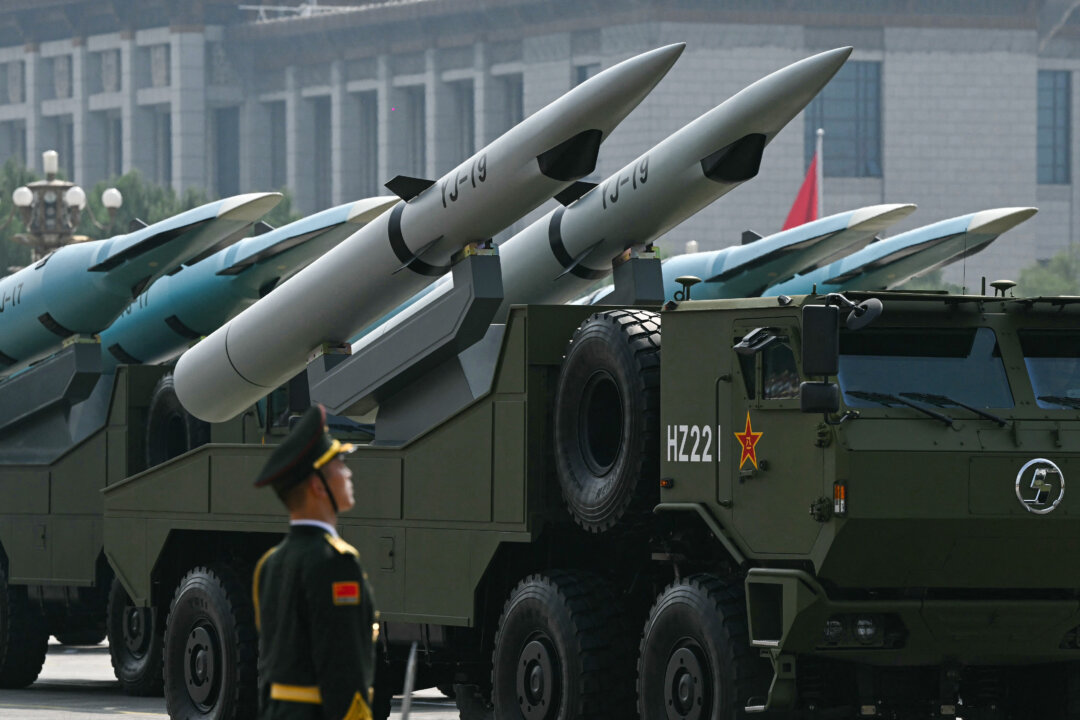
The Chinese regime is using claims of Japanese “remilitarization” as a cover for its massive military buildup at a pace unseen since World War II, experts warn.China’s Dalian Maritime Safety Administration barred entry into parts of the Bohai Strait and the northern Yellow Sea for a military mission from 4 p.m. on Aug. 16 until 4 p.m. on Aug. 30, according to a navigation warning it issued.The operation began one day after Japanese Defense Minister Shinjiro Koizumi visited the Yasukuni Shrine, which commemorates Japan’s fallen soldiers and has long been a source of tension between Tokyo and Beijing.On the same day, China’s foreign ministry condemned the visit as Japan’s “remilitarization” and lodged a strong protest. Two days later, Hong Kong-based Ta Kung Wen Wei Media Group, a mouthpiece for Beijing, called the Chinese regime’s maneuvers a “necessary response” to Japan in a commentary.However, Bonnie Yushih Liao, a senior research fellow at the Japan Forum for Strategic Studies in Tokyo, said exercises of this scale are usually planned in advance and that the timing is politically useful for Beijing.“It allows China to connect Yasukuni, Taiwan, and Japan’s stronger defense posture into a broader narrative of ‘Japanese remilitarization,’” Liao told The Epoch Times.In a similar vein, Edo Naito, a retired international business attorney and political analyst specializing in Japan’s foreign relations, told The Epoch Times that the regime is using this narrative as a pretext for its own massive buildup.“The PRC buildup is not only massive and at a pace unseen since World War II; it covers both conventional and strategic capabilities concurrently,” Naito said, using an acronym for China’s official name, the People’s Republic of China.The new DF-5C, a globally capable strategic nuclear missile, on trucks as it debuts at a military parade marking the 80th anniversary of victory over Japan and the end of World War II, in Tiananmen Square in Beijing on Sept. 3, 2025. Kevin Frayer/Getty ImagesTokyo and Beijing’s relations have soured after Japanese Prime Minister Sanae Takaichi said in November 2025 that Japan would be justified in activating its Self-Defense Forces if Taiwan were attacked.Days after Takaichi’s remarks, China conducted military operations from Nov. 23 to Dec. 7, 2025, in largely the same area as the August mission, and followed with a series of military provocations and economic coercion measures against Japan.Taiwan is a self-governed democracy that the Chinese Communist Party (CCP) has never ruled but has vowed to annex by force.China’s external posture, military activities, and other activities present “an unprecedented and the greatest strategic challenge” to Japan, Tokyo’s 2026 defense white paper released on Aug. 4 states.Pressuring US and Japan Robert Eldridge, director of North Asia for the Global Risk Mitigation Foundation in Hawaii, said the CCP is rapidly ramping up its assertiveness and disrupting international navigation, severely threatening regional security.“Over the past 30 years, China’s military expansion is constantly changing the status quo [in the Indo-Pacific],” Eldridge told The Epoch Times.“China blames Japan for it, [which is] actually a cover for what it’s doing, but it’s an extremely immature way to conduct international affairs.”Naito said China’s constant flood of new nuclear-powered subs and aircraft carriers will continue to pressure the United States and Japan, and could potentially block them from the Pacific in the event of a conflict.“Should they achieve free rein in the Western Pacific, this seriously complicates Japan’s own defense,” he said.Creating Stress Eldridge said the Japanese side was watching for signs of preparation for an exercise, as China’s drills will disrupt international trade, commerce, and navigation in the region.An SH-60K anti-submarine helicopter sits on the flight deck of Japan’s Maritime Self-Defense Forces (JMSDF) helicopter carrier JS Izumo (DDH-183) off the coast of Brunei on June 26, 2019. Emily Wang, File/AP Photo“It will further annoy the international community, and Japan is going to be affected because Japan can’t ignore it,” he said.Liao said Japan’s Self-Defense Forces (SDF) must monitor the operation, collect intelligence, and maintain readiness to respond, which imposes a steady drain on personnel and military resources.“More frequent encounters also increase the risk of an accident or miscalculation,” she said.Naito said Beijing’s military aggression has driven Japan to accelerate the development of its Pacific-facing deterrence.Koizumi announced on Feb. 24 that Tokyo plans to station surface-to-air missiles on Japan’s westernmost island, Yonaguni, by March 2031, the first concrete deadline set since the plan was unveiled in 2022.“The [regime’s] strategic buildup in ballistic nuclear-capable missiles is already creating a lot of stress,” Naito said.“You are seeing with the first open discussions of Japan changing its ‘Nuclear Three Nos.’”Japan’s long-standing Three Non-Nuclear Principles are “not possessing, not producing, and not permitting” the introduction of nuclear weapons, he said.Koizumi called for a discussion “without taboos” on July 17, but Takaichi reaffirmed what she called Japan’s “realistic and pragmatic approach” to a nuclear-free world, during the Aug. 9 anniversary of the atomic bomb being dropped on Nagasaki.Backfiring on Beijing The Chinese regime will continue its military operations against Japan, especially around the Senkaku Islands—a disputed territory in the East China Sea, administered by Japan but also claimed by Beijing and Taipei—Eldridge said.A Chinese coast guard vessel sails near disputed East China Sea islands on Aug. 6, 2016. 11th Regional Coast Guard Headquarters via AP“Taking the Senkakus would be a major way [for China] to drive a wedge between Japan and the United States if the two countries don’t get better prepared for that,” he said.“It’s part of its lawfare, and it can undermine the [U.S-Japan] alliance.”Liao said Beijing may also intensify its cognitive warfare to erode confidence between Washington and Tokyo.“For example, [Beijing could] encourage doubts about whether the United States would really accept the costs of defending Japan, while telling Japanese audiences that Washington is dragging them into a confrontation over Taiwan,” she said.However, China’s tactics have already backfired and will continue to draw increased international political backing, joint exercises, and intelligence sharing for Japan, according to Liao.Japan and Australia agreed to strengthen their bilateral defense partnership on Aug. 18, according to a statement released by Canberra.From May 17 to 22, Japan’s Ground Self-Defense Force held command and control drills with the U.S. Marine Corps in Japan’s southwestern Nansei Islands near Taiwan, marking the first such joint training in the region.“Cooperation with countries such as Australia and the Philippines all make it harder for Beijing to isolate Japan,” she said.“The irony for Beijing is that the harder it pushes Japan, the more it may strengthen the very coalition it is trying to weaken.”

China Using Japans Remilitarization as Pretext to Reshape Indo-Pacific: Analysts








Related Articles
China Business & EconomyChina NewsChina Technology
China Tech Index Plunges More Than 40 Percent From July Peak
China’s technology-heavy STAR 50 index has fallen by more than 40 percent...
China Military NewsChina NewsChinese RegimeInside CCP OfficialdomSpecial TopicsZhang Youxia
Xi Opens CCP Plenum Amid Sweeping Purges, Record-Low Attendance Forecast
Chinese Communist Party leader Xi Jinping opened a four-day meeting of senior...

China Business & EconomyChina NewsChinese RegimeFinance & Business TiesInside CCP OfficialdomSpecial Topics
Chinas Economic Woes Deepen as CCP Plenum Focuses on Political Control
The Chinese Communist Party (CCP) opened a four-day leadership meeting in Beijing...



China NewsEuropeGlobalUK NewsWorld News
UK Must Be Ready for War in 1,000 Days, Says British Defense Secretary
British Defense Secretary Wes Streeting has said the country must be ready...
