South Korea’s president has said that his country needs to do more to strengthen its own defense capabilities, while also praising the U.S.–South Korean alliance.“Through this year’s Ulchi exercise, we need to thoroughly assess and strengthen our defense posture and further enhance the country’s overall capacity to respond to crises,” President Lee Jae Myung said during an Aug. 18 cabinet meeting.“A strong national defense is the most fundamental foundation for protecting the lives of our people and building an irreplaceable Republic of Korea [ROK].”The annual Ulchi Freedom Shield exercise is an all-domain drill between South Korean and U.S. forces in which the allies strengthen their joint response capabilities against a range of regional security threats. It often features live, virtual, and field-based training, engaging personnel from a range of military services from both forces.It is taking place this year between Aug. 17 and Aug. 27.Lee said that to further strengthen his country’s defense posture, “it is essential to comprehensively enhance our operational capabilities and establish a system for training the personnel needed to achieve this.”“To this end, we must proceed without disruption, in line with the government’s original plan, to complete the transfer of wartime operational control within my term in office,” he said, referring to the command authority over joint military forces during a conflict, which the United States currently holds.Lee also praised the South Korea–U.S. alliance, saying that Seoul’s strengthening of its independent defense capabilities reinforces the allies’ mutual defense.“A strong alliance makes the foundation of security stronger, and strengthening our own capabilities increases our value and necessity as an ally,” he said.Trump Orders Scale-BackThe remarks came after U.S. President Donald Trump ordered the Pentagon to scale back Ulchi, saying it was sending the wrong message to Pyongyang.“Based on my very good relationship with Kim Jong Un, of North Korea, I am not happy with the fact that the United States has, long ago, agreed to participate in Joint Military Exercises with South Korea,” Trump wrote in a Truth Social post on Aug. 16.“These exercises are not only costly, with much of these costs paid for by the United States of America (as usual!), but send a signal that is totally inappropriate and hostile, to a Country that, as long as Donald J. Trump has been President, has been unthreatening and respectful.”Trump has repeatedly questioned the cost of maintaining roughly 28,500 American troops in South Korea. He does maintain that Seoul is an important U.S. ally.South Korea’s Joint Chiefs of Staff said on Aug. 17 that the drills started as scheduled.The South Korean presidential Blue House said it was reviewing the U.S. president’s post and it “hopes that the friendly relationship between the U.S. and North Korean leaders will lead to meaningful dialogue between the two countries, opening discussions aimed at advancing peace and stability on the Korean Peninsula.”The Blue House said that the two allies would continue to coordinate on their combined defense posture and military exercises.This year’s Ulchi exercises are expected to focus on evolving threats posed by North Korea, which has developed new tactics while assisting Russia in the Ukraine war.Col. Ryan Donald, director of public affairs at the ROK–U.S. Combined Forces Command, said last week that the character of warfare is changing, so drones, GPS disruption, and cyberattacks would be reflected in the exercises.“DPRK soldiers have deployed and fought in Ukraine, and they’ve taken those lessons they learned there and brought them back to North Korea,” he said, using the initials of North Korea’s official name, the Democratic People’s Republic of Korea.The DPRK routinely denounces the Ulchi exercises, this year calling them provocative and “a demonstration of an aggressive war.”North Korean RelationsTrump on Aug. 17 told reporters in the Oval Office that Kim had responded to his efforts to reengage, without providing further details.During his first term, Trump reached out to Kim, resulting in meetings between the two leaders in Singapore in 2018, Hanoi in 2019, and later in the Demilitarized Zone in 2019.After the Singapore summit, the U.S. president suspended the 2018 Ulchi Freedom Guardian joint exercises, calling them expensive and provocative. Several subsequent drills were redesigned or canceled.Talks in Hanoi ended without an agreement on denuclearization, and Pyongyang subsequently expanded its missile and nuclear capabilities.The United States and South Korea have since restored larger exercises on the Korean Peninsula.Reuters contributed to this report.

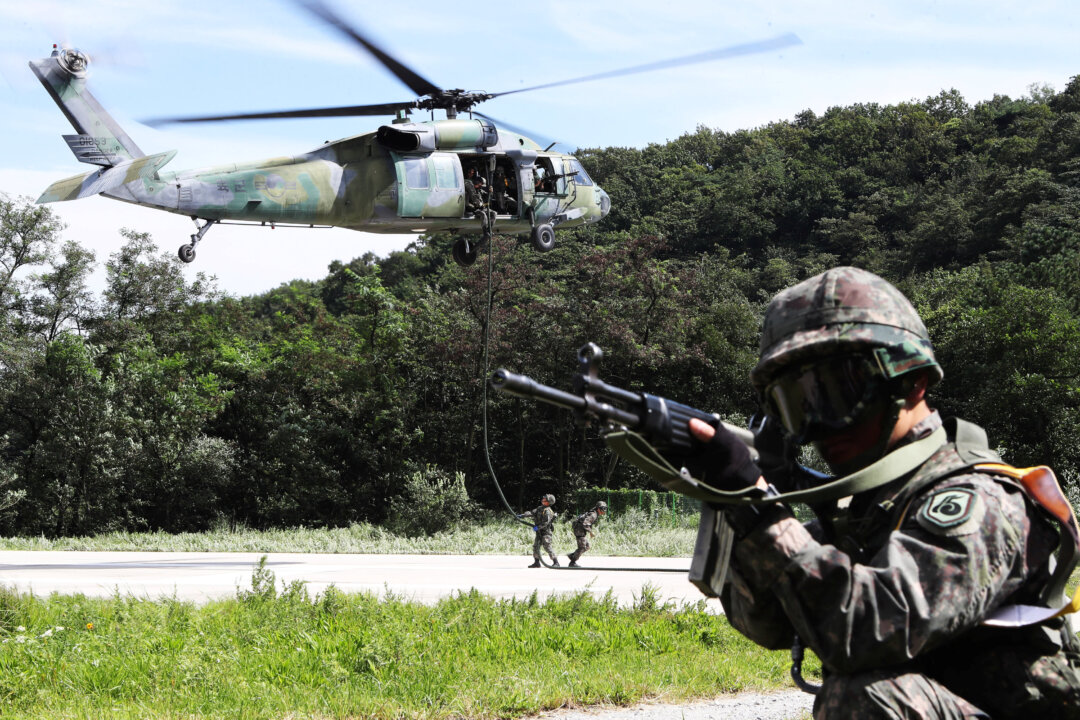
South Korea Backs Stronger Self-Defense Capabilities








Related Articles

EuropeThe Final wakeup call
Lula wins a miracle election in Brazil. Now comes the hard part: putting the country back on the right track
Three weeks ago, Brazilian President Luiz Inácio Lula da Silva’s political obituaries...
EuropeThe Final wakeup call
US midterms: what a new Congress could and could not change for Europe
US midterm elections traditionally attract fewer voters than presidential contests. But this...
EuropeThe Final wakeup call
Political power without balance leads to the erosion of democracy, what Montesquieu can teach modern-day France
KEY TAKEAWAYS Democratic erosion does not start by doing away with elections;...


China NewsEuropeGlobalUK NewsWorld News
UK Must Be Ready for War in 1,000 Days, Says British Defense Secretary
British Defense Secretary Wes Streeting has said the country must be ready...
