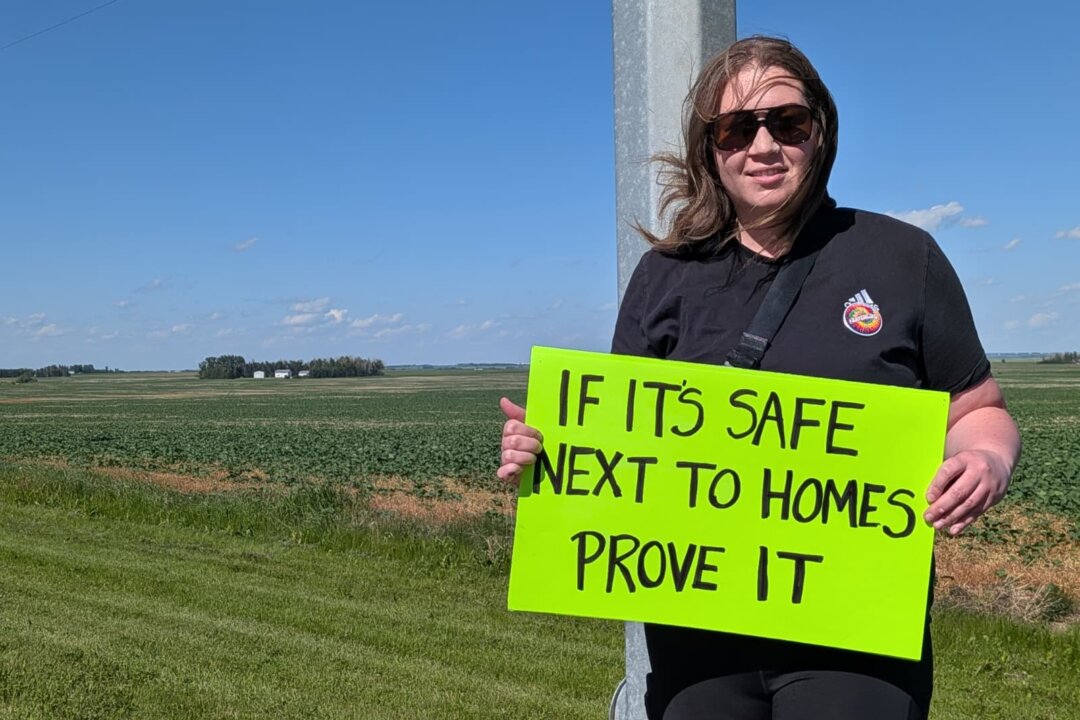
OLDS, Alta.—Alberta’s bid to become a North American hub for artificial intelligence infrastructure is facing a major local test, as residents of the town of Olds challenge a proposed data centre campus that would rank among the world’s largest.The AI boom has fuelled a wave of proposals for massive data centres across North America as developers seek locations with abundant energy, affordable electricity, and supportive infrastructure. Alberta has quickly become one of the industry’s top targets because of its natural gas resources, deregulated electricity market, and relatively low development costs.On July 8, tech giant Meta announced plans to build its first Canadian data centre—a massive $13 billion facility in Sturgeon County, near Edmonton. The company said the project will create 3,000 construction jobs and 300 permanent positions once operational.Part of the land parcel for Synapse’s proposed AI data centre campus in Olds, Alta. Paul Rowan Brian/The Epoch TimesBut as billion-dollar AI developments proliferate, local resistance is growing too.Communities across North America have raised concerns about land acquisitions, water consumption, noise, emissions, and other environmental impacts. Earlier this year, a Kentucky woman made headlines after rejecting a US$26 million offer for her family farm rather than selling the land for a proposed AI data centre.Similar battles are unfolding across Canada. Manitoba recently rejected a proposed hyperscale data centre over concerns about electricity demand and environmental impacts, while residents have mounted opposition to AI-related developments in Hamilton, Ont., and Vancouver over issues ranging from farmland preservation to water use and public accountability.Alberta has sought to encourage investment while relying on regulators to assess environmental, land-use, and public-interest concerns. In recent years, the province has slowed or rejected a number of major energy and infrastructure proposals as officials weighed competing priorities.Battle in OldsNow, the AI data centre debate is now playing out in Olds, a town of about 9,000 residents in central Alberta.Supporters say the proposed campus would be an economic boon to the community and a major step toward establishing Alberta as a global AI leader. Opponents say it would bring unacceptable health, environmental, and quality-of-life risks, while permanently changing the character of the town.The proposed one-gigawatt (GW), two-million-square-foot campus would include 10 AI data centres spread across roughly 300 acres, along with an off-grid natural gas power plant and backup diesel generators.The Town of Olds said in January that if built, the development would be the largest AI data centre campus in Canada and represent a $10 billion private-sector investment, creating about 2,000 construction jobs and more than 1,000 long-term jobs.Synapse, the company behind the proposal, says the campus would market its computing capacity to major AI, cloud-computing, and enterprise customers, with companies such as Google, Meta, Microsoft, and CoreWeave representing the type of clients it hopes to attract.Opponents, however, say the project’s economic benefits have been overstated. They also argue the proposal has not adequately addressed concerns about noise, cooling systems, water use, emergency planning, and other potential impacts on nearby residents.The proposal has attracted an unprecedented level of public interest. By May, 480 people had registered their intent to participate in the regulatory process, more than for any recent Alberta utility project.The town of Olds, Alta., has about 9,000 residents and is roughly 100 kilometres north of Calgary. Paul Rowan Brian/The Epoch TimesKayla Piccinin, who lives near the proposed site and is a member of the Olds Transparency Project, said local residents are not opposed to economic development but believe the proposal has moved forward without enough information about its potential impacts.“It felt like they were winging it,” Piccinin told The Epoch Times. “And they’re still winging it.”In an interview with The Epoch Times, Synapse CEO Jason van Gaal rejected suggestions that the project’s risks have been understated, saying Alberta’s regulatory process is designed to ensure the facility is built safely.The AI Boom Comes to AlbertaAI data centres house powerful computer systems that train, operate, and deliver artificial intelligence services. As demand for AI continues to grow, the International Energy Agency projects global electricity consumption from data centres will roughly double by 2030, driven largely by artificial intelligence.The residents’ concerns are not unique to Olds. In The Dalles, Ore., where Google has operated data centres since 2006, the facilities were using roughly a third of the city’s water supply by 2024, prompting officials to seek additional sources of water. The Environmental and Energy Study Institute says a large AI data centre can consume up to 5 million gallons of water per day.Despite those concerns, demand for AI infrastructure continues to accelerate, with governments and industry viewing data centres as critical to economic growth and national security.The federal government has pledged major investments in domestic AI computing capacity as part of its “AI for All“ strategy, while Alberta has launched its own plan to attract hyperscale data centres and position the province as a global AI hub.Alberta’s strategy leans heavily on its abundant natural gas reserves, competitive electricity market, available land, and relatively streamlined regulatory environment.Beyond its energy resources, the province offers relatively inexpensive land, a cooler climate that reduces cooling costs, and a privatized electricity market that allows companies to build dedicated power generation for large industrial projects.Those advantages have helped place Alberta at the centre of Canada’s push to expand domestic AI computing capacity, with multiple large-scale proposals now under consideration.As interest in AI projects has grown, however, Alberta has also faced many of the same questions that accompanied the province’s recent renewable energy boom. Regulators imposed additional scrutiny—and in some cases delays and restrictions—on wind and solar projects over concerns about farmland, viewscapes, and environmental impacts.AI data centres are now raising many of those same land-use and environmental questions, with regulators again being asked to weigh the potential economic benefits against concerns raised by nearby communities.How regulators handle the proposed Olds campus could help shape how future AI developments are assessed as more projects are proposed across Alberta.The proposal is now before the Alberta Utilities Commission (AUC), which will decide whether to approve the project’s power-generation component. Other approvals involving water, emissions, and environmental standards would fall to Alberta Environment and Protected Areas, while the Town of Olds would oversee local planning and development matters.The proposal has already encountered setbacks.Synapse’s initial application was closed by the AUC earlier this year after the regulator identified significant deficiencies, including incomplete and inconsistent information. The company has since submitted a revised application.Despite the resubmission, opposition has continued to mount, and the project has drawn more registered intervenors than any recent Alberta utility proposal.Many say they remain unconvinced that the company has adequately addressed concerns about noise, cooling systems, emergency planning, water use, and other potential impacts on nearby homes, schools, and businesses.For supporters, however, the extensive regulatory scrutiny demonstrates that the approval process is working as intended and that any project moving forward will have to satisfy Alberta’s environmental and safety requirements.Opponents Say Questions RemainOlds resident Geoff Davidson says the proposed AI data centre campus poses serious environmental, health, safety, and quality-of-life concerns. Paul Rowan Brian/The Epoch TimesGeoff Davidson, an opponent with a background in technology and finance, said cooling is one of the most important unresolved questions in Synapse’s proposal.“That heat has to be dispersed or managed somehow, and there are no magic wands to do it,” he said in an interview with The Epoch Times.Davidson questioned Synapse’s proposal to use a non-evaporative cooling system, saying the company has not provided enough information to demonstrate that it will work at the proposed scale.“It’s a behemoth,” he added.Davidson also questioned Synapse and the Town of Olds’ employment claims.“They have never answered my number one question, which is, what jobs?” he said. “Where are these jobs coming from? They’re unicorn jobs—they’re imaginary.”He said he also worries about noise and infrasound from the facility, noting that the proposed site is roughly one kilometre from the local high school and only a few hundred metres from Olds College.Davidson’s concerns were echoed by Alex de Vries, founder of the Netherlands-based Digiconomist which focuses on studying the “unintended consequences of digital trends,” saying the job creation numbers seem “optimistic” and will likely only amount to a “few dozen” in the end.“There’s various concerns, from rising electricity prices and grid congestion, to the impact on local water systems and supply, air pollution (power generation), thermal pollution (at the power generation and a heat island surrounding the data center) and noise pollution (with the latter three affecting biodiversity and human health),” he said in an email to The Epoch Times.Scott Honeyman, another local resident opposed to the project, said he is skeptical of the project’s job claims and worries about noise and disruption.“It’s taking farmland away from a farmer, and it’s not going to create jobs for the town,” he said in an interview.Supporters See Economic OpportunitySynapse CEO Jason van Gaal says his AI data centre campus proposal for Olds will bring many benefits to the town. Paul Rowan Brian/The Epoch TimesSynapse’s van Gaal said concerns about noise, emissions, and other environmental impacts are being addressed through the approval process and that the company has incorporated the data centre and power plant into its sound modelling.“Honestly, I’ve never had a noise complaint,” van Gaal said of the company’s previous data centre projects in Quebec. “People took shortcuts in how they built these before in the U.S. … That can’t happen in Alberta. The regulatory system won’t allow for it.”Van Gaal acknowledged the natural gas plant will produce emissions, but said it would use modern pollution-control technology.He said the project also reflects Alberta’s “bring your own power” approach, under which large industrial developments build their own electricity generation rather than relying on the provincial grid.He also argued the project fits Alberta’s strategy of using its natural gas resources to power AI infrastructure.Van Gaal said the company is prepared to begin construction once the necessary approvals are in place but acknowledged the timeline will depend on regulators.“I would love to start as soon as the AUC permits are available, but we’ll have to see,” he said.James Cummings, a former Olds councillor who has worked on public engagement for Synapse, said the lengthy regulatory process demonstrates the system is functioning as intended rather than being rushed.He said Olds has lost several major employers over the years and needs new sources of investment and industrial tax revenue.Cummings also argues the land has long been designated for industrial development and should be compared with other possible uses. “I‘d rather the noise level of a data centre than the noise level of a gravel crushing facility,” he said. “I’d rather the safety of a data centre versus the safety of an ethanol production facility.”“Are we going to get 1,000 jobs? I don’t know,” Cummings said. “Maybe we’ll get 200 jobs. You know what? Two hundred jobs is significant job creation for our community.”Philip Finlay, who owns a local crane company and lives across the road from the proposed site, said he was initially skeptical but changed his mind after meeting with company officials and engineers.“I personally don’t see anything that scares me about it,” Finlay said, adding that he still wants questions answered about potential impacts on his property but believes the project can be built safely.The property where Synapse Real Estate Corp. is planning a data centre complex with 1.4 gigawatts of natural gas-fired power generation is seen from across Highway 2A , in Olds, Alta., on June 4, 2026. The Canadian Press/Lauren KrugelAUC ReviewWhatever regulators ultimately decide, the outcome in Olds is likely to reverberate far beyond the central Alberta town, as provincial officials seek to attract investment as a key part of Alberta’s economic strategy.Entrepreneur Kevin O’Leary has separately proposed the much larger Wonder Valley AI campus near Grande Prairie, while industry observers expect additional projects to follow if the province succeeds in establishing itself as a destination for hyperscale AI infrastructure.The Alberta Utilities Commission has requested additional information from Synapse before proceeding with its review.Its eventual decision will determine more than the future of one proposed development. It may also provide the clearest indication yet of how Alberta intends to balance its ambitions to lead the AI economy with the concerns of the communities expected to host that growth.

How a Small Alberta Town Became the Battleground for One of Canadas Largest AI Data Centres









Related Articles

China NewsEuropeGlobalUK NewsWorld News
UK Must Be Ready for War in 1,000 Days, Says British Defense Secretary
British Defense Secretary Wes Streeting has said the country must be ready...

China NewsEuropeGlobalUK NewsUK Top NewsWorld News
UK Prime Minister Says He Agrees With Principle of Migration Reform
British Prime Minister Andy Burnham said on Oct. 26 that he agreed...

China NewsEuropeGlobalWorld News
Serbian President Concedes Election Defeat to Student-Led Coalition
Serbian President Aleksandar Vucic has conceded defeat in the Oct. 25 election...



Asia & PacificChina NewsEuropeInternational RelationsNational SecurityPolicies & ImpactsUSUS NewsUS-China RelationsWorld News
Japan Defense Academy Chief Calls for 3 Red Lines in Competition With China
Japan’s former top uniformed military officer has called for establishing three “red...
