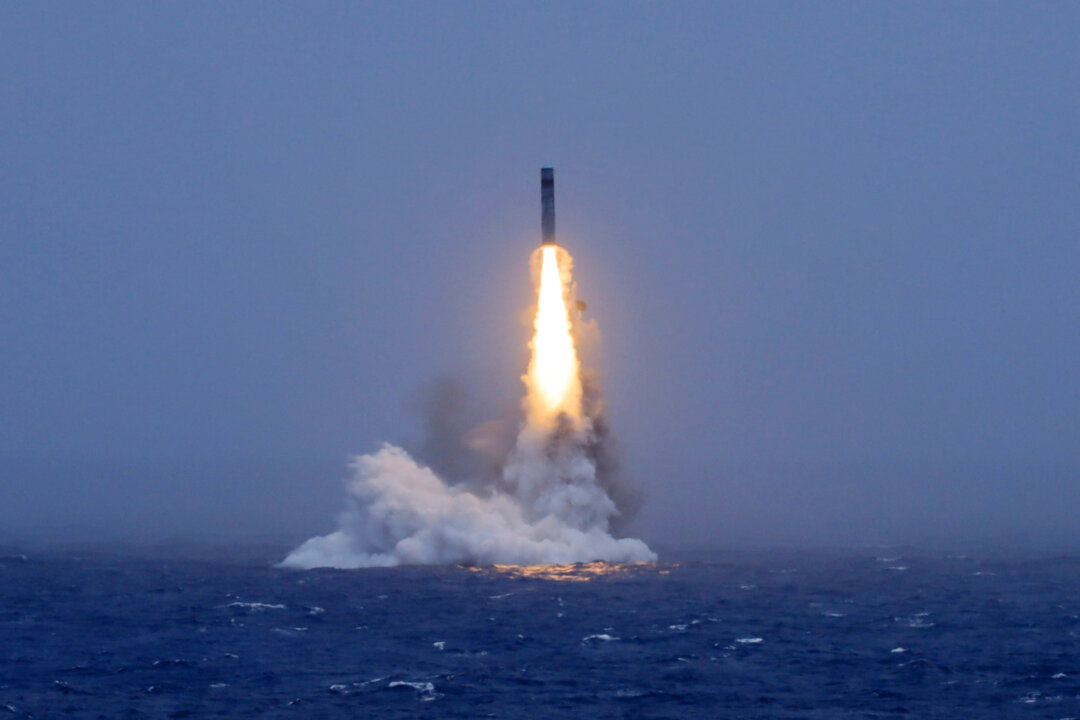
The Chinese regime’s recent missile test is an attempt to pose a threat to the U.S. mainland and a means of breaking through the First Island Chain, analysts say, but it has also prompted democratic nations to strengthen cooperation in countering China’s military threat.The Chinese Navy test-fired a submarine-launched long-range missile equipped with a training warhead that landed in the south Pacific during a joint military drill with Russia on July 6.The Chinese Navy said on July 6 that a nuclear submarine launched a strategic missile carrying a dummy warhead toward relevant high seas of the Pacific Ocean, and the missile landed precisely in the designated waters.It marks the first time in nearly two years that the regime has explicitly conducted a test launch of an intercontinental ballistic missile into the Pacific Ocean, drawing condemnation from the United States, Japan, Australia, New Zealand, the Philippines, and Taiwan. The CCP’s previous ballistic missile test into the Pacific took place in September 2024, when a missile was launched into waters near French Polynesia.The United States stated on July 6 that it had monitored a test launch of a submarine-launched strategic missile by the Chinese regime.The nuclear-capable, long-range ballistic missile launched by a Chinese submarine flew over several Pacific island nations before splashing down in waters near Tuvalu, according to international media reports.New Zealand Foreign Minister Winston Peters said the missile launched by the Chinese regime on Monday landed in the waters of the South Pacific Nuclear-Free Zone, and that he is “deeply concerned.”The Chinese regime rarely publicly reports on its missile tests, and it did not disclose the model of the missile tested this time.Mark Cao, a U.S.-based military tech analyst, former materials engineer, and host of Chinese-language military news YouTube channel Mark Space, told The Epoch Times that the missile launched by China was likely the JL-3—a new type of strategic submarine-launched ballistic missile—which has a range exceeding 10,000 kilometers (6,214 miles).“Countries like communist China and the former Soviet Union do not disclose any details whatsoever about their weaponry, particularly their strategic nuclear weapons,” he said.Cao said China’s first successful launch of the JL-3 missile was in December 2019, traveling from the Bohai Sea to an inland test range in western China.This time, its launch from a nuclear submarine toward the South Pacific demonstrates that the JL-3 possesses operational capability, he said.A submarine-launched strategic missile is a ballistic missile—typically armed with a nuclear warhead—that is carried by a strategic nuclear submarine and launched from underwater, according to public information.Multiple PurposesThe missile launch shows that the Chinese regime’s nuclear weapon is capable of threatening the U.S. mainland directly from China’s coast, Su Tzu-yun, researcher and director of Division of Defense Strategy and Resources at Taiwan’s Institute for National Defense and Security Research, told The Epoch Times. Its purpose is to breach the first island chain and to intimidate the United States, he said.First and second island chains. Courtesy of Department of DefenseThe first island chain is a strategic line in the Asia-Pacific that includes Japan, Taiwan, and the Philippines, designed by the U.S. military to contain the Chinese regime’s maritime expansion.The most critical aspect of China’s ruling Communist Party’s (CCP) geostrategy at present is the attempt to decisively break through the First Island Chain, Su said.“Only by breaching and securing control over the First Island Chain—and Taiwan in particular—can the CCP establish a foothold in the open Pacific.”Should the United States and its allies seek to provide defense for Taiwan, this demonstrated long-range nuclear missile capability of the CCP could complicate their decision-making, Su said.“The CCP aims to leverage such strategic strike capabilities to push the United States out of the First Island Chain.”The launch of the missile from a Chinese submarine into the South Pacific demonstrates the CCP’s capability to deploy nuclear-powered submarines in the region and to launch preemptive or forward-deployed strikes against nations such as the United States, Australia, and New Zealand, said Shen Ming-shih, research fellow at Taiwan’s Institute for National Defense and Security Research.“This display of nuclear deterrence is intended to counter the U.S. strategy of strengthening its denial and deterrence capabilities in the Indo-Pacific. It may also be a response of the CCP to recent drills conducted by the U.S. military with neighboring countries, reflecting multiple strategic objectives,” he told The Epoch Times.A Chinese PLA Navy ship is seen in the background while an Australian Navy destroyer takes part in a maritime cooperative activity near Scarborough Shoal in the South China Sea on Sept. 3, 2025. Ted Aljibe/AFP via Getty ImagesThe CCP launched the missile a day before the NATO summit, which took place on July 7 in Turkey. It was intended to intimidate the United States and its Western allies, according to analysts.However, Beijing’s decision to launch missiles just before the NATO summit effectively validated the narrative that Beijing poses a security threat to the world and will help to foster a stronger consensus among the United States and other NATO countries on the need to bolster their defense capabilities, Su said.“It will also prompt countries along the first island chain to foster closer cooperation on collective defense against the CCP,” he said.“Japan, South Korea, Taiwan, and the Philippines are likely to increase investment in missile defense, using such capabilities as a deterrent to counter the missile threat posed by the CCP. Meanwhile, the United States itself will accelerate the development of precision systems.”Shen said the CCP’s launch of this missile will prompt countries in this region, including Australia, Japan, South Korea, and especially the United States, to strengthen their anti-missile and attack capabilities.“The CCP’s capabilities already lag behind those of the United States. If it turns into a ballistic missile arms race, it will be detrimental to the CCP,” he said.In addition, Shen said, “After being warned by this action of the CCP, countries in the Indo-Pacific region will of course find ways to cooperate to jointly face and counter the threat of the CCP.”Tang Bing and Luo Ya contributed to this report.

China Tests Long Range Missile in the Pacific to Advance Its Aggression: Analysts









Related Articles

China Business & EconomyChina NewsChina Technology
China Tech Index Plunges More Than 40 Percent From July Peak
China’s technology-heavy STAR 50 index has fallen by more than 40 percent...
China Military NewsChina NewsChinese RegimeInside CCP OfficialdomSpecial TopicsZhang Youxia
Xi Opens CCP Plenum Amid Sweeping Purges, Record-Low Attendance Forecast
Chinese Communist Party leader Xi Jinping opened a four-day meeting of senior...

China Business & EconomyChina NewsChinese RegimeFinance & Business TiesInside CCP OfficialdomSpecial Topics
Chinas Economic Woes Deepen as CCP Plenum Focuses on Political Control
The Chinese Communist Party (CCP) opened a four-day leadership meeting in Beijing...



China NewsEuropeGlobalUK NewsWorld News
UK Must Be Ready for War in 1,000 Days, Says British Defense Secretary
British Defense Secretary Wes Streeting has said the country must be ready...
