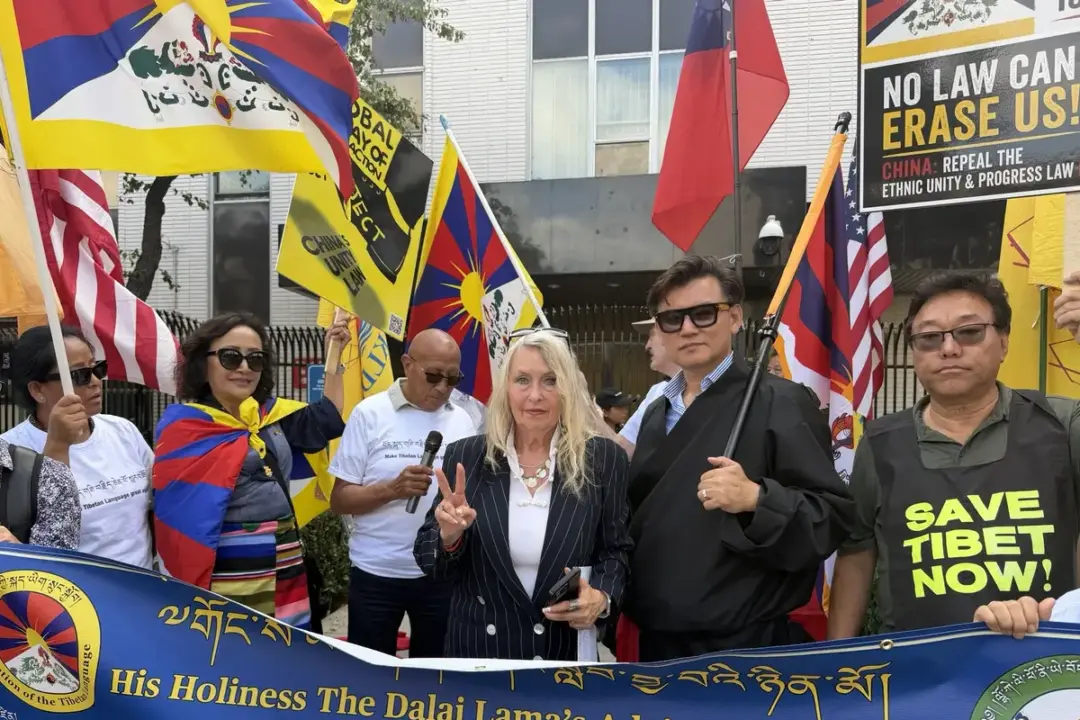
China’s new ethnic unity law, which took effect on July 1, is drawing criticism from lawmakers, human rights advocates, and ethnic minority groups, who say it creates a legal framework for Beijing to expand its political control beyond China’s borders.The new law, known as the Ethnic Unity and Progress Promotion Law, codifies Chinese Communist Party (CCP) leader Xi Jinping’s vision of building a “community of the Chinese nation”—a political concept that critics say prioritizes ideological conformity over ethnic diversity while granting the CCP broad discretion to target dissent.Opponents of the law who spoke to The Epoch Times say it reaches far beyond domestic ethnic policy. They say several provisions could be used to justify Beijing’s increasingly aggressive campaign of transnational repression by asserting jurisdiction over individuals and organizations overseas that criticize the CCP’s ethnic policies or advocate for the rights of China’s minority communities.The law’s implementation has prompted unusually strong international criticism, including a bipartisan resolution introduced in the U.S. House of Representatives and warnings from European lawmakers and international human rights organizations that it threatens fundamental freedoms both inside and outside China.Expands Beijing’s ReachAlthough Beijing describes the law as promoting ethnic unity and national cohesion, critics contend that it institutionalizes policies aimed at assimilating China’s ethnic minorities while extending the CCP’s political influence overseas.Among the law’s most controversial provisions are Articles 15 and 20, which require the promotion of the regime’s standard spoken and written Chinese language and directs families to educate children to love the CCP while prohibiting ideas deemed harmful to ethnic unity.Even greater concern has focused on Articles 62 and 63.Article 62 criminalizes activities such as “incitement” and “support” for conduct considered harmful to ethnic unity, while leaving those terms largely undefined and subject to interpretation by the CCP.Article 63 goes further, stating that overseas organizations and individuals may also be held legally accountable if Beijing determines they have engaged in activities involving “ethnic separatism” or actions that undermine ethnic unity. The provision contains no nationality or geographic limitations, prompting critics to argue that the CCP is asserting legal authority beyond China’s borders.At the center of the new law is the concept of the “community for the Chinese nation,” an ideological framework first introduced by Xi in 2014 and later enshrined in the CCP Constitution at the Party’s 19th National Congress in 2017.Under that framework, Beijing is accelerating policies promoting linguistic and cultural assimilation in regions including Tibet, Xinjiang, and Inner Mongolia. Chinese dissidents argue that those policies have steadily reduced public space for minority languages, religious practices, and distinct cultural identities.The new law reflects a broader trend under Xi. Over the past decade, Beijing has enacted a series of laws covering national security, counterespionage, cybersecurity, Hong Kong governance, and foreign sanctions, expanding the Party’s legal authority while narrowing the space for political dissent. The Ethnic Unity Law is the latest addition to that framework, and its extraterritorial application distinguishes it.Jiang Pinchao, U.S.-based editor of the “June 4th Poetry Collection” and a writer whose works have been collected by the Library of Congress, told The Epoch Times that the law is less about unifying China’s ethnic groups than enforcing loyalty to the CCP.“The CCP only allows support for one unified political identity,” Jiang said. “It isn’t really about the Han [Chinese] people or any other ethnic group. Ultimately, it’s about creating what amounts to a ‘Communist Party ethnicity’ that replaces traditional cultures and histories with loyalty to the Party.”Germany-based Temtselt Shobshuud, president of the Inner Mongolian League for the Defense of Human Rights, told The Epoch Times that the new law is “forced control and forced assimilation wrapped in the language of law.”He pointed to changes introduced in Inner Mongolia in recent years, when the regime significantly expanded Mandarin-language instruction in schools, prompting widespread protests among ethnic Mongolians. The Chinese regime responded with arrests and a broader clampdown on dissent.Parents wait outside a school in Tongliao, China’s northern Inner Mongolia region, on Sept. 10, 2020. Noel Celis/AFP via Getty ImagesNew Phase of Transnational RepressionThe most significant feature of China’s new ethnic unity law is not its language policy or its emphasis on ideological education, but its potential use against people living outside China.For activists from Tibet, Xinjiang, Inner Mongolia, Hong Kong, and the broader Chinese diaspora, the concern is that the law could provide a formal legal rationale for the CCP’s surveillance, intimidation, pressure on relatives in China, and efforts to silence criticism abroad.Shobshuud said previous CCP control mechanisms were focused primarily on people inside China, while pressure overseas was often exercised quietly through monitoring, threats, or influence operations. The new law, he argued, signals a more open assertion that overseas Chinese communities and critics abroad should also be expected to conform to Party authority.“The law takes what used to be a political slogan and turns it into a legal instrument,” he said. “People see it not as a unity law, but as an openly repressive law.”Joseph Shi, a former municipal councilor in Alberta, Canada, and a pro-democracy activist who was jailed in China in the aftermath of the 1989 Tiananmen Square massacre, told The Epoch Times the new law appears designed in part to discourage overseas criticism of Beijing’s treatment of ethnic minorities and its policies toward Taiwan.“One purpose is intimidation,” Shi said. “The message is that people should stop speaking out overseas and stop supporting equal treatment for minority groups.”Shobshuud said pressure would not be limited to ethnic minority activists.“Not only Tibetans, Uyghurs, and Mongolians will feel this pressure,” he said. “Chinese and Hong Kong pro-democracy activists [outside of China] will increasingly feel it as well.”Shi said people “should not assume citizens of Western [countries] are immune.”“The CCP has shown before that it is willing to detain foreigners when it believes doing so serves its political interests,” he said.Shi pointed to the 2018 detention of Canadians Michael Kovrig and Michael Spavor as evidence that Beijing has previously targeted foreign nationals during political and diplomatic disputes.He also described what he called indirect pressure on politicians and activists through relatives and community networks. According to Shi, critics of Beijing living in Canada have long worried that family members in Hong Kong or China could face harassment or intimidation because of activities conducted abroad.In electoral districts with large Chinese-speaking populations, he said, politicians sometimes face intense pressure campaigns from groups aligned with Beijing, ranging from lobbying efforts to organized opposition during elections.Riot police detain a man as they clear protesters taking part in a rally against a new national security law in Hong Kong on July 1, 2020, on the 23rd anniversary of the city’s handover from Britain to China. Dale De La Rey/AFP via Getty ImagesIntimidation CampaignShi, who frequently publicly criticizes the CCP in Canada, recounted a recent incident he believes was intended to intimidate him.He said he received a phone call from a man claiming to be a Canadian police officer investigating a report of DUI. The caller, speaking fluent English, knew Shi’s license plate number, vehicle model, vehicle color, approximate route home from Calgary, and the location of his house.“It sounded like a real police officer,” Shi said. “[The level of detail was] what made it frightening.”After contacting local police, Shi said he was told that no DUI complaint had been filed against him and that no officer had called him. The incident occurred shortly after he returned from a Hong Kong-related public event on July 1, leading him to suspect that the call was intended to create psychological pressure.Shi also described what he believes were efforts to undermine his business. He said he operated a Chinese restaurant in a small Canadian community where his landlord had repeatedly renewed the lease.About six months ago, he said, the property was unexpectedly purchased by a Panama-based company at a price he considered unusually high, and the new owner declined to renew his lease.Separately, Shi said that roughly five years ago, a businessman with close ties to the Chinese consulate purchased a nearby hotel and restaurant despite its limited profitability, invested heavily in renovations, and opened a competing Chinese restaurant in the area.Those allegations could not be independently verified by The Epoch Times.Shi said he could not prove the transactions were connected to political pressure, but he believes the timing and circumstances were intended to send a message.“For someone with relatively limited influence, the amount of money involved seemed extraordinary,” he said. “That is what made it feel disturbing.”The Chinese Consulate in Toronto is seen on April 25, 2023. Andrew Chen/The Epoch TimesInternational Criticism MountsThe Chinese regime’s ethnic unity law has drawn condemnation from lawmakers and rights organizations in several countries.In the United States, 14 House lawmakers requested on June 30 the Secretary of State condemn the legislation, arguing that it would expand Beijing’s efforts to export its ideology internationally, authorize actions targeting people living abroad—including those in the United States—and further erode the cultural and religious rights of China’s ethnic minorities.“Beijing’s message is chilling: Abandon your faith, forget your language, obey the Party—or face punishment, even abroad,” Rep. Chris Smith (R-N.J.) told The Epoch Times in a statement. “This is not unity. It is tyranny—and it turns cultural and religious erasure into official policy.”German lawmaker Michael Brand warned that the legislation threatens the cultural survival of Tibetans, Uyghurs, and other minority groups, describing it as a dangerous policy of forced assimilation that could establish a troubling international precedent.Amnesty International also voiced concern over the law’s broad language.Sarah Brooks, the group’s deputy regional director, said anyone, anywhere in the world, who peacefully advocates for the rights of China’s ethnic minorities could potentially be accused of undermining “ethnic unity.”“‘Unity’ in this context is not harmony between different communities — it is political and ideological alignment with the Chinese Communist Party,” Brooks said. “Rather than protecting diversity and equality, the law requires conformity.”Rep. Chris Smith (R-N.J.), co-chair of the Congressional-Executive Commission on China, during a hearing on Capitol Hill in Washington on May 14, 2026. Madalina Kilroy/The Epoch TimesBroader Trend Since 2018Shi linked the new law to a broader shift in the CCP’s governance that accelerated after the U.S.–China trade war began in 2018 and after Hong Kong’s pro-democracy protests in 2019.During that period, Beijing increasingly embedded Xi’s political concepts into legislation and national security measures, creating legal mechanisms to enforce ideological priorities that had previously existed mainly as Party directives.Jiang said that many of these laws serve a common purpose—deterrence through fear.“These are not laws designed to protect citizens,” he said. “They are laws designed by the CCP to protect the Party and frighten people into silence.”He questioned how a domestic Chinese law could legitimately regulate the thoughts and speech of people living in other countries, calling the effort both legally dubious and politically revealing.For critics like Jiang, the significance of the new legislation lies less in whether Beijing can enforce it everywhere than in the signal it sends—that the CCP increasingly views ethnic identity, political loyalty, and overseas speech as part of a single global sphere of Party authority.Activists Urge Overseas ChineseDespite their concerns about the law, the activists interviewed said its greatest immediate effect may be psychological rather than legal.Jiang said Beijing’s objective is to deter criticism by creating uncertainty over what consequences outspoken critics could face.“The first thing is not to let yourself be intimidated,” he said. “People overseas should continue exercising the freedoms they enjoy. If the CCP attempts to interfere with those rights abroad, they should rely on the legal protections of the countries where they live.”Shobshuud said remaining silent would only encourage Beijing to expand its reach.“If people think the CCP is too powerful to challenge and stop speaking, that’s exactly what it wants,” he said.“Those of us living in free and democratic societies have both the opportunity and the responsibility to speak out. Many people inside China cannot express their views freely. We should help make their voices heard.”Co-chair of the Congressional-Executive Commission on China (CECC) Rep. Chris Smith (R-N.J.), Chairman Sen. Dan Sullivan (R-Alaska), and Rep. James McGovern (D-Mass.), listen to testimonies during a hearing on Capitol Hill in Washington on Nov. 20, 2025. Madalina Kilroy/The Epoch TimesShobshuud, who has participated in the Southern Mongolian rights movement for more than four decades, described the campaign as one that extends beyond any single generation.“I’ve been involved in this movement for 46 years,” he said. “[I] cannot abandon it halfway simply because of intimidation. The choices we make today will become part of the legacy we leave to the next generation.”Shi likewise argued that public awareness remains one of the most effective responses.He encouraged overseas Chinese communities to continue engaging lawmakers and broader society, particularly in Western countries where governments have become increasingly aware of transnational repression linked to Beijing.Speaking from his experience in Canada, Shi said he also urges local business leaders to reduce their dependence on the Chinese market, arguing that economic leverage has become one of Beijing’s most effective political tools.“Companies should plan ahead,” he said. “No one should build a business strategy that depends entirely on access to the Chinese market because the CCP could change [its policies] any day.”Gu Tong and Yi Ru contributed to this report.

Chinas New Ethnic Unity Law Is Tool to Expand CCPs Transnational Repression, Critics Say









Related Articles
China Business & EconomyChina NewsChina Technology
China Tech Index Plunges More Than 40 Percent From July Peak
China’s technology-heavy STAR 50 index has fallen by more than 40 percent...
China Military NewsChina NewsChinese RegimeInside CCP OfficialdomSpecial TopicsZhang Youxia
Xi Opens CCP Plenum Amid Sweeping Purges, Record-Low Attendance Forecast
Chinese Communist Party leader Xi Jinping opened a four-day meeting of senior...
China Business & EconomyChina NewsChinese RegimeFinance & Business TiesInside CCP OfficialdomSpecial Topics
Chinas Economic Woes Deepen as CCP Plenum Focuses on Political Control
The Chinese Communist Party (CCP) opened a four-day leadership meeting in Beijing...



China NewsEuropeGlobalUK NewsWorld News
UK Must Be Ready for War in 1,000 Days, Says British Defense Secretary
British Defense Secretary Wes Streeting has said the country must be ready...
