Back in November 2023 – a time when it wasn’t even clear that Donald Trump would be allowed to run in the upcoming presidential primaries – the European Union approved a tough new “anti-coercion instrument”.
This stated: “Economic coercion exists where a non-EU country applies or threatens to apply a measure affecting trade or investment in order to prevent or obtain the cessation, modification or adoption of a particular act by the EU or a Member State, thereby interfering in the legitimate sovereign choices of the EU or a Member State”.
At the time, the threats were all coming from Russia, which stood accused of interfering in election campaigns, and undermining trust in liberal democracy.
Yet that regulation now seems a perfect fit for the US under a president who is threatening “substantial additional tariffs” against countries he deems to be imposing unfair laws against tech companies. Europe, where those digital regulations were literally invented, is now the clear target of Trump’s ire. Although I would argue that the EU’s approach to regulating in this area has some serious problems, it should not risk bowing to US pressure. The union would lose credibility if it showed that it does not believe in its own rules.
In just eight years, European institutions have approved ten laws in the digital space. The legislation spans 591 articles and covers 1,091 pages. This would have been a monumental effort, with each regulation stemming from the work of potentially hundreds of lawyers, experts and policymakers. That’s even before the EU’s three different institutions (commission, parliament, and council) all had their say.
The problem, though, is that the more articles you have regulating interconnected activities, the more likely you are to find contradictions among them. Paradoxically, the firms that may be more damaged by the necessity to comply tend to be European start-ups, which are generally too small to afford the fees needed to pay lawyers who can help them make sense of such complex legislation.
Added to this is the fact that the phenomena we are trying to govern is extremely radical and unprecedented (especially large language model artificial intelligence). We therefore don’t yet know what the impact of digital change will be and whether the regulations in place are the right ones. Indeed, it’s almost inevitable that such detailed regulation contains what will eventually turn out to be mistakes as circumstances change.
But while EU digital regulation is far from perfect, the bloc cannot allow a third party to bully its way to changing the rules. EU regulation is suboptimal but it is not targeting “incredible American tech companies”, as Trump suggests.
True, elements of the Digital Service Act only apply to “very large platforms” (with over 45 million users in the EU), but while the majority of the 19 giants meeting this threshold are American, the list also includes three Chinese, one Canadian and three European companies.
In fact, some of the comments made by the US president arguably meet the description of actions that the Anti-Coercion Instrument is designed to sanction.
Fighting fire with fire
Trump has put in the bluntest terms that “digital taxes, legislation, rules or regulations are all designed to harm, or discriminate against, American technology”. He has said: “unless these discriminatory actions are removed, I, as President of the United States, will impose substantial additional Tariffs”. This is “threatening a measure affecting trade or in order to obtain the cessation of a particular act by the Union”. Not to open a case to investigate the US on these points would send a dangerous message that competitors (or former allies) can meddle in European sovereign affairs.
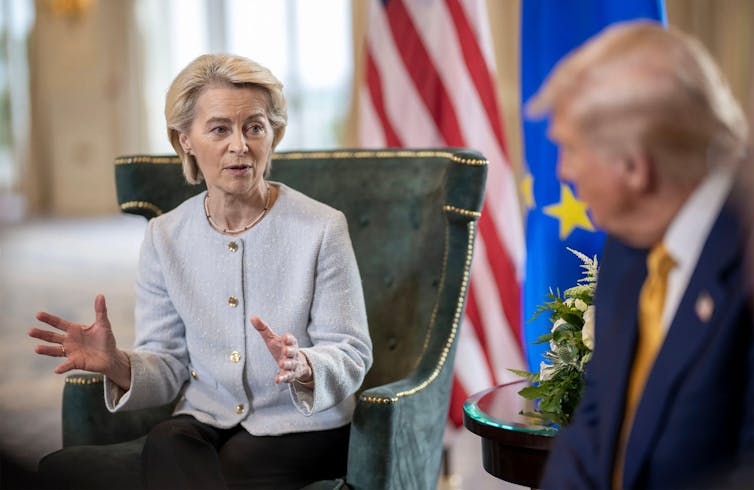
The activation of countermeasures would require a qualified majority at the European Council which would not be impossible to reach: 55% of the member states (15 out of 27 would be enough) representing 65% of the population (the sum of Germany and France is one third of the total). In any case, even if a qualified majority is not reached, the exercise is still worthwhile. It would be helpful to know which member states are still serious about being part of a (sovereign) union and which of them would rather go for a union “à la carte”. This latter option is not, logically, good enough for times that require the EU to react quickly to crises.
Trump has taken a similar approach to the EU’s renewable energy policy, calling for member states to dismantle their wind turbines.
The times in which we are living will soon force Europe into a make or break decision. This is what Mario Draghi, former Italian prime minister and author of the report currently guiding the EU’s competitiveness, hinted saying recently when he said: “we have been reminded, painfully, that inaction threatens not only our competitiveness but our sovereignty”. Europe cannot afford to give the impression that it has lost faith in its ability to be free.