Before Donald Trump, John F. Kennedy was the last president to celebrate the unique unity of politics and culture which emerged with the American Revolution. JFK launched the visionary Apollo project, unleashing scientific and technological optimism in an entire generation. But he understood that such projects had to be coupled with the classical culture capable of inspiring the creative souls of the nation. That is why he invited the great classical cellist Pablo Casals to perform at the White House.The defining feature separating the Anglo-Dutch imperialists from their opponents is their irreconcilable concepts of human beings. The Empire faction, spawned in the tradition of their Roman and Venetian forebears, believes human beings are nothing more than clever beasts.Their opponents, steeped in the philosophy of the Renaissance, are committed to the idea that Man is a creative being, made in the living image of the Creator and participating in the perfection of God’s creation.In 1688, William of Orange took over England on behalf of the Dutch Empire. His Anglo-Dutch “Venetian faction” immediately moved to set up the British East India Company and the private Bank of England, modeled on the Dutch East India Company and the Rotterdam banking system.The resistance to this Imperial System spawned one of the greatest periods of creative thought in Philosophy, Science, and Culture seen since the Renaissance itself.The Fight to Save EnglandFrom the time of the Dutch takeover until roughly 1714, the German genius Gottfried Leibniz coordinated a two-fold strategy to defeat the oligarchical faction. As confidant of the Electress Sophie of Hanover, the lawful successor to the throne upon the death of Queen Anne, Leibniz was positioned to become the next Prime Minister of Great Britain — but this was thwarted by Sophie’s sudden death.Simultaneously, Leibniz collaborated with the anti-Empire leadership in England engaged in a pitched battle to become the trusted advisors to Queen Anne. This “republican faction” included Jonathan Swift, Dr. Arbuthnot (physician to the Queen), John Gay, and Alexander Pope, among others.Between 1710 and 1714, the Swift-led grouping wrested control from the Venetian operatives, securing the appointments of Swift ally Alexander Spotswood as Governor of Virginia and Robert Hunter as Governor of New York/New Jersey.Those appointments, coupled with the Leibniz collaborators James Logan and Ben Franklin in Pennsylvania, enabled America to sustain a healthy resistance to the British Empire from the early 1700s through the Revolution and beyond.With the death of Queen Anne in 1714, the direct battle for control of Britain was lost. The death of Leibniz two years later forced the focus increasingly to the last hope for republicanism — America.The Power of the Cultural WeaponThe cultural weapons of satire, music, drama, and art were wielded by the republican faction in the battle to save Britain. Now they had to be nourished and allowed to flourish in the New World.The Scriblerus SocietyThe collaboration of the republican forces around Swift, Arbuthnot, Gay, and Handel coalesced into a group known as the Scriblerus Society, whose works became the cultural arsenal of the American founding generation.Gulliver’s TravelsOne of the greatest pieces of satire ever written was Jonathan Swift’s Gulliver’s Travels, published in 1726. In this masterpiece, Swift exposed and ridiculed the perversities of the newly created British Empire and the false axioms upon which it was based.When Gulliver visits LaPuta, Swift conjures both Homer and Aristotle. Homer, representing the vital spirit of reason, is described as “the taller and comelier Person of the two, walked very erect for one of his Age, and his Eyes were the most quick and piercing I ever beheld.”1 Aristotle, embodying dead empiricism, appears “stooped much, and made use of a Staff. His visage was meager, his Hair lank and thin, and his Voice hollow.”2In Book Two, Swift ridicules the British Royal Society, references Newton’s intellectual theft of Leibniz’s calculus, attacks Descartes by “exploding his theory of Vortices,”3 and predicts Newton will suffer the same fate, warning of “the same Fate to Attraction, whereof the present Learned are such zealous Asserters.”4 Most importantly, he attacks the impossibility of describing natural systems through pure mathematical principles.5Swift endorsed Leibniz’s dynamic, developing concept of Nature while ridiculing the static Aristotelian-Newtonian view.Swift also exposes oligarchical colonial policy in the starkest terms: pirates discover unknown territory, loot and plunder it, torture native leaders to reveal where gold can be found, then drag natives back home to demand pardon and divine right to seize the land.Then, Swift applies withering sarcasm to what he wrote: “But this Description, I confess, doth by no means affect the British Nation, who may be an example to the whole World for their Wisdom, Care and Justice in planting Colonies.”6Swift gives us a glimpse of authentic humanity in his description of the sea captain who rescues Gulliver — a man of “a little portion of Reason”7 who acts solely for Gulliver’s wellbeing. Swift wrote his masterwork, as Gulliver declares, for those who reject the oligarchical worldview: “I write for the noblest End, to inform and instruct Mankind.”8 Swift was a favorite of the founders, including both Ben Franklin and James Logan.John Gay and The Beggar’s OperaTwo years after Swift wrote Gulliver’s Travels, John Gay — a key Swift collaborator and Scriblerus Society member — published The Beggar’s Opera.It was a devastating ridicule of Minister Walpole’s Venetian-faction clique that had taken over England with the ascension of King George I. The play was immensely popular in England and widely read in America. William Byrd II, in his diary Progress to the Mines, relates how in 1732, while delayed by heavy rains at the home of Thomas Randolph en route to Governor Spotswood in Virginia, the two passed the idle time reading parts of The Beggar’s Opera aloud to one another.Handel, Swift, and AmericaGeorg Fredrick Handel, who graduated from the German University of Halle — established by Leibniz’s collaborator Hermann Franke — moved to London in 1712 and took up residence at the home of Lord Burlington, whose home served as a meeting place for the Scriblerus Society. Handel composed the ode “Eternal Source of Light Divine” for Queen Anne’s birthday in 1713. In 1737 he composed the Funeral Anthem for Queen Caroline, who had studied under Leibniz and arranged for the publication of the famous Leibniz-Clarke correspondence.Handel viewed his music in the true “republican” concept of culture: beauty as a means to uplift and nourish the soul of the listener. When a nobleman described his Messiah as “noble entertainment,” Handel rebuked him: “My Lord, I should be sorry if I only entertained them. I wish to make them better.”9The music of Handel and Bach was promulgated in America by the Moravians who settled in Pennsylvania in 1741. Ben Franklin spent several weeks studying their music and wrote that the Moravians in Bethlehem had “very fine music in the church,” with “flutes, oboes, French horns and trumpets” accompanying the organ.10 Between 1759 and 1761, One Moravian acquaintance of Franklin built, the first violin, viola, and cello ever made in America.Franklin himself created the Glass Armonica in 1761, and later both Mozart and Beethoven composed music for it.In 1762, Elijah Dunbar organized singing meetings in Stoughton, Massachusetts, and in 1774 the revolutionary composer William Billings set up a similar school in Boston. In 1786, Dunbar established the Stoughton Musical Society — still the oldest existing musical institution in America. Its historic singing contest with the Dorchester First Parish Church Choir was decided when the Stoughton performers won by singing, from memory, Handel’s Hallelujah Chorus as their finale.George Washington was an avid concert-goer who attended performances in Philadelphia by Alexander Reinagle — a composer in direct correspondence with Bach’s son, C. P. E. Bach, and the man who introduced both Haydn’s and Mozart’s music to American audiences around 1790.Theater in AmericaThe establishment of classical American theater was also a direct result of the battle between the British oligarchical faction and the Scriblerus Society networks. When the Churchill-Walpole allied owner of the Lincoln Theatre refused to perform The Beggar’s Opera, John Gay turned to the Theatre Royal, Covent Garden, owned by Scriblerus Society ally John Rich. The play became the longest-running production in London history at the time.The Beggar’s Opera was the first theater production by professional actors in America. The British Hallam family, actors associated with John Rich, subsequently moved to America and performed The Merchant of Venice in Williamsburg, Virginia.Lewis Hallam Jr. later opened a theater in New York and performed the first American-authored play, The Prince of Parthia, written by Thomas Godfrey — son of the inventor who was a close collaborator of James Logan and Ben Franklin. The influence of Shakespeare runs throughout the play, particularly in a scene reminiscent of Julius Caesar in which two minor characters reflect on the fickleness of the mob.The Artistic Gift of America to Great BritainThe establishment of American art culture began when Ben Franklin and his collaborators, in 1760, deployed the young American genius Benjamin West to study painting in London and Italy. West never returned to America, but he trained and inspired three generations of American artists.In Italy, West studied the great Renaissance paintings and was briefly tutored by Anton Rafael Mengs, himself a student of the great German classical scholar Johann Winckelmann. Returning to London, West co-founded the Royal Academy of Arts in 1768 and later became its President. Reflecting the depth of classical culture shaping American thought before the Revolution, West — using an engraving as a model — had painted The Death of Socrates as early as 1756.Under the British Empire’s oligarchy, it was near-sacrilege to paint figures from current history unless garbed in Roman togas. West was committed to allowing the American people to reflect on and take pride in their own history.In 1770, he revolutionized art by painting The Death of General Wolfe in the native background and garb of the French and Indian War. In 1771 he followed with a commissioned painting celebrating Penn’s Treaty with the Indians. In 1805, he celebrated the great American revolutionary leader by painting Ben Franklin Drawing Electricity from the Sky.In the same year, Benjamin West’s student Charles Willson Peale founded the Pennsylvania Academy of Fine Arts. West expressed his vision in a letter to the new Academy, envisioning the United States as an “empire bursting into magnitude of the first order,” with Philadelphia assuming the role of Athens — where the fine arts would flourish thanks to “eminent men” of its “greatly distinguished” Academy.11Charles Willson PealeCharles Willson Peale, born in Delaware in 1741, joined the Sons of Liberty at the age of 23. This student of Benjamin West used Leonardo da Vinci’s Treatise on Painting as his guide and the works of Raphael as his model. He recognized the revolutionary role America was destined to play in world history and dedicated his life, through his paintings, to preserving for posterity the individuals and events shaping that revolution.Peale served with Washington in the two crossings of the Delaware in 1777 and two years later painted Washington at the Battle of Princeton, portraying him as confident and prepared for the war’s next phase. He painted every major American figure — Franklin, Hamilton, and many lesser-known figures critical to the cause — all the way into the 1820s.Peale and his sons also fostered “great projects” advancing American culture and science. The Peale Museum (later the Philadelphia Museum) was made affordable to the general public to encourage enthusiasm for the sciences. It housed specimens collected from across America and from as far away as China and India; the entirety of specimens from the Lewis and Clark expedition were housed there.Peale offered lectures from scientists of the American Philosophical Society and musical concerts. He kept an organ in his museum because he believed “the best way to educate the public was to unite art and science to show the harmony of the universe.”12Benjamin West’s StudentsThe influence of Benjamin West (1738–1823) shaped American art culture well into the period of the Civil War and beyond. His most famous students included Robert Fulton (1765–1815), painter and inventor of the steamboat; William Dunlap, painter and major promoter of American theater; Thomas Sully (1783–1872), famous for his 1824 portraits of John Quincy Adams and General Lafayette; Samuel Morse (1791–1872), painter and developer of the telegraph and Morse Code; and John Trumbull, whose paintings The Declaration of Independence, The Surrender of General Burgoyne, The Surrender of Lord Cornwallis, and George Washington Resigning His Commission adorn the Rotunda of the United States Capitol to this day.An excerpt from a letter Trumbull wrote to Franklin in 1789 captures the revolutionary spirit at work: “I have begun a series of pictures of the great Events of the Revolution… I hope by confining my pencil to subjects so interesting to Human Nature that I shall not only meet the approbation of my Country, but… that I may Render some distant service to Posterity.”13ConclusionThis nation was founded on the idea that Genius exists — that it must be cherished; that we must fight for the right for it to flourish; that institutions must be created that nourish its development. Our great world-historic genius, the Prometheus of his Age, Ben Franklin understood this well. He expressed it in verse:’GENIUS; AN IRREGULAR ODE’ POEM BY B FRANKLIN (excerpts)”LET THERE BE LIGHT”-TH’ ALMIGHTY SPOKE- OBSERVANT OF THE GREAT COMMAND, ALL SHOULD THE SOLE SUPREME INVOKESCIENCE TO SPREAD O’ER EVERY LAND; SCIENCE! WHOM SUPERIOR POWERS ARE GIVEN. THE FRIEND OF MAN, AND DELEGATE OF HEAVEN. “LET THERE BE LIGHT”- TH’ANGELICK THRONG, SILENT, SURVEYED THE SPACIOUS VOID; THEN ECHOED IN THEIR CHEERFUL SONG, (STILL IN JEHOVAH’S PRAISE EMPLOYED SERVING IN TRUTH THE UNIVERSAL CAUSE) AND SANG “LET THERE BE LIGHT,”–AND LIGHT THERE WAS. HOMER! STAND FORTH!—THY GENIUS KNOWN, TO THEE WE EVERY TRIBUTE PAY; THY FANCY RAISED THE POET’S THRONE, WHICH FUTURE AGES SHALL OBEY. BY THEE FULL MANY A REALM WAS TAUGHT TO GLOW;BUT SHAKESPEARE TEARS THE LAUREL FROM THY BROW.DRYDEN TO PHILIP’S SON A FANE HAS REARED, A TEMPLE STRONGER THAN THE HERO’S NAME; THOUGH LIKE A GOD BY SOME HE WAS REVERED THE BARD HAS MORE ILLUSTRIOUS MADE HIS FAME.The cultural lineage traced here — from Leibniz and Swift through Handel and West to Peale and Trumbull — was not accidental. It was a deliberate and sustained campaign to nourish a republican civilization capable of producing, and sustaining, the American Revolution. We don’t run ads on our website. We don’t take corporate sponsors. Our work is funded almost entirely by readers and viewers like you. For just $10 a month, you directly support the writers and editors bringing you the truth about what’s really happening in our fight to rebuild the nation. Become a paid subscriber and join us in this battle. Subscribe for $10 a month Endnotes1. Jonathan Swift, Gulliver’s Travels, ed. Robert A. Greenberg (New York: W.W. Norton, 1970/1961), p. 168.2. Swift, Gulliver’s Travels, p. 168.3. Swift, Gulliver’s Travels, p. 169.4. Swift, Gulliver’s Travels, p. 169.5. Swift, Gulliver’s Travels, p. 169.6. Swift, Gulliver’s Travels, pp. 258–259.7. Swift, Gulliver’s Travels, p. 251.8. Swift, Gulliver’s Travels, p. 257.9. W. S. Rockstro, Life of George Frederick Handel (London, 1883), p. 397.10. Oscar George Theodore Sonneck, Early Concert-Life in America (1731–1800) (Leipzig: Breitkopf & Härtel).11. Benjamin West to the Pennsylvania Academy of Fine Arts, 22 July 1807.12. Steven Carr, “Charles Willson Peale, America’s First Official State Portrait, and the Institution of the Presidency,” Schiller Institute, 2015.13. John Trumbull to Benjamin Franklin, New York, 25 November 1789 (unpublished).

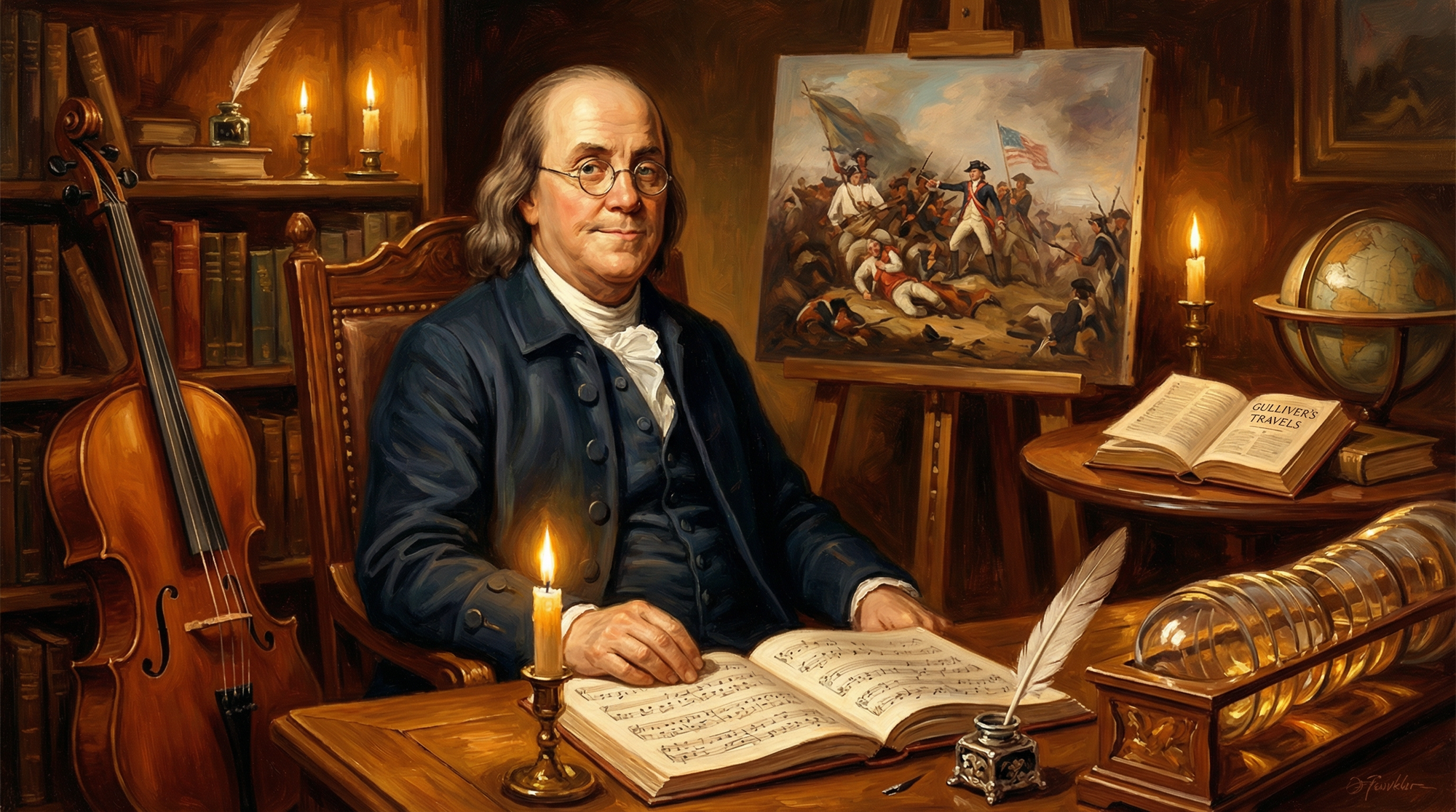
The Culture that Shaped the Fight for Independence







Related Articles

EuropeThe Final wakeup call
Lula wins a miracle election in Brazil. Now comes the hard part: putting the country back on the right track
Three weeks ago, Brazilian President Luiz Inácio Lula da Silva’s political obituaries...
EuropeThe Final wakeup call
US midterms: what a new Congress could and could not change for Europe
US midterm elections traditionally attract fewer voters than presidential contests. But this...

EuropeThe Final wakeup call
Political power without balance leads to the erosion of democracy, what Montesquieu can teach modern-day France
KEY TAKEAWAYS Democratic erosion does not start by doing away with elections;...



DruthersThe Final wakeup call
Facing the Crooked of Hormuz
By Tom Engelhardt | Substack.com/@TomEngelhardt I was born on July 20, 1944,...
