President Donald Trump and India’s Prime Minister Narendra Modi will meet this week for the first time since Trump returned to the White House last month.
NEW DELHI—India’s Prime Minister Narendra Modi is set to meet with U.S. President Donald Trump in Washington on Feb. 12–13. It will be the first meeting between the two leaders since Trump returned to the White House last month.
Amid a reignited U.S. trade war with Beijing, analysts expect that tariffs and China will be central to the meeting’s discussions.
Last week, the United States imposed a 10 percent tariff on Chinese imports. In retaliation, Beijing announced new tariffs on American imports, including 15 percent on coal and liquefied natural gas and 10 percent on crude oil and farm equipment.
The developments generated buzz in Indian media, with Indian analysts opining that the U.S.–China trade conflict could further India’s interests.
Indian media outlets, including the Financial Express, India’s state media DD news, the Times of India, and Asian News International (ANI) predicted that U.S. tariffs on China could benefit Indian exporters by generating a substantial increase in orders.
As a United States–China trade war flared during Trump’s first term as president, Indian exports to the United States rose from $57 billion to $73 billion, according to government sources cited by Indian media.
Related Stories
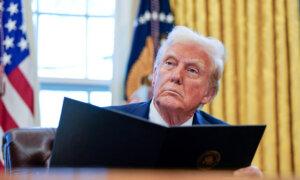

Trade developments are stirred by geopolitics, analysts said, and thus, much is expected from Trump–Modi’s meeting.
“Of course, there will be discussions on China and its trajectory as well as mutual concerns,” according to Anil Trigunayat, a former Indian diplomat and a distinguished fellow at the New Delhi-based Vivekananda International Foundation.
When it comes to U.S.–China relations, Trump appears to be taking a different bilateral approach, Trignunayat said.
India–United States relations are guided by a “global comprehensive strategic partnership,” he said, and he expects an in-depth exchange of views between Modi and Trump this week.
In his phone call with Modi last month, Trump emphasized fair bilateral trade relations with India and “emphasized the importance of India increasing its procurement of American-made security equipment,” according to a White House readout of the meeting.
Now, ahead of Modi’s visit to Washington, observers are watching if India will grant additional tariff cuts to American exporters in order to avoid a potential trade war.
India’s budget this month cut average import tariff rates from 13 percent to 11 percent on several items, besides reducing taxes on high-end bikes and luxury cars. India is also reviewing surcharges on more than 30 items, including luxury cars and solar cells.
Shekhar Sinha, chairman of the board of trustees of the New Delhi-based India Foundation, told The Epoch Times that as the two leaders focus on their respective countries’ interests, the tariff relief that India will provide to the United States is key to negotiations.
S. D. Pradhan, India’s former deputy national security adviser, told The Epoch Times the revived United States–China trade fight has “certainly” added to trade dynamics between the two countries. The trade fight provides an opportunity for India to export items on which the United States has increased tariffs for Chinese exporters, he said.
“The Modi–Trump meeting would be crucial in this respect. India needs to develop an effective strategy for a long-term agreement for export of Indian products to the U.S.,” said Pradhan.
He noted that the United States imports consumer goods, automobile parts, pharmaceuticals, and medical equipment from China, and textiles from Bangladesh, which is currently in turmoil. Those products could be supplied by India, he said.
“Besides, [Indian] refineries are working well, ” he added. “These can be utilized for the U.S.”
Other China Factors
While Indian exporters will benefit from the trade war between Washington and Beijing, China will continue to be a factor in the relationship between the United States and India in other ways as well.
China’s expansionism in the Indo-Pacific and the risk of critical technology falling into Chinese hands will be a topic of discussion between Trump and Modi, according to Madhav Nalapat, vice chair of the Manipal Advanced Research Group.
“Both seek decoupling of sensitive items from production in China. It is an important reason why the two can be expected to have a good meeting,” said Nalapat.
Sinha predicted that Modi will raise India’s China concerns with Trump, while the U.S. president will probably talk about bilateral relations and assure Modi of continued American support for the QUAD alliance between the United States, India, Japan, and Australia.
Sinha expects the Indian prime minister to raise concerns about “the situation in Bangladesh and [the] increasing Chinese footprint in Maldives and Nepal.”
Pakistan’s worsening economic and political crisis will also be discussed, he said.
Pradhan said China remains the key strategic rival for both the United States and India, and Beijing will continue to make tactical adjustments vis-a-vis both nations.
“Trump may be able to get some assurances, but given China’s strategic objective, it is not likely to work in the long term,” he said.
“Strategic pressure” from the QUAD nations is the only way to induce China to behave acceptably, he said.
According to Pradhan, semiconductors may also be a topic of discussion when Modi visits Trump this week.
China currently controls key areas of the global semiconductor supply chain—mainly rare earth elements. A “trilateral agreement” between India, the United States, and Taiwan could counter that grip, he said.
Reuters contributed to this article.