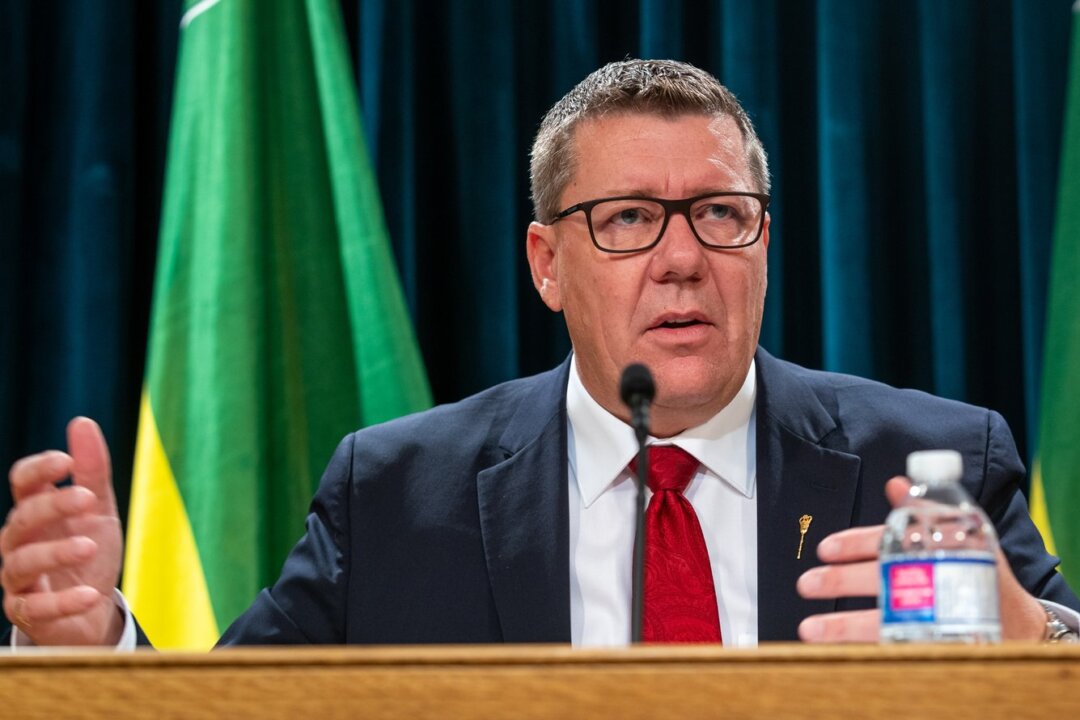
Premier Scott Moe has announced his government will take steps to remove the carbon tax on industry in Saskatchewan, making it the first province in Canada to be “fully carbon tax-free.”
Moe said setting the industrial carbon tax rate to “0 percent” will help businesses be more competitive as the United States continues to impose tariffs on Canada, and will give consumers “a break.”
“The immediate effect is the removal of the carbon tax on your SaskPower bills saving Saskatchewan families and small businesses hundreds of dollars a year,” Moe said in a video posted to social media March 26.
“In the longer term, it will reduce the cost of other consumer products that have the industrial carbon tax built right into their price.”
Shortly after being sworn in as prime minister on March 14, Mark Carney signed a directive instructing the consumer carbon charge to be set to 0 percent effective April 1. Since Parliament was prorogued at that time, the Liberal government couldn’t remove the legislation requiring the consumer carbon tax.
Carney said the consumer carbon tax had become “too divisive,” and pledged to instead implement a new “climate policy that is unifying, credible, and predictable.”
Related Stories

The move means consumers and small businesses will no longer have to pay a charge on fuels. Carney has said “big polluters” in industry will have to continue to pay the tax through an output-based pricing system.
Conservative Leader Pierre Poilievre has long said he would scrap the consumer carbon tax if he became prime minister, but is now pledging to also stop the carbon tax on industry.
Past Opposition
Moe has been one of the most vocal opponents of the carbon tax among Canada’s premiers, and made the decision in 2023 to begin withholding the home heating carbon tax as of Jan. 1, 2024.
The province stopped collecting the carbon tax on home heating in response to the government’s decision not to exempt all forms of home heating from the tax. Ottawa paused the tax for home heating oil in the fall of 2023, a move that largely benefited Atlantic Canada but had little impact in the western provinces, where natural gas is primarily used for home heating.
The province unanimously passed legislation to designate the Crown as the exclusive registered distributor of natural gas. The measure was put in place to protect SaskEnergy employees and board members from being held accountable by Ottawa for not imposing the tax on residential heating.
Then-federal Environment Minister Steven Guilbeault said Moe’s action was illegal, saying he is “not respecting federal laws.”
Moe’s government said that the tax was driving up inflation and that it was the fair move to do.
Carbon Pricing Systems
Pricing methods varied from province-to-province under former Prime Minister Justin Trudeau’s carbon tax system, but every jurisdiction was required to meet the minimum standards set out in the 2016 Pan-Canadian Framework on Clean Growth and Climate Change, and the 2018 Greenhouse Gas Pollution Pricing Act (GGPPA).
The GGPPA places a minimum price on carbon emissions which Ottawa called its “carbon pricing backstop.” As long as Canada’s provinces and territories met the minimum, they were allowed to run their own carbon pricing system. The federal backstop would only kick in if those minimums were not met.
Moe said he is hoping the next federal government will not implement a backstop to collect levies from Saskatchewan as a result of his decision to end the industrial tax.
The federal carbon only applies in provinces that don’t have their own carbon levy.
B.C. was the first Canadian province to implement its own carbon pricing system and, now that Ottawa is scrapping the consumer tax, B.C. Premier David Eby has said his province will follow suit. The province said in a statement the tax would be removed on April 1.
The federal carbon pricing kicked off in 2019 at $20 per tonne and rose to $50 per tonne in 2022. The price was set to rise $15 per tonne every year until it eventually reached $170 per tonne in 2030.