
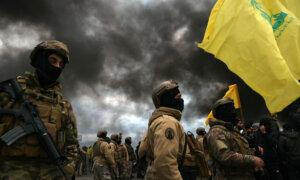
Israeli ground forces were originally meant to leave Lebanon by Jan. 26 as part of a broader November cease-fire agreement, pending abidance by Hezbollah.
Israeli troops are preparing to stay at five outposts inside Lebanon’s borders, temporarily extending their presence in the country beyond a previously announced Feb. 18 withdrawal deadline.
In an emailed press statement shared with The Epoch Times on Feb. 17, the Israel Defense Forces (IDF) confirmed their troops would be primarily positioned at points inside Lebanon overlooking several northern Israeli border communities. The border deployment points include Lebanese heights overlooking the Israeli border community of Shlomi; another set of heights inside Lebanon overlooking Israel’s Avivim and Mallaqi’a communities; a third set of heights overlooking the Israeli communities of Saluq and Margaliot; a fourth outpost in Jabal Blat; and a fifth outpost in Hamames.
“We need to remain at those points at the moment to defend Israeli citizens, to make sure this process is complete and eventually hand it over to the Lebanese armed forces,” Lt. Col. Nadav Shoshani, an IDF spokesperson, told reporters on Monday.
Israeli ground forces originally crossed into southern Lebanon in October 2024 after around a year of cross-border attacks by Hezbollah; a Shia Islamist Lebanese faction designated as a terrorist group by Israel, the United States, and various other countries. Hezbollah began targeting Israel’s northern interests on Oct. 8, 2023, just hours after Hamas carried out attacks across southern Israel.
The United States, under then-President Joe Biden, had helped broker a cease-fire that officially went into effect on Nov. 27, 2024. The deal called for Hezbollah to pull its fighting forces north of the Litani River, and for Lebanese government forces to reassert control over the areas south of the river. If these conditions were meant, Israel, in turn, agreed to stop striking Lebanon and pull its ground forces out of Lebanon within 60 days.
Last month, the Israeli government announced a decision to delay the withdrawal of its ground troops from southern Lebanon beyond the original Jan. 26 deadline. Explaining the delay, Israeli Prime Minister Benjamin Netanyahu’s office said they were still waiting for Hezbollah to fully withdraw north of the Litani River, and for the Lebanese armed forces to finish deploying along the Israel-Lebanon border.
Related Stories
The Epoch Times asked the IDF how long it expects Israeli troops to remain at these five outposts inside Lebanon and the overall progress each side has made toward fulfilling their cease-fire obligations. The Israeli military declined to comment.
Newly-selected Lebanese President Joseph Aoun, in a Monday press statement, expressed his concern that Israeli forces would again extend their presence inside Lebanon’s borders.
“We are working diplomatically to achieve a complete Israeli withdrawal, and I will not accept that a single Israeli remains on Lebanese territory,” Aoun said.
Lebanon’s Parliament elected Aoun, a former Lebanese army general, in January.
Speaking Monday, the new Lebanese president insisted his country’s forces stand ready to assert control over the Lebanese border communities from which Israeli forces are meant to withdraw.
On Monday, Lebanon’s official National News Agency (NNA) reported that Lebanese government troops were blocked from entering the southern town of Houla, where Israeli military operations continue.
Israeli forces have continued to conduct strikes on suspected Hezbollah and Hamas targets throughout Lebanon.
On Monday, the IDF announced that Israeli aircraft had conducted an airstrike in the city of Sidon, Lebanon, targeting a car being driven by Hamas suspect Muhammad Shaheen. NNA reported a local hospital was conducting DNA testing to identify an individual killed in the airstrike.
Hassan Fadlallah, a Hezbollah-aligned member of Lebanon’s parliament, has called on Aoun’s new administration to more directly confront the Israeli military presence inside the country.
“The question today is how does this government want to confront the occupation of the land?” Fadlallah said in a Feb. 17 statement carried by Hezbollah-affiliated media channels.
“As for those who do not want resistance, what is their plan to expel the occupation? And regardless of what will be stated in the ministerial statement, how will these people deal with the reality of the existence of an occupation?”
Reuters contributed to this report.