

‘We’re trying to actively sit down with our American friends and say, let’s make the situation better,’ a European Commission spokesperson said.
The European Commission, which coordinates EU trade policy, expects to present a plan early next week for the bloc’s next move in response to wider import tariffs imposed by the United States, a spokesperson for the body said on Tuesday.
The 27-nation bloc faces 25 percent import tariffs on steel, aluminum, and cars, as well as new, broader “reciprocal” tariffs of 20 percent on almost all other goods, under President Donald Trump’s policy targeting countries that impose high barriers to U.S. imports.
“Early next week, we will basically be presenting our plan. We’ll explain what the roadmap is, then consult with member states, consult with industries, before we come forward with the final measures that we will then present to member states to vote on,” Olof Gill, the commission’s spokesperson for economic security, trade, and financial services, told a press conference in Brussels.
“We’re in a sticky situation here. Things aren’t getting better. They’re getting worse. And we’re trying to actively sit down with our American friends and say, let’s make the situation better. … We didn’t start this situation. We’re trying to fix it. We are waiting for our American counterparts to engage in a meaningful way.”
Separately, the commission proposed extra tariffs on Monday, mostly at 25 percent, on a range of U.S. imports in response to the U.S. tariffs on metals.
A committee of trade experts from the EU’s 27 member states will vote on the commission’s proposal on Wednesday afternoon. The proposal will only be blocked if a qualified majority—15 EU countries representing 65 percent of the bloc’s population—votes against it.
Related Stories

U.S. products that have so far been mooted in negotiations as targets include motorbikes, poultry, fruit, wood, clothing, and dental floss.
U.S. alcoholic beverages were also among the proposed targets, but that drew objections from major wine-exporting nations France and Italy after Trump threatened to impose a 200 percent tariff on EU wine and spirits if the EU proceeded with its planned 50 percent duty on U.S. whiskey.
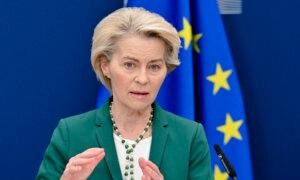
Earlier this week, European Commission President Ursula von der Leyen suggested that the EU could offer “zero-for-zero” tariffs on certain goods to the United States.
“We stand ready to negotiate with the U.S. Indeed, we have offered zero-for-zero tariffs for industrial goods as we have successfully done with many other trading partners,” she told reporters on Monday.
Trump rejected the proposal later that day, telling reporters in the Oval Office during a meeting with Israeli Prime Minister Benjamin Netanyahu that it was not good enough. The president suggested that EU countries import more energy from the United States.
The tariffs have already had a marked effect on Europe, with the continent’s stock markets waning on Wednesday as the levies kicked in.
The pan-European STOXX 600 dropped by 2.5 percent at 7.11 a.m. GMT, as the previous session’s moderate rally vanished.
The index in Frankfurt, Germany, also took a 2.1 percent dive as trading commenced.
German Minister of Finance Joerg Kukies said that Europe’s largest economy is at risk of another recession as a result of trade tensions.
“A possible trade conflict increases the risk of recession, there is no question about that,” he told German outlet Deutschlandfunk radio.
The European Central Bank (ECB) is already prepared to ensure the sound financing of the eurozone economy and financial stability amid the turmoil, according to French ECB policymaker Francois Villeroy de Galhau.
In his annual letter to French President Emmanuel Macron, he said that leveraged hedge funds could be at particular risk of big liquidity pressures.
“In this context, the Bank of France and the European Central Bank are fully mobilised to ensure the economy is well financed and [ensure] financial stability,” he wrote. “They are monitoring to make sure the financial system’s liquidity is good, including in times of market stress.”
Reuters contributed to this report.