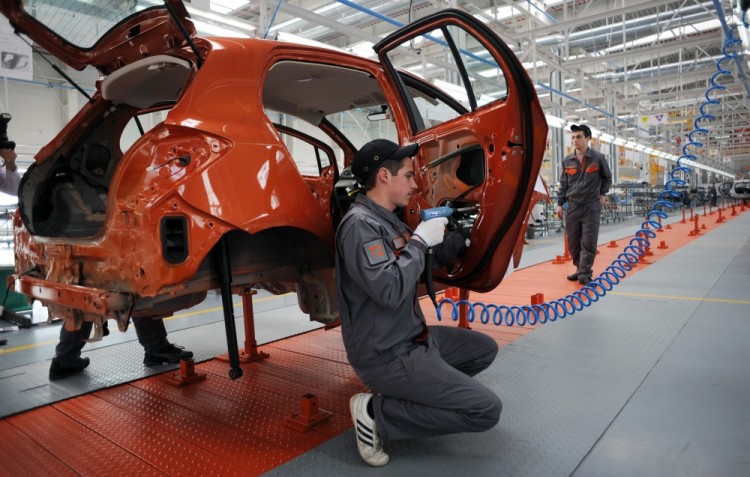
China’s Great Wall Motor Co. (GWM) will produce its Ora 5 compact SUV in Bulgaria from early 2027 by partnering with a local manufacturer—GWM’s first wholly localized manufacturing base in Europe.Analysts warn that trade competition between China and the European Union (EU) could transform into internal EU economic conflict through China incorporating its own automakers into the EU’s production chain.GWM announced in a statement on Oct. 27 that its Bulgarian plant would have a capacity of 50,000 vehicles a year, with production scheduled to start in the first quarter of next year. GWM’s local partner is Bulgaria Automotive Industry, which operates a plant in Bahovitsa and has cooperated with GWM in the past. GWM did not disclose financial details of the agreement with its Bulgarian partner.Previously, GWM opened an assembly line plant in Bulgaria in 2012 as a joint venture with local company Litex Motors, but it shut down in 2016 due to financial collapse and market pressures. The new manufacturing base is at the same location as the failed joint venture.GWM plans to launch at least 10 new or derivative models over the next two years, expanding its product lineup beyond just electric vehicles.GWM has also operated a research and development center in Munich, Germany, since 2021. The Chinese automaker plans to produce 300,000 vehicles in Europe by 2029 and aims to capture a 3–5 percent market share by 2030. In 2025, its sales in Europe fell by nearly 30 percent to approximately 3,500 vehicles.GWM’s latest move is part of its strategy to expand into the European market by establishing local production facilities in Europe to support sales and mitigate the impact of trade barriers, including tariffs.The company’s EVs imported from China are subject to a 20.7 percent EU anti-subsidy duty on top of the bloc’s standard 10 percent car import tariff.“From local R&D to local manufacturing, we are building a full localized ecosystem for Europe, and aim to grow together with European customers and partners through long-term investment and collaboration,” GWM Chief Technology Officer Nicole Wu said on Oct. 27.“We don’t just want to sell cars to Europe: we want to become part of Europe,” Wu said.The Chinese regime officially stated in December 2025 that “Bulgaria is becoming a pivot for Chinese automakers in Europe.”Political-Economic ImpactBulgaria is both an EU member and a NATO member.Bulgaria has a relatively small economy and a lower level of development, creating a strong demand for investment in the manufacturing sector and for job opportunities, Davy J. Wong, a U.S.-based independent political economist, told The Epoch Times.“Naturally, the local government welcomes Chinese enterprises looking to invest. For GWM, the relatively low costs—combined with the country’s status as an EU member—make it an ideal production hub for reaching the entire European market.”In terms of the strategic gains for Beijing, this project also serves to tie some of Bulgaria’s interests to Chinese enterprises through economic investment, Wong pointed out.“Once the project generates factories, jobs, supply chains, and local tax revenue, Bulgaria would have to weigh its own potential losses should the EU move to restrict Chinese vehicles or companies. Consequently, Bulgaria would have a greater incentive to oppose or delay such EU measures, or to push for them to be relaxed,” Wong explained.This effectively transforms what would otherwise be a trade dispute between China and the EU into an internal conflict of interest within the European Union, Wong said. “By leveraging the development gaps and the competition for investment among EU member states, Beijing can cultivate support from within the bloc.”People look at a line of Great Wall cars parked in front of the newly opened car factory for Great Wall Motor Co. near the town of Lovech, some 150 kilometers (93 miles) north-east of Sofia, Bulgaria, on Feb. 21, 2012. Stoyan Nenov/ReutersBy creating shared commercial interests, Chinese investment could strengthen Bulgarian support for continued economic engagement with Beijing. This interpretation is reinforced by China’s explicit request in September 2026 that Bulgaria play a positive role within the EU on China–Europe economic relations. However, economic cooperation does not automatically translate into political alignment, Sun Kuo-hsiang, a professor of international affairs and business at Nanhua University in Taiwan, told The Epoch Times.For Beijing, forging close ties with a small nation that has a strong appetite for investment can yield political returns that far exceed the scale of the country’s own economy—all for a relatively modest economic outlay, Wong said.Such political returns for Beijing are not limited to influencing countries such as with Bulgaria’s voting behavior, Wong said. “Countries with close ties can also serve as channels for policy coordination, providing insight into internal deliberations and acting as conduits for lobbying,” he said. “When the European Union prepares to tighten its policy toward China, Beijing can leverage these internal allies to voice opposition in advance, secure exemptions, or foster divergent positions among member states.”In terms of political impact, the intertwining of interests between China and EU member countries could indeed turn them into a supporter of Beijing—and a channel of communication—within the European Union, Wong said.For the EU, the potential tension is between Bulgaria’s investment priorities and collective concerns about subsidies and industrial dependence. For Washington, concerns would likely focus on Chinese-controlled vehicle software, data access, and supply-chain security; U.S. connected-vehicle restrictions demonstrate this sensitivity, Sun said of the impact. “These are potential sources of friction.”LimitationsThe ultimate stability of this foothold, however, will depend on the scale of the investment, operational performance, and shifts in the local political landscape, Wong said.This is where the difficulty lies for the European Union, Wong noted: “While every member state desires Chinese investment, they are not necessarily willing to share the costs of a common policy toward China. Beijing can exploit these divisions by negotiating terms with individual member states, making it all the more challenging for the EU to forge a consistent and unified course of action.”The economic value of a Beijing co-production project in Europe hinges on the extent to which it leaves behind tangible benefits—such as jobs, local procurement, and technical capabilities, Wong said.“If the primary components are sourced from China and Bulgaria serves merely as an assembly site, the resulting industrial advancement for the local economy will be quite limited. Furthermore, the long-term viability of the factory will ultimately depend on sales volume; tariff advantages cannot serve as a substitute for genuine consumer demand,” Wong said.As to the measures that the West could take to counter this localized co-production strategy of Beijing, Sun said that the EU already has several responses: customs and anti-circumvention enforcement, Foreign Subsidies Regulation investigations into distortive support, and investment screening where security or public-order risks arise.“Its proposed Industrial Accelerator Act would additionally seek stronger European employment, local sourcing and technology benefits from qualifying foreign investments,” he said.The United States, meanwhile, will focus on the software, data, and remote-control capabilities of connected vehicles related to Chinese companies, even those produced in Europe, Wong said. “For Bulgaria, balancing its own economic interests, European Union regulations, and the security concerns of its allies following the receipt of Chinese investment will remain an ongoing political issue.”Luo Ya and Reuters contributed to this report.

Chinese Company to Produce Compact SUV in Bulgaria as Analysts Warn of Possible EU Internal Divide
Chinese Company to Produce Compact SUV in Bulgaria as Analysts Warn of Possible EU Internal Divide









Related Articles
EuropeThe Final wakeup call
Spains high-speed train network is plagued by old signalling systems. They may have caused the deadly crash
Shortly after 8am, two high-speed trains set off from Madrid’s Atocha station...

EuropeThe Final wakeup call
The impossible equation of being a researcher mother, striving to make ends meet
How can we encourage women to pursue scientific careers? In recent years,...

EuropeThe Final wakeup call
Eurovision 2027: Is Canada singing its way into the European Union?
Officials are meeting this week for the 21st Canada-European Union Leaders’ summit....



Australia Featured NewsAustralia NewsAustralia Top NewsChina NewsChina-Australia RelationsEducation and FamilyInternational RelationsWorld News
ANU Says CCP Seizure of Academics Passports a Misunderstanding
Australian National University (ANU) officials say a 2024 incident where the passports...
