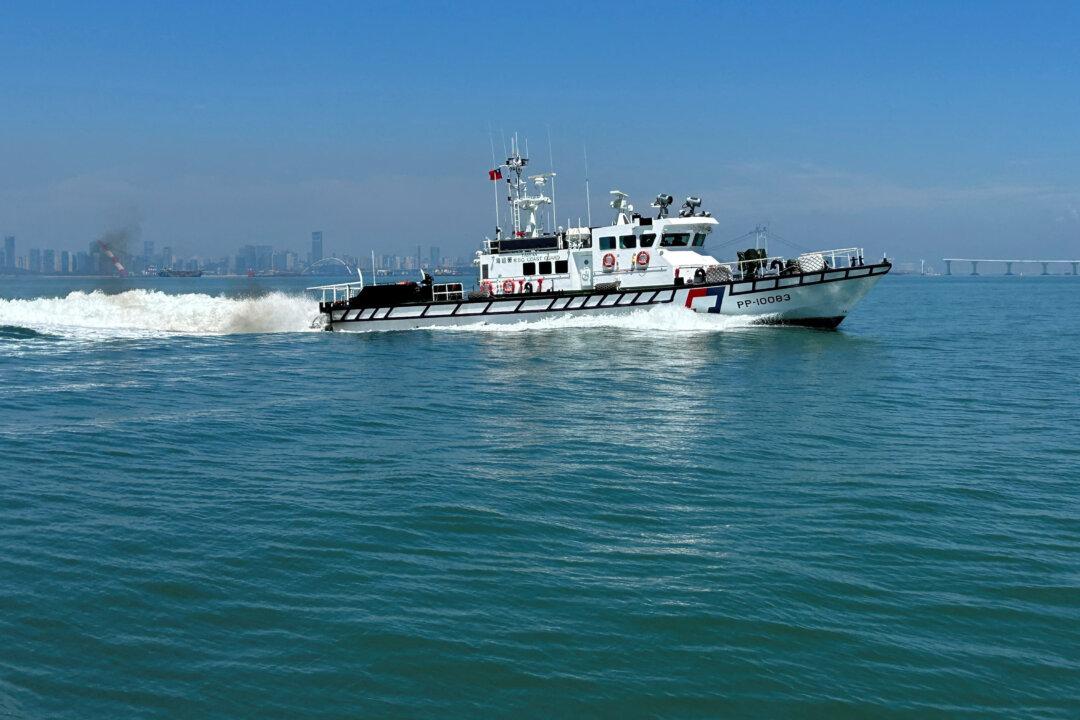
The Chinese regime’s repeated incursions around Taiwan’s outlying territories are eroding Taipei’s sovereignty and inducing a public threat fatigue that could cloud future escalations, experts warn.Taiwan’s Ocean Affairs Council (OAC)—the governing body of the island’s coast guard—said it spotted four Chinese coast guard vessels on July 14 sailing into restricted southern waters around the Kinmen Islands.The Kinmen Islands is an offshore outpost that sits about four miles from China but remains under Taiwan’s control.The council said the Chinese ships exited the area at around 5 p.m. that same day after Taiwanese patrol vessels issued radio warnings demanding their immediate departure.The maneuver occurred shortly after Taiwan lifted the alert on July 12 for Typhoon Bavi, the largest storm by size to hit its territory in nearly 30 years.Despite the unstable sea conditions trailing the storm, the Chinese coast guard launched an “irrational, unprofessional, and unsafe harassment operation,” the agency said.“This not only undermines peace and stability but also exposes its underlying logic of achieving political goals by any means necessary,” it said.The OAC said the Chinese regime continues to shift its patterns of targeting Taiwan with gray-zone operations—aggressive and coercive actions that are designed to intimidate an opponent yet remain below the threshold of warfare.As of mid-July, Chinese coast guard vessels have intruded into Kinmen’s waters 24 times in 2026, it said.Taiwan is a self-governed democracy that the Chinese Communist Party (CCP) has never controlled but has vowed to annex by force.VulnerabilitiesLin Ting-hui, former deputy secretary-general at the Taiwan Society of International Law, said Beijing deliberately encroached upon Kinmen waters largely spared by Typhoon Bavi to project a facade of an uninterrupted maritime presence and assert its claimed jurisdiction.A person looks on as large waves crash against the coast as Typhoon Bavi passes off Taiwan, in Keelung, on July 11, 2026. I-Hwa Cheng/AFP via Getty Images“The move exposed its operational vulnerabilities,” Lin told The Epoch Times.“This further demonstrates that during natural disasters, the Chinese coast guard is incapable of conducting maritime rescue operations, opting instead to advance its hegemonic ambitions.”Su Tzu-yun, an assistant professor at Tamkang University’s Graduate Institute of International Affairs and Strategic Studies in Taipei, said the CCP’s latest move is part of a calculated gray-zone campaign.“Severe weather and rough seas around Taiwan’s main island complicate radar surveillance, law enforcement, and logistics for the coast guard and armed forces,” Su told The Epoch Times.“Beijing is exploiting these conditions to test how Taiwan’s military responds, mobilizes, and coordinates across agencies during a crisis.”Su said the tactic also lets the regime gain operational experience in the waters surrounding Taiwan at a lower political cost and with minimal international scrutiny.‘Threat Fatigue’ Su said Beijing’s increasingly routine incursions around Taiwan’s outlying islands are designed to sow uncertainty and wage a war of attrition against Taipei’s coast guard.In this screen grab from video released by the Taiwan Coast Guard, a member of the Taiwan Coast Guard monitors a China Coast Guard boat as it passes near the coast of Matsu islands, Taiwan, on Oct. 14, 2024. Taiwan Coast Guard via AP“While these operations may not trigger an immediate crisis, they risk inducing threat fatigue among the public,” Su said.“This could condition ordinary citizens and the media to simply tune out the persistent presence of Chinese military aircraft, naval vessels, and drones.”Su said the real danger lies in this desensitization, which could blind society to genuine warning signs if the CCP suddenly escalates its operations.“These sustained incursions will compound the manpower, equipment, and maintenance burdens on both Taiwan’s coast guard and armed forces,” Su said.“They will also erode international recognition of Taiwan’s effective jurisdiction over the waters surrounding its offshore islands.”Echoing Su’s assessment, Lin warned that Beijing is relying on creeping encroachment to steadily hollow out Taiwan’s jurisdiction.He said that the island will face even greater peril if the public fails to recognize this incremental threat early on.“Such unawareness of the regime’s true intentions risks painting Taiwan’s standard naval responses as provocative,” Lin said.“This is highly detrimental to Taiwan’s overall national cohesion.”Diplomatic Deterrence Days before the Chinese incursion, a delegation from the Inter-Parliamentary Alliance on China (IPAC)—an international coalition of lawmakers focused on countering Beijing’s malign activities—boarded a Taiwan Coast Guard patrol vessel to observe Kinmen waters on July 9, per an X post from OAC.British Member of Parliament Tom Tugendhat looks at a map on board the Taiwan Coast Guard ship PP-10081 patrolling around Taiwan’s Kinmen islands next to the Chinese coast, on July 9, 2026. Ben Blanchard/ReutersThe group called peace and stability across the Taiwan Strait vital and warned that the international community cannot ignore China’s attempts to change the cross-strait status quo, the post said.The trip marked the first time a multinational parliamentary group visited Taiwan’s frontline waters.Su said the move holds significant political weight.“Foreign lawmakers can bring their firsthand observations from Kinmen back to their own parliaments to generate policy, budgetary, and diplomatic pressure,” Su said.“This also drives up the political costs for Beijing’s future aggression.”Lin concurred.“The visiting officials should help shape policy discussions in their home countries,” he said.“The international community will gain a clearer understanding of the CCP’s coercion, prompting them to further advocate for Taiwan.”Su added that while such fact-finding trips cannot immediately halt the regime’s hostility, they foster multilateral policy coordination and provide a degree of diplomatic deterrence.“This sends a clear message to Beijing that harassing Taiwan’s outlying islands is no longer just a cross-strait issue,“ he said.“It is now a regional security concern shared by democratic nations.”

Chinas Harassment of Taiwans Frontline Outpost Numbs Public, Masking Escalation Risks: Experts
Chinas Harassment of Taiwans Frontline Outpost Numbs Public, Masking Escalation Risks: Experts








Related Articles

EuropeThe Final wakeup call
Lula wins a miracle election in Brazil. Now comes the hard part: putting the country back on the right track
Three weeks ago, Brazilian President Luiz Inácio Lula da Silva’s political obituaries...

EuropeThe Final wakeup call
US midterms: what a new Congress could and could not change for Europe
US midterm elections traditionally attract fewer voters than presidential contests. But this...

EuropeThe Final wakeup call
Political power without balance leads to the erosion of democracy, what Montesquieu can teach modern-day France
KEY TAKEAWAYS Democratic erosion does not start by doing away with elections;...


China Business & EconomyChina NewsChina Technology
China Tech Index Plunges More Than 40 Percent From July Peak
China’s technology-heavy STAR 50 index has fallen by more than 40 percent...
