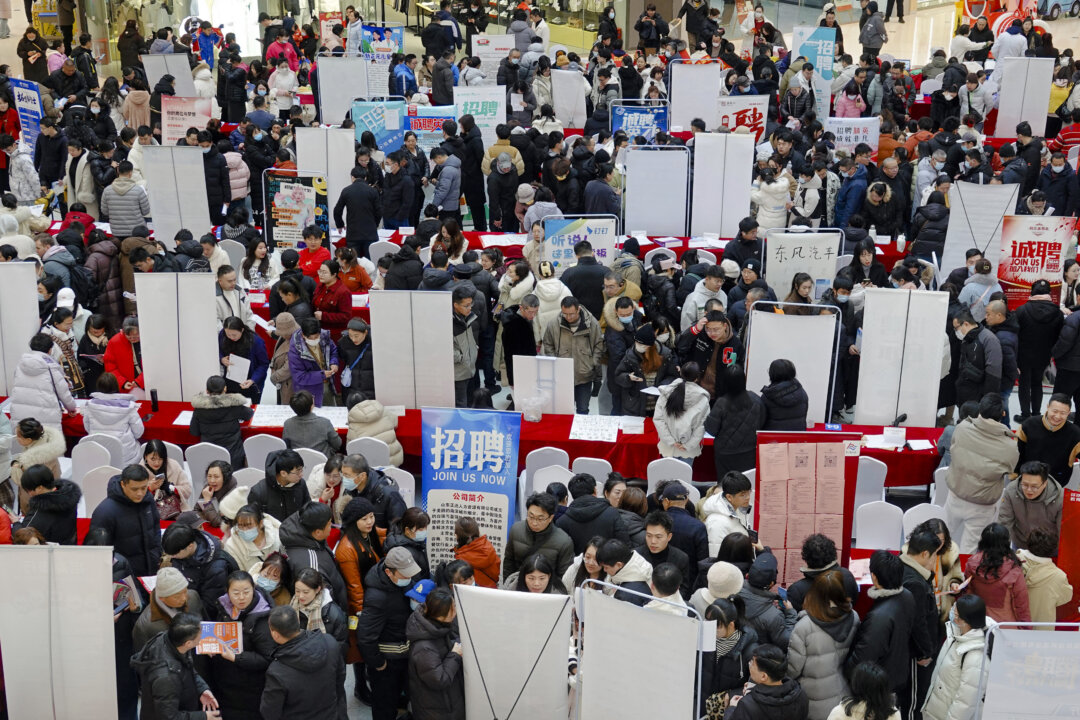
People gather at a spring job fair following a week-long Lunar New Year national holiday in Yantai, in Shandong Province, China, on Feb. 6, 2025. AFP via Getty ImagesThe Chinese communist regime hasn’t set any numeric target for urban job creation in its latest five-year plan for the first time in at least three decades amid persisting unemployment and a sluggish economy.The Chinese regime’s Ministry of Human Resources and Social Security released its “15th Five-Year Plan” on July 9, projecting that the number of new urban jobs created during the 2026–2030 period will remain at a “substantial scale” and stating that the surveyed urban unemployment rate will be kept at 5.5 percent or below.However, it didn’t set any specified target figure for new urban jobs in the national medium-term economic plan. Annual targets will be set flexibly based on each year’s conditions, the ministry said.The rare omission is the first time since the 1990s for the regime’s five-year plans.The previous five-year plan issued in 2021 set a target of creating over 55 million new urban jobs between 2021 and 2025, while aiming to keep the surveyed urban unemployment rate at or below 5.5 percent.In the 13th Five-Year Plan, officials set targets to create over 50 million new urban jobs between 2016 and 2020 and to keep the registered urban unemployment rate nationwide at or below 5 percent.In the latest Five-Year Plan, the ministry of human resources and social security mentioned artificial intelligence’s role as a new technology in employment.U.S.-based current affairs commentator Li Linyi told The Epoch Times that while the impact of AI on employment is certainly a factor—as is the case worldwide—the most significant influence is the prolonged slump in China’s economy, with actual unemployment rates far exceeding official figures.“The fact that this five-year plan sets no specific numerical targets for new urban jobs clearly reflects the authorities’ awareness of a grim reality and poor employment outlook,” he said. “This mirrors the official decision to lower the economic growth target for the year.”The Chinese regime cut its official economic growth target for 2026, setting gross domestic product growth at 4.5 to 5 percent—the lowest since 1991.In recent years amid China’s persisting sluggish economy, numerous enterprises have closed down and many full-time employees have been laid off, including white collar workers. A large number of people engage in short-term, temporary employment and sporadic work—task-based or hourly labor, such as delivery jobs and other gig work. Many migrant workers from rural areas often fail to find work on a daily basis in cities, especially those middle-aged or older. Some have chosen to sell their blood just to put food on the table.A recent report indicates that the number of people engaged in “flexible employment” in China will exceed 300 million in 2026.A delivery worker brushes his teeth on a street in Shanghai on May 12, 2022. Aly Song/ReutersThe term “flexible employment” is a term crafted by the Chinese regime amid severe and lasting unemployment issues. It primarily refers to people at the bottom of the social hierarchy who lack fixed or stable jobs.Based on China’s official number for the current employed population, which is approximately 725 million, more than 40 percent of the workforce lacks stable employment.Furthermore, 12.7 million Chinese college graduates will enter the job market this summer, competing against previously unemployed graduates, returning overseas graduates, and those who failed in their attempts at postgraduate studies or civil service exams.Tang Bing contributed to this report.

China Omits Job Goal in 5-Year Plan for First Time in Decades Amid Persistent High Unemployment
China Omits Job Goal in 5-Year Plan for First Time in Decades Amid Persistent High Unemployment









Related Articles

EuropeThe Final wakeup call
Lula wins a miracle election in Brazil. Now comes the hard part: putting the country back on the right track
Three weeks ago, Brazilian President Luiz Inácio Lula da Silva’s political obituaries...

EuropeThe Final wakeup call
US midterms: what a new Congress could and could not change for Europe
US midterm elections traditionally attract fewer voters than presidential contests. But this...

EuropeThe Final wakeup call
Political power without balance leads to the erosion of democracy, what Montesquieu can teach modern-day France
KEY TAKEAWAYS Democratic erosion does not start by doing away with elections;...


China Business & EconomyChina NewsChina Technology
China Tech Index Plunges More Than 40 Percent From July Peak
China’s technology-heavy STAR 50 index has fallen by more than 40 percent...
