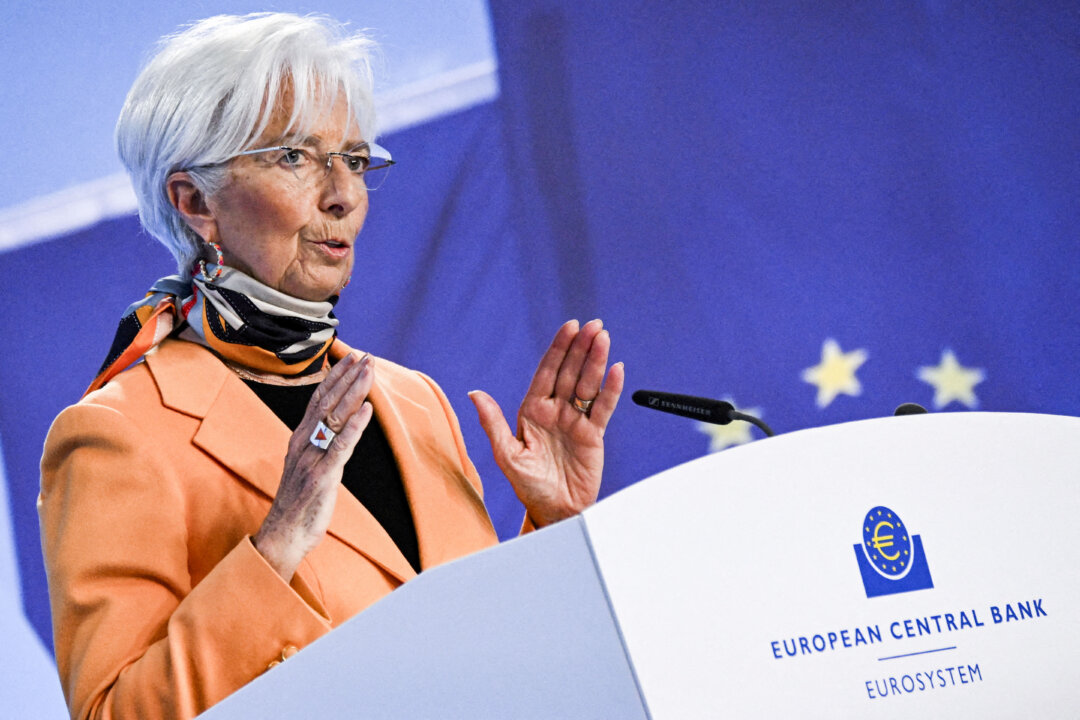
European Central Bank President Christine Lagarde speaks to the media following the Governing Council’s monthly monetary policy meeting in Frankfurt, Germany, on March 6, 2025. Jana Rodenbusch/ReutersFour in 10 leading companies in the Eurozone said that they expect employees to demand higher wages as a result of a rise in the cost of living caused by the Iran war, a European Central Bank (ECB) survey has found.The ECB quarterly survey said that wage growth is expected to slow from 3.2 percent last year to 3.0 percent this year and 2.9 percent in 2027.“Consistent with this, around 40% of contacts thought that the uptick in inflation caused by the conflict in the Middle East would result – or risked resulting in – higher wage demands,” the report, released on Oct. 30, said.This is up from 20 percent from the previous survey. However, most, “citing the subdued economic conditions and employment outlook,” said that they did not anticipate any notable impact on wage growth.These findings were gathered from 64 leading non-financial companies operating in the eurozone, between Sept. 28 and Oct. 7.The eurozone is the economic region within the EU comprising 21 of the 27 member states that use the euro currency.With its heavy reliance on energy imports—making up nearly 60 percent of its energy consumption—it has been particularly affected by disruptions to oil, gas, and other shipments through the Strait of Hormuz, a critical route that handles approximately a fifth of the world’s oil traffic.ECB Holds Interest RatesThe survey results came a day after the ECB announced it was leaving interest rates unchanged.The central bank said in an Oct. 29 statement that its Governing Council had decided to keep its three key interest rates at their current levels.The deposit facility, the main refinancing operations, and the marginal lending facility will leave their rates at 2.50 percent, 2.65 percent, and 2.90 percent, respectively.The ECB said that while the effects of the energy shock continue, so far, inflation has remained broadly stable.ECB President to Step DownHours before the ECB was due to publish its latest monetary policy decision, its president, Christine Lagarde, announced she would be stepping down in February 2027, ahead of the scheduled end of her eight-year term.In a video message posted to social media, Lagarde said she told fellow policymakers and ECB staff that she would step down following the Governing Council’s monetary policy meeting on Feb. 7.“I leave this institution with a sense of good work done and an ECB that is fit for the future,” she said.The ECB said Lagarde had informed European Council President Antonio Costa of her decision. The European Council, which comprises the heads of government of the 27 member-states, will appoint her successor through the official process set out in European Union (EU) law.Costa confirmed that the process to appoint Lagarde’s successor would begin immediately to ensure a smooth transition.Under EU rules, eurozone countries first put forward candidates to lead the ECB. After consultations with EU finance ministers, the European Parliament, and the ECB’s Governing Council, the European Council appoints the new president.The decision requires broad backing from eurozone governments; at least 16 of the 21 countries, representing 65 percent of the euro area’s population, must vote in favor.Evgenia Filimianova contributed to this report.

Major Companies in Eurozone Expecting Demands for Higher Wages Amid Surge in Cost of Living









Related Articles

EuropeThe Final wakeup call
Barcelona unrest: how to fabricate a protest in the age of TikTok
Imagine coming across a TikTok post calling you to protest for better...

EuropeThe Final wakeup call
Serbias leaderless student movement has won a historic election but what happens next?
Serbia’s leaderless anti-corruption coalition, the Student List, defeated the group led by...
EuropeThe Final wakeup call
Is France in 2026, Greece in 2009?
France’s ten-year government bond yield reached 5% last week, its highest level...


CanadaCanadian PoliticsChina NewsChinese RegimeFeatured Canadian NewsTop Canadian NewsWorld News
MP Questions Global Affairs Over Unfinished Review of Canadas China-Led Bank Membership
The logo of the Asian Infrastructure Investment Bank at its headquarters in...
