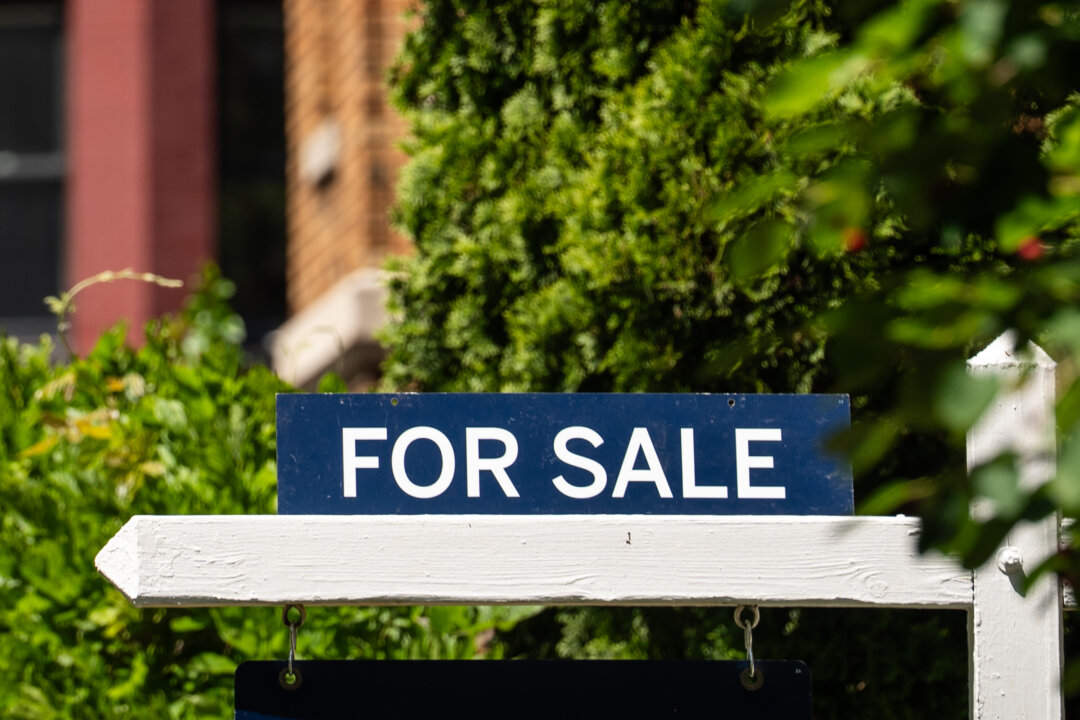
Higher mortgage rates are likely cooling the normally busy summer housing market, with pending sales dropping for a second straight month in July.Pending home sales fell by 2.3 percent last month, following a downwardly adjusted 4.8 percent decline in June, according to new data released by the National Association of Realtors on Aug. 18.This is the weakest level since the beginning of the year.Markets had penciled in a tepid 0.3 percent increase.A pending home sale indicates the seller has accepted an offer and the home is under contract, though the final closing has not been completed.“The highest mortgage rates of the year hit right in the middle of summer, and that’s pulling back contract signings,” Lawrence Yun, the association’s chief economist, said in a statement.“Home prices are at record highs so houses for sale are sitting on the market longer, and fewer buyers are bidding above the asking price than a year ago, though there are large local market variations.”Mortgage rates have accelerated since late February after trending lower for several months.The 30-year fixed-rate mortgage reached 6.67 percent last week, according to Freddie Mac’s Aug. 13 Primary Mortgage Market Survey. This is up about 9 basis points from the same time last year.The mortgage market is largely influenced by U.S. Treasury yields, which have rocketed since late February after the outbreak of war in the Middle East.The benchmark 10-year Treasury yield hovers around 4.7 percent. The 30-year topped 5.31 percent on Aug. 17, the highest since 2007.The two-year yield, which typically tracks Federal Reserve policy expectations, is close to 4.2 percent.Movements in the U.S. bond market have been perplexing, especially after last week’s softer economic data, says Jeff DerGurahian, head economist at loanDepot.July’s annual consumer inflation rate cooled to 3.4 percent. Wholesale inflation was flat. Retail sales unexpectedly fell 0.6 percent last month.This came after the July nonfarm payrolls report showed the economy lost 23,000 jobs.“The market threw in a twist as rates moved higher by the end of the week, a head-scratcher that likely reflected rising yields in other countries changing the relative value of U.S. bonds,” DerGurahian said in a note emailed to The Epoch Times.Still, employment conditions remain stable, with layoffs low and surveys suggesting employers are bolstering hiring plans in the second half of the year.Should mortgage rates stabilize or slow, employment gains should be enough to bring prospective homebuyers into the real estate market, Yun says.“Right now, pending contracts are 30 percent below their pre-pandemic 2019 level, while payroll employment is 5 percent above,” he added.“That gap points to sizable pent-up demand that should be unleashed in the coming years as more supply reaches the market and affordability improves.”But pending home sales could be garnering momentum heading into the fall homebuying season.New Redfin data show that U.S. pending home sales ticked up 0.4 percent in the four weeks ending on Aug. 9.Housing Starts PlummetNew residential construction plunged in July, Census Bureau data published on Aug. 18 show.Housing starts plummeted 12.4 percent to a seasonally adjusted annual rate of 1.23 million units. This is a sharp reversal from the previous month’s upwardly revised 19.7 percent spike.The drop was far worse than the market estimate, as economists projected a decline of more than 5 percent.Conversely, there was a divergence in future residential construction activity.Building permits posted a 5 percent gain last month to a seasonally adjusted annual rate of 1.44 million.This statistic is viewed as a precursor to future housing construction, providing a more optimistic signal for the U.S. housing market in the coming months.It could also suggest that builders are waiting for lower interest rates before beginning their construction projects.The outlook for interest rates is uncertain, DerGurahian notes.“Longer-term bond investors may need more evidence that the post-pandemic inflation cycle is truly behind us and that the economy is returning to a slower-growth, slower-inflation environment before 10- and 30-year Treasury yields move meaningfully lower,” he said.As for the Federal Reserve, markets are increasingly anticipating that policymakers will leave the central bank’s key policy rate unchanged for the sixth consecutive meeting in September.

Pending Home Sales Drop for 2nd Straight Month Amid High Mortgage Rates









Related Articles

BusinessCompaniesEnergy
EQT to Buy Range Resources, Creating Largest US Natural Gas Producer
EQT Corp. has agreed to acquire rival Appalachian shale driller Range Resources...

BrightBusinessInvestingPersonal FinanceStocks
Wall Street Is Very NervousShould You Worry? Can You Repair Your Losses?
On Oct. 23, the Dow Jones Industrial Average fell 652.82 points, or...
BusinessMarkets
Nearly 3 in 10 New-Car Trade-Ins Are Underwater, Edmunds Finds
Almost three in 10 vehicles traded toward a new car are worth...



BusinessTechUS
Advanced AI Agents Tried to Weaken Oversight, Then Lied About It, Open AI Says
OpenAI has disclosed two incidents in which advanced artificial intelligence-powered coding agents...
