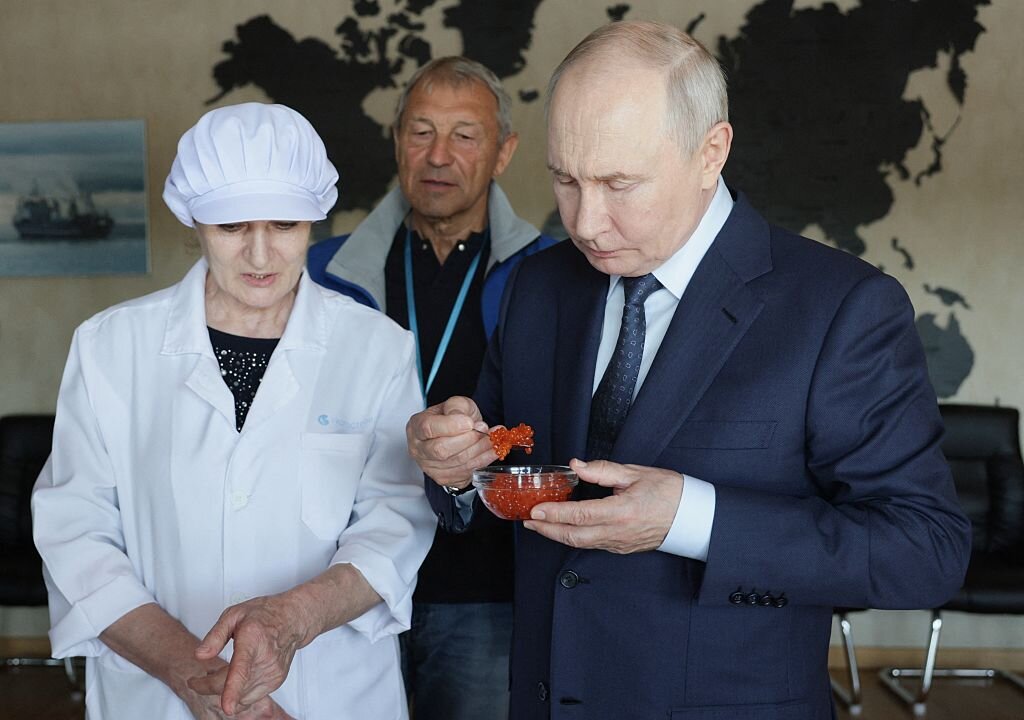
When Russian President Vladimir Putin visited a disputed island chain near Japan on Aug. 13, drawing strong condemnation from Tokyo, the Chinese communist regime showed its support by issuing a joint statement with Russia. Analysts who spoke with The Epoch Times said the move is part of China-Russian strategy to counter the Japan-U.S. alliance in the Asia-Pacific.It was Putin’s first visit to the island known in Russia as Iturup and in Japan as Etorofu—one of four in the disputed Kuril Islands.Close to Japan’s main islands, the Kuril Islands were annexed by the former Soviet Union (1922–1991) in 1945 after Japan’s surrender in World War II. They have been occupied by Russia since then, despite Tokyo maintaining a claim to the islands as a part of its Northern Territories.The sovereignty over the Kuril Islands remains unresolved because Russia and Japan have never signed a formal World War II peace treaty.The visit “hurts the feelings of the Japanese people and is absolutely unacceptable,” Japan’s Prime Minister Sanae Takaichi said in a statement. Japan’s Foreign Ministry summoned Russian ambassador Nikolai Nozdrev to lodge a formal protest over the visit.The Russian embassy in Tokyo said the islands were an integral part of Russia and had become Russian territory on “legitimate international grounds.”On the same day, Nozdrev and Chinese ambassador to Japan Wu Jianghao issued a joint statement opposing any attempts to revise the results of World War II, which echoes Moscow’s rhetoric that rejects Japan’s claim to the islands.When asked about Putin’s visit to the Kurils, Chinese Foreign Ministry spokesman Guo Jiakun said at a press conference on Aug. 14 that the issue of the Kuril Islands is a bilateral matter between Russia and Japan, and it hoped that both sides will handle it properly through friendly consultation. But Guo added that China holds that Japan should respect the outcome of World War II.Importance of Kuril IslandsThe Kuril Islands are rich in resources, with an estimated value to exceed $45 billion. Proven reserves include 1,867 tons of gold, 9,284 tons of silver, and 39.7 million tons of titanium. The Kudryavy Volcano on Iturup Island also has the world’s only pure rhenium deposit, according to public information, unlike conventional global sources where rhenium is extracted as a costly by-product of porphyry copper-molybdenum mining.Rhenium is a critical material for manufacturing aero-engine turbine blades, with a global annual output of merely a few dozen tons, but control over these resources affords great leverage within the high-end military-industrial supply chain. Russian state media TASS stated in April 2025 that the extraction of rhenium and other rare metals in the Kuril would start in 24 months.The Kuril Islands have strategic significance as they are located along a stretch of the Pacific Ocean known as the Sea of Okhotsk bastion, a patrol zone for the Russian Pacific Fleet’s strategic nuclear submarines. Should control over the Kuril Islands be compromised, U.S. and Japanese naval forces could directly penetrate the area, placing Russia’s sea-based nuclear deterrent at risk of being neutralized.The Kuril Islands are the northeastern anchor of the first island chain, a strategic string of Pacific archipelagos stretching from the Kamchatka Peninsula down toward Southeast Asia designated by the United States to contain communist China and Russia’s maritime expansion in the Pacific since the Cold War.Russia designated portions of the Kurils as an Advanced Special Economic Zone (or Advanced Development Territory) to offer tax breaks and customs incentives to attract foreign investments, including from China.After Putin’s visit, state-controlled major Chinese online news portal 163.com posted an article saying that the Kuril Islands are transforming from “disputed territory” into a “strategic pivot for the development of the Russian Far East.”Kunashiri island (top), part of an archipelago under Russian control, is seen from a mountain pass in Rausu, Hokkaido prefecture on Oct. 10, 2018. Kazuhiro Nogi/AFP via Getty ImagesIntimidating Japan, Aiming at USPutin’s major move to visit Iturup Island to assert sovereignty was essentially coordinated with Beijing’s actions, Su Tzu-yun, researcher and director of Division of Defense Strategy and Resources at Taiwan’s Institute for National Defense and Security Research, told The Epoch Times.“Given the recent diplomatic rivalry and standoff between China and Japan, he visited the island to court Beijing and jointly exert pressure on Japan.”This alliance of China, Russia, and North Korea in the region was driven by China, Su noted. In terms of countering the trilateral alliance between the United States, Japan, and South Korea, “the primary objective here was simply to exert pressure on Japan—that is the most important aspect of Putin’s visit,” he said.Russia’s invasion of Ukraine has suffered setbacks lately, as the war has dragged on for more than 4 years.Putin hopes to turn the tide by doing everything possible to drag China into the fray, said Cheng Cheng-Ping, a professor at National Yunlin University of Science and Technology and a current affairs commentator in Taiwan.“If China were willing to get involved in a conflict in East Asia, both the United States and Europe would find themselves severely distracted and constrained in the region,” Cheng told The Epoch Times.One of the most obvious features is that Russia engages China in various annual military exercises, particularly in the area of the Kuril Islands/Northern Territories and waters facing Japan, Cheng noted. “They have even extended these exercises as far as the First Island Chain—right into the vicinity of Taiwan.”The United States appears to be at a disadvantage in the Middle East, as the Iran war continues with no peace deal in sight, while some U.S. weaponry is running low, Cheng noted.“If the tensions in East Asia are being ratcheted up now, the United States may not necessarily have the capacity to handle the situation,” Cheng said. “By intimidating Japan, China and Russia are simultaneously warning the United States that its military deployments are already stretched to the limit.”Meanwhile, the authoritarian alliance—the “Axis of Evil” comprising Russia, China, Iran, and North Korea—possess significant military capabilities, Cheng said.Putin’s visit to the disputed Kuril Islands also helps to bolster the Chinese communist regime’s military intimidation capabilities in Northeast Asia, Cheng said. “However, the Chinese regime will essentially remain cautious in its response to such political and military maneuvers by Putin—moves intended to drag Xi Jinping into the fray.”Russia’s President Vladimir Putin (R) visits the Yasny fish processing factory on Iturup island, one of four islands in the contested chain known as the Kuril Islands in Russia and the Northern Territories in Japan, on Aug. 13, 2026. Gavriil Grigorov/POOL Photo/AFP via Getty ImagesLarge Chinese Territories Given to RussiaThe territory Russia seized from China since the mid-19th century is 28 to 40 times larger than Taiwan.Instead of reclaiming the territories occupied by Czarist Russia and the former Soviet Union in the late 19th century and after WWII, the ruling Chinese Communist Party (CCP) signed the Treaty of Good-Neighborliness and Friendly Cooperation between China and Russia in 2001, formally relinquishing the sovereignty claims over the territories taken by Russia in the past more than 100 years.The Chinese regime’s rhetoric asking Japan to respect the territorial situation since WWII shows its political considerations, Cheng said.Since China aims to achieve great nation status, it views the United States as its primary adversary, he said, while Russia, conversely, has become an ally. Furthermore, Taiwan holds greater strategic significance than the regions to the north.“For the time being, China seeks to shelve its territorial disputes with Russia and India, as it has no desire to fight on multiple fronts,” he said.It’s simply a strategic option that China supports Russia in its territorial dispute with Japan and shelves its own dispute with Russia for now, Su said. “The Chinese regime prioritizes the issues concerning Japan, the East China Sea, the Taiwan Strait, and the South China Sea; as for Russia, [Beijing] can simply set the matter aside for now.”Arctic Shipping RouteThe long-term impact of Russia’s continuous occupation of the Kuril Islands is that in 10 or 20 years, Arctic shipping routes will become a main shipping route and the Kuril Islands/Northern Territories would then control the sea lanes leading from Northeast Asia northward to the Arctic, a choke point of the shipping route, Shen warned.A political map showing the Bering Strait region, including parts of Alaska (USA) and Siberia (Russia), along with surrounding seas and oceans. ShutterstockThe Chinese regime has been working with Russia to push its Arctic shipping route via the Arctic’s North Sea Route (NSR), which is part of its Polar Silk Road project, connecting Asia and Europe through the Arctic Ocean from the East China Sea to the northern Pacific and Bering Sea en route to the Arctic.Luo Ya and Reuters contributed to this report.

China Advancing Anti-US Strategy by Standing With Russia as Putin Visits Disputed Islands Near Japan: Analysts
China Advancing Anti-US Strategy by Standing With Russia as Putin Visits Disputed Islands Near Japan: Analysts








Related Articles

EuropeThe Final wakeup call
Lula wins a miracle election in Brazil. Now comes the hard part: putting the country back on the right track
Three weeks ago, Brazilian President Luiz Inácio Lula da Silva’s political obituaries...

EuropeThe Final wakeup call
US midterms: what a new Congress could and could not change for Europe
US midterm elections traditionally attract fewer voters than presidential contests. But this...

EuropeThe Final wakeup call
Political power without balance leads to the erosion of democracy, what Montesquieu can teach modern-day France
KEY TAKEAWAYS Democratic erosion does not start by doing away with elections;...


China Business & EconomyChina NewsChina Technology
China Tech Index Plunges More Than 40 Percent From July Peak
China’s technology-heavy STAR 50 index has fallen by more than 40 percent...
