
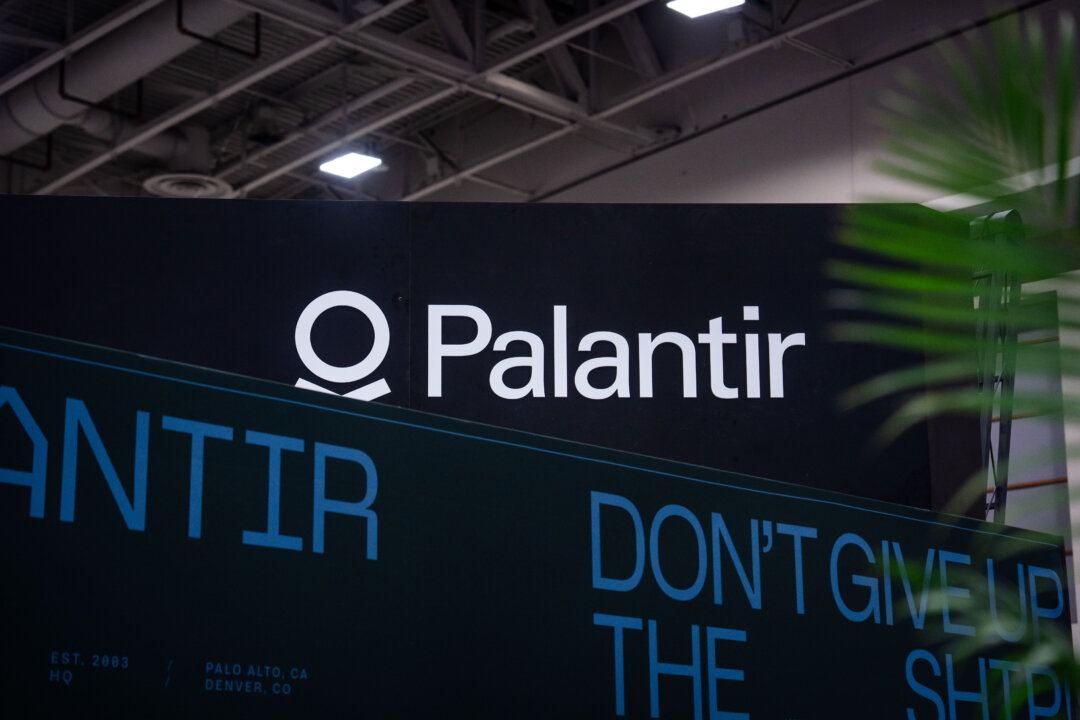
Palantir reported record quarterly revenue and profit, driven by strong demand for its artificial intelligence software from U.S. commercial customers.Chief executive officer Alex Karp said in an Aug. 3 shareholder letter that second-quarter U.S. commercial revenue rose 149 percent from a year earlier to $764 million and increased 28 percent from the previous quarter.The results reflected particularly strong growth in the United States, where revenue rose 115 percent year over year to $1.6 billion.“Such an achievement would be cause for astonishment in any business; for one of our size, scale, and consequence, it is simply staggering,” Karp said.The software-maker reported second-quarter revenue of $1.9 billion, up 93 percent from a year earlier, marking the highest quarterly revenue in its two-decade history.Profit reached $1.1 billion, also a company record.Jay Woods, chief market strategist at Freedom Capital Markets, told The Epoch Times in an Aug. 4 emailed statement that before the results, investors were looking for signs that Palantir could sustain its rapid AI-driven growth to justify its premium valuation.Woods said the stock had delivered strong financial results but had struggled in recent months, with technical indicators suggesting investors remained cautious despite the company’s strong fundamentals.“It has fallen into that tricky spot where it can exceed expectations and still see the stock trade lower,” he said.Customer PrioritiesPalantir develops software used by government agencies, defense organizations, and commercial companies for data analysis, decision-making, and artificial intelligence applications.While roughly half its revenue comes from government contracts, it also serves commercial businesses in more than 40 industries. Palantir has drawn concern both domestically and abroad over its surveillance capabilities and the privacy issues they raise.The company’s expansion in Europe has faced resistance as several European governments, including in Germany and France, questioned whether the firm should play a long-term role in sensitive public-sector technology projects.Karp said the company’s performance reflected a broader shift in how organizations are approaching AI.He argued that companies increasingly want AI systems that let them retain control over their own data rather than handing sensitive data to the developers of large language models.“The demand from our partners is clear,” Karp wrote. “It is for control over data, the prompts that the models ingest, and more fundamentally, the organizational and business intelligence.”Karp said Palantir had benefited from what he described as growing customer resistance to relying exclusively on AI model developers.Palantir achieved quarterly revenue growth from commercial operations in the United States with a relatively small sales organization, according to Karp.Despite the rapid expansion, he said the business remained in its early stages.The company did not provide additional details in the shareholder letter on which industries accounted for the strongest commercial demand.AI Business ModelsBeyond the financial results, Karp used the shareholder letter to criticize what he described as business models adopted by some developers of large language models.He said Palantir seeks to generate revenue by creating measurable value for customers rather than charging based on AI usage.“We are paid, and have always aspired to be paid, as a derivative of value creation,” he wrote. “We do not get paid for clicks or tokens or chats.”Karp argued that heavy use of an AI platform does not necessarily translate into better business outcomes.He also criticized what he called the “token industrial complex,” saying some companies were attempting to capture increasing amounts of customer data and business intelligence.Accenture, a global consulting and technology services company, says tokens are the units of data processed by AI models.Every prompt, response, retrieval step, and AI agent interaction consumes tokens, making them “a factor of production” that organizations increasingly need to track, measure, and manage, it states.










USDA Unveils New Support for Ranchers to Rebuild Cattle Herds
The U.S. Department of Agriculture has unveiled a new package of measures...

How Major US Stock Indexes Fared Aug. 31
Oil prices rose and U.S. stocks fell after American forces struck Iranian...

Trump Unveils New Drug Pricing Deals With 9 Pharmaceutical Companies
President Donald Trump on Aug. 31 announced agreements with nine midsize pharmaceutical...



Delcy Rodrguez Says Venezuelas Vast Oil Reserves Must Be Turned Into Prosperity
Oil rigs are pictured in Cabimas, south of Lake Maracaibo, Zulia State,...
