
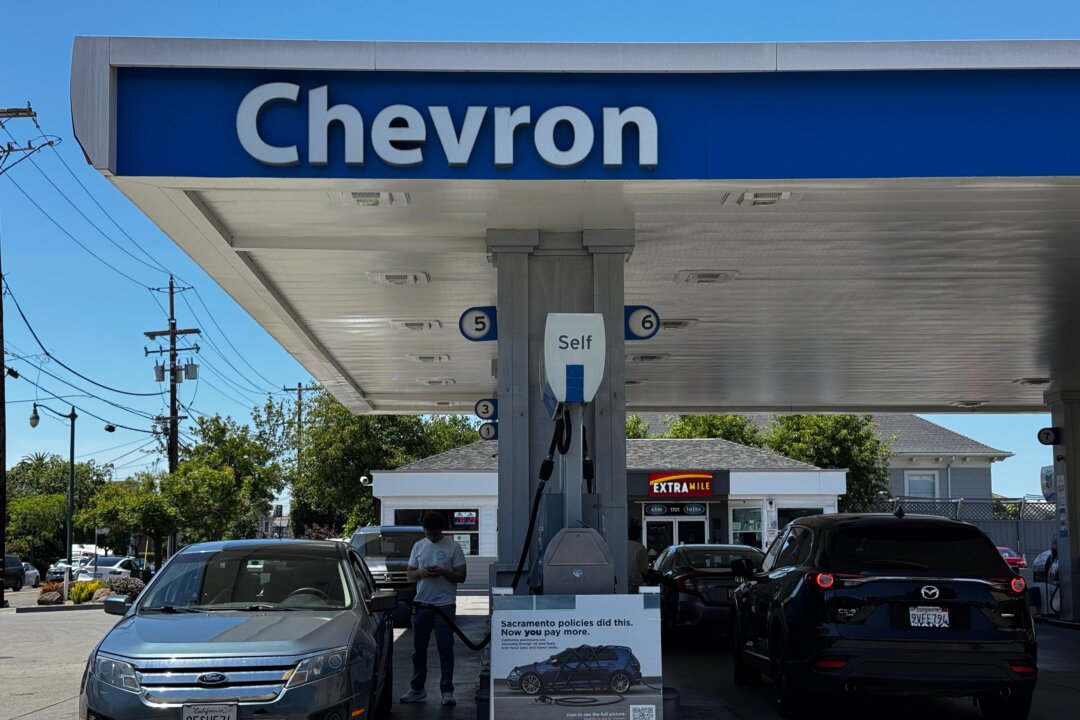
Gasoline prices in the United States continue to remain high at over $4 per gallon as the U.S.–Iran war shows no signs of easing anytime soon.The national average price for a gallon of regular gasoline was $4.10 on July 31, essentially unchanged from last week, according to data from the American Automobile Association (AAA). State-wise, regular gasoline prices exceeded $5 per gallon in three states: Hawaii, California, and Washington state. In 25 states, gas costs between $4 and $5 a gallon.“Gas prices are nearly a dollar higher than they were this time last year. Typically, August brings some relief at the pump as road trips wind down and fall routines get underway for many families. But elevated crude oil prices could prevent that seasonal shift from starting just yet,” AAA said in a July 30 statement.AAA highlighted that crude oil prices continue to remain at the $80 per barrel level as instability in the critical Strait of Hormuz lingers.The Strait of Hormuz is a shipping passageway located south of Iran through which a fifth of the global oil and gas supplies are transported. Shipping through the waterway has been disrupted due to the Iran war, contributing to rising oil prices.On Feb. 27, a day before the war’s outbreak, Brent crude oil futures closed at $72.48 per barrel. On July 31, oil was trading at $90.04 as of 7:18 a.m. ET, an increase of more than 24 percent.Both the United States and Iran have hardened their stances in recent days, causing uncertainties in oil markets.On July 29, U.S. President Donald Trump told Fox News that Iran would be hit “very hard” and that Tehran was “going to get a beating.”A day later, Iran’s Islamic Revolutionary Guard Corps (IRGC) warned through state media that nations supporting Washington in its war against Tehran would face a “harsh response.” The threat came after Iranian strikes targeting Jordan and Kuwait.The IRGC said that the Strait of Hormuz was “our territory” and that the regime’s naval forces “firmly control it,” adding that Tehran would not allow the full reopening of the waterway while the United States continued to intervene in the region.Valero gas prices are displayed in Austin, Texas, on June 16, 2026. Brandon Bell/Getty ImagesU.S. Central Command (CENTCOM) had previously disputed Iran’s claim of control over Hormuz in a July 29 statement, asserting that the IRGC has “no authority to dictate routes for free and open traffic flow.”“Since early May, CENTCOM forces have helped approximately 1,000 vessels and 500 million barrels of crude oil pass through the narrow waterway,” the command said.In a July 24 post, ING Bank said that Washington could face pressure to deescalate the war situation if Brent crude oil were to trade near $120 per barrel.“The potential supply disruptions facing the market now are larger than at any time during the war. Not only have oil flows through the Strait of Hormuz essentially dried up, but there are clear risks to Saudi oil flows from the Red Sea,” ING said.Oil tanker HELGA berthed at one of Iraq’s southern offshore oil terminals near Basra as it prepares to load crude oil, becoming the second vessel to arrive since the closure of the Strait of Hormuz, on April 24, 2026. Mohammed Aty/ReutersThe Russian government said on July 30 that it has extended a ban on the export of gasoline and diesel fuel in a bid to maintain stability in the domestic market.Russia, a key oil exporter, initially introduced the ban on diesel from July 8 to July 31 as part of a broader package of measures to support the domestic fuel market. On Thursday, the government said it was temporarily banning the export of gasoline, diesel, marine fuel, and gas oils in order to maintain stability in the domestic market.The export ban will remain in effect from Aug. 1 to Jan. 31, 2027. From Sept. 1, producers’ exports will be exempt from the restrictions on diesel, marine fuel, and gas oils, the Russian government said.Some fuel exports will still take place under intergovernmental agreements and in the form of humanitarian aid, Moscow said. The government added that it had also adopted a temporary procedure until Nov. 1 to ensure that farmers, who are now in the harvest season, get the volumes of fuel they need.A further resolution aims to ensure a stable supply of motor fuel for state and local institutions, it said.A tugboat guides a Russian oil tanker as it arrives at the oil terminal in the port of Matanzas, Cuba, on March 31, 2026. Yamil Lage/AFP via Getty ImagesThere were signs of supply recovery in the global oil market in June. Global oil supply rebounded by 4.1 million barrels per day last month, according to a July 10 report from the International Energy Agency (IEA).Global output was still roughly 9.4 million barrels per day lower than pre-war levels. If shipping volumes improve, the IEA expects oil supply to expand by an additional 7.5 million barrels per day next year.










Ohio State Agrees to $2.1 Million Federal Settlement Over Undisclosed China Research Ties
Ohio State University has agreed to pay $2.1 million to resolve federal...
USDA Unveils New Support for Ranchers to Rebuild Cattle Herds
The U.S. Department of Agriculture has unveiled a new package of measures...

How Major US Stock Indexes Fared Aug. 31
Oil prices rose and U.S. stocks fell after American forces struck Iranian...



Trump Unveils New Drug Pricing Deals With 9 Pharmaceutical Companies
President Donald Trump on Aug. 31 announced agreements with nine midsize pharmaceutical...
