The average price paid for a new car rose marginally in June as buyers shifted to affordable vehicle options amid an economically uncertain environment, according to vehicle valuation company Kelley Blue Book (KBB).In June, the average transaction price (ATP) of a new vehicle was $49,758, a 0.6 percent increase year-over-year, KBB said in a July 14 statement. Prices have remained steady, below the $50,000 level throughout this year. Buyers were found to have gravitated toward lower-priced offerings, with sales of subcompact SUVs, with an ATP of $31,113 in June, rising by over 23 percent on an annual basis.The sales of small/medium pickup trucks rose by 12.3 percent year-over-year, while the sales of full-size pickups, which tend to be more expensive, grew by a smaller 2.5 percent.Erin Keating, executive analyst at industry expert Cox Automotive, said one of the biggest shifts in the auto market is that consumers are no longer waiting for economic uncertainty to disappear to make a purchase.“After several years of inflation, high interest rates, and policy volatility, many buyers have come to view uncertainty as the new normal. If they need a vehicle, they’re moving forward and adjusting their budget and vehicle choice accordingly,” Keating said.“The strength of midsize SUVs, with sales up more than 16 percent year over year, shows that consumers are gravitating toward the center of the market where value, utility, and affordability intersect. In 2026, ‘mid’ is in.”Amid moderate new vehicle price growth in June, new vehicle sales last month rose by 7.2 percent year-over-year to hit an estimated 1.36 million units, according to a July 2 statement from Cox.Cox Automotive chief economist Jeremy Robb highlighted that automotive demand has remained resilient even with all the “economic noise.”Household wealth, rather than consumer sentiment, seems to be fueling vehicle demand, the report said. While the economy sends mixed signals, record returns in equity markets are offsetting many pressures that typically weigh down on auto demand.As long as household wealth keeps growing, the new vehicle market may remain more resilient than traditional economic indicators may suggest, the company said.This year, the S&P 500 index has risen by more than 10 percent as of July 15.EV Sales, Auto Financing IssuesComparing electric vehicles (EV) to internal combustion engine and hybrid vehicles, EV sales have taken a hit in the first quarter of 2026, according to a July 1 statement from the Alliance for Automotive Innovation.While the internal combustion vehicle market share rose by 0.5 percentage points in Q1 2026, compared to Q1 2025, and hybrid by 2.9 percentage points, the market share of EVs decreased by 3.4 percentage points during this period.In the first quarter, 154 electric vehicle models were up for sale in the United States, down from the 164 models available at the end of 2025.Meanwhile, car buyers are now taking longer-term auto loans, exposing themselves to financial risks, automotive company Edmunds said in a July 1 statement.Almost one out of every four new vehicle buyers stretched out their loan terms to a record 84 months or longer in the second quarter of the year, with monthly payments also hitting a record-high $777, Edmunds said.Jessica Caldwell, Edmunds’ head of insights, said in a statement that the extension of loan terms, shrinking down payments, and higher monthly payments suggest a risk of “long-term financial strain” to buyers.Ivan Drury, Edmunds’s director of insights, said in a statement that vehicle buyers are now mired in the dangerous practice of “focusing heavily” on their monthly payments, ignoring how this can potentially damage them financially over the long term.“Pushing loan terms past six or seven years might make an average monthly payment more digestible today, but it’s a mathematical trap. When you pair a 7.0 percent APR with an 84-month loan and a smaller down payment, you’re signing up to hand over nearly $10,000 on average in interest alone.”“Unfortunately, stretching out the term to be able to swallow a higher-priced vehicle guarantees you’ll be building equity at a snail’s pace, leaving you highly vulnerable to falling underwater when it’s time to trade in.” Going underwater means the owner will owe more money on the car’s loan than the car’s actual value.

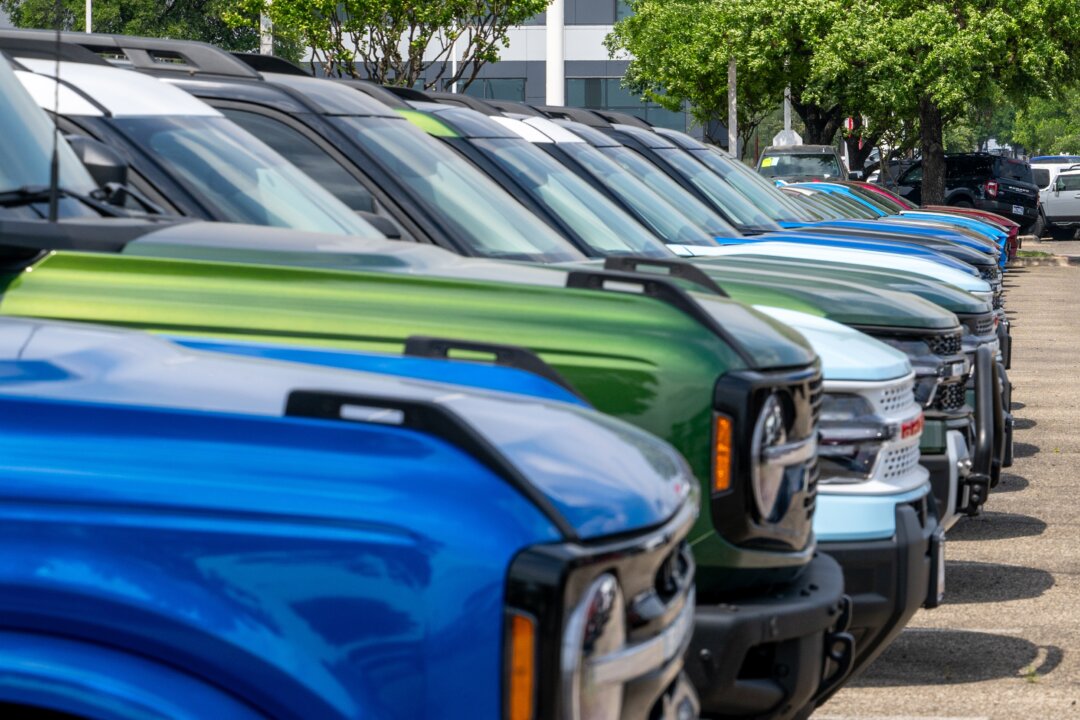
Average Price Paid for New Car Increased Modestly in June: Report









Related Articles
BusinessCompaniesEnergy
EQT to Buy Range Resources, Creating Largest US Natural Gas Producer
EQT Corp. has agreed to acquire rival Appalachian shale driller Range Resources...
BrightBusinessInvestingPersonal FinanceStocks
Wall Street Is Very NervousShould You Worry? Can You Repair Your Losses?
On Oct. 23, the Dow Jones Industrial Average fell 652.82 points, or...
BusinessMarkets
Nearly 3 in 10 New-Car Trade-Ins Are Underwater, Edmunds Finds
Almost three in 10 vehicles traded toward a new car are worth...



Asia & PacificChina NewsEuropeInternational RelationsNational SecurityPolicies & ImpactsUSUS NewsUS-China RelationsWorld News
Japan Defense Academy Chief Calls for 3 Red Lines in Competition With China
Japan’s former top uniformed military officer has called for establishing three “red...
