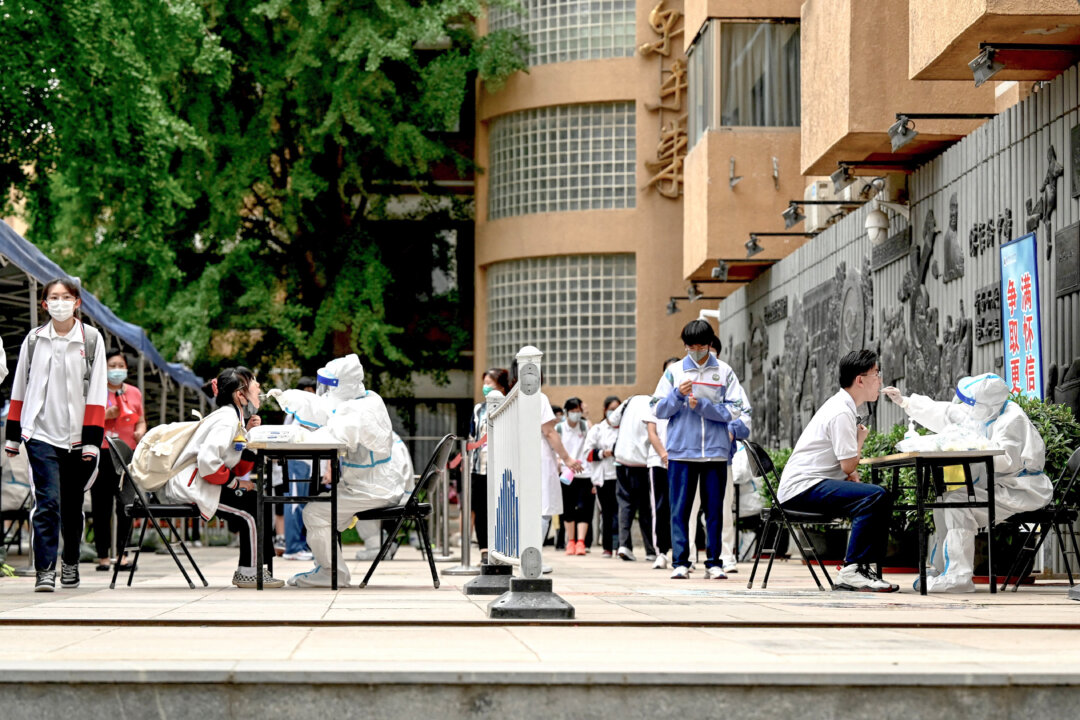
China has seen a spike in COVID-19 infections this summer, as health authorities reported 79,000 new confirmed cases in June. Experts who spoke with The Epoch Times warned about a new variant of the SARS-CoV-2 virus that is spreading in East Asia.The Chinese Center for Disease Control and Prevention (China CDC) released the report for COVID-19 infections nationwide for June on July 8. A total of 79,000 new confirmed COVID-19 cases were reported across the country. Among these, there were 130 severe cases and one death “involving underlying medical conditions and COVID-19 infection.”It’s a significant increase from the data for May, which listed 21,861 cases, including 35 severe cases and one death. China’s official data cannot be relied on as accurate, but it does reveal a new trend.All the June cases with genome sequencing, involved the SARS-CoV-2 Omicron variant, with the NB.1.8.1 lineage and its sub-lineages identified as the dominant circulating strains, according to the official report.In the official surveillance data for acute respiratory infectious diseases nationwide in Week 27 of 2026 (June 29–July 5) released on July 9, the top three pathogens that causing infections were influenza virus (11.6 percent), SARS-CoV-2 that causes COVID-19 (9.6 percent), and enterovirus (9.1 percent).The spike of reported cases in June sparked heated discussion Chinese social media.Lin Buli, a talk show host, posted on Chinese social media platform Weibo on July 12, questioning the official report that claimed only one death was related to COVID-19. “What about the resulting aftereffects, such as immune system disorders, chronic fatigue, tachycardia, heart pain, chronic cough, allergies, diabetes, kidney damage, anxiety and depression, and autonomic nervous system dysfunction?”Yixue Shouza—a prominent health influencer with nearly 2 million followers on Weibo—posted on July 12 that many people struggle to distinguish between the common cold, the flu, and COVID-19, and noted that COVID-19 is not going away and it should not be taken lightly.Meanwhile, Taiwan also saw an increase of COVID-19 infections. In the week of July 6, Taiwan reported 2,811 new cases including 17 severe ones and no deaths.Taiwanese infectious disease specialist Cheng Yuan-yu told The Epoch Times that the overall COVID-19 situation in the region is indeed on the rise.Given the population size of China and the number of reported infections, “the numbers of severe cases and deaths reported by the Chinese regime is far too low,” he said. “We cannot know for certain whether this is due to insufficient healthcare system coverage, inaccurate statistics, or the intentional concealment of the true situation.”Because of the Chinese communist regime’s record of publishing unreliable data, including its underreporting of COVID-19 infections and related deaths since early 2020, anecdotal accounts by local medical workers and residents have become helpful supplementary information for understanding the situation on the ground in the authoritarian country.Variant PQ.16.1.1Dr. Feng, a medical doctor working within China’s disease control and prevention sector who only gave his last name out of fear of reprisal, told The Epoch Times that PQ.16.1.1, a specific variant of SARS-CoV-2 that is causing infections in China now, deserves special attention.According to public information, PQ.16.1.1 is a highly mutated, rapidly spreading SARS-CoV-2 Omicron sublineage (a descendant of NB.1.8.1) that emerged in early 2026. It is primarily expanding across Southeast Asia and mainland China. The variant is characterized by key spike protein mutations.“COVID cases have quadrupled recently,” Dr. Feng said. “This particular strain is deadly because people have had multiple cumulative infections, and they’ve reached a critical tipping point.”Medical workers in protective suits attend to COVID-19 patients at the intensive care unit (ICU) of a designated hospital during the coronavirus disease (COVID-19) outbreak in Wuhan, Hubei Province, China, on Feb. 6, 2020. China Daily via ReutersOver the years, COVID-19 infections have never ceased to exist, with residents reporting repeated infections.“While the mortality rate of PQ.16.1.1 is less than 1 percent for someone who contracted COVID-19 for the first time, if someone has already had COVID-19 three or more times, a subsequent infection of this strain can lead to severe symptoms or even death,” he explained.Multiple genomic surveillance platforms are detecting several new SARS-CoV-2 lineages, including RF.5, RV.1, PQ.16.1.1, RE.1.1.5, and their related descendant lineages, Xiaoxu Sean Lin, former U.S. Army microbiologist and associate professor of biomedical science at Fei Tian College Northern Campus, told The Epoch Times.“Yet these are not receiving sufficient attention amidst declining global testing and shifting public focus. The risks posed by the virus’s continued mutation are being underestimated,” he said.The mutated variants may be evolving toward “a stronger affinity for the nervous system or gastrointestinal tissues,” Lin said. “If individuals experience sudden fatigue, unusual headaches (whether during sleep or upon waking), unexplained digestive discomfort, loss of appetite, or brief flu-like symptoms, they should seek medical evaluation and viral testing,” he suggested.Dr. Feng also warned that in mainland China, “attention needs to be paid to the following viruses right now: diphtheria (the primary concern this year), RSV, influenza, COVID-19 variants, norovirus, and measles, as well as their coinfection.”Lin said a COVID-19 infection compounded by a respiratory disease like diphtheria could lead to significant combined effects: “Damage to the respiratory epithelium makes it easier for bacterial or toxin-mediated diseases to cause severe local lesions; the compounding of inflammatory and immune responses elevates the risk of complications affecting the lungs, heart, and nervous system; and overlapping symptoms may delay the diagnosis of diphtheria.”For individuals, “the greatest danger arises from the combination of respiratory and immune stress caused by COVID and the airway obstruction, myocarditis, and neurotoxicity caused by diphtheria toxin,” Lin warned. “This situation should be treated as a potential medical emergency rather than a routine respiratory infection to be monitored at home,” he said.Luo Ya and Fang Xiao contributed to this report.

China Reported 79,000 COVID-19 Cases in June, Causing Public Concern









Related Articles

China Business & EconomyChina NewsChina Technology
China Tech Index Plunges More Than 40 Percent From July Peak
China’s technology-heavy STAR 50 index has fallen by more than 40 percent...
China Military NewsChina NewsChinese RegimeInside CCP OfficialdomSpecial TopicsZhang Youxia
Xi Opens CCP Plenum Amid Sweeping Purges, Record-Low Attendance Forecast
Chinese Communist Party leader Xi Jinping opened a four-day meeting of senior...

China Business & EconomyChina NewsChinese RegimeFinance & Business TiesInside CCP OfficialdomSpecial Topics
Chinas Economic Woes Deepen as CCP Plenum Focuses on Political Control
The Chinese Communist Party (CCP) opened a four-day leadership meeting in Beijing...



China NewsEuropeGlobalUK NewsWorld News
UK Must Be Ready for War in 1,000 Days, Says British Defense Secretary
British Defense Secretary Wes Streeting has said the country must be ready...
