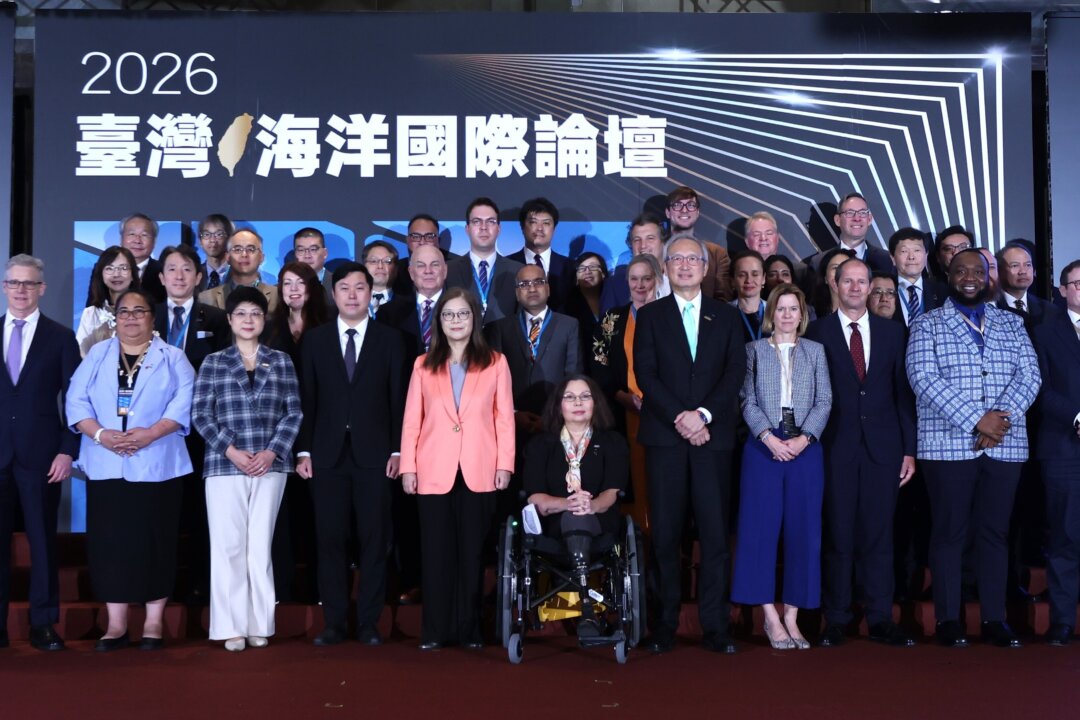
Taiwan’s ocean affairs minister urged democratic partners on July 8 to draw clearer lines against China’s gray-zone pressure, warning that Beijing is gradually changing the regional status quo without triggering open war.Ocean Affairs Council Minister Kuan Bi-ling spoke at the Taiwan International Ocean Forum in Taipei, where officials, lawmakers, and maritime-security specialists gathered to discuss resilience at sea, coast guard cooperation, undersea infrastructure, and Indo-Pacific security.Speaking during the forum’s opening session, Kuan said countries along the First Island Chain—from Japan to Taiwan to the Philippines—are facing more frequent and complex maritime pressure in different forms.Japan has long faced Chinese coast guard activity in disputed waters; Taiwan faces more frequent Chinese military and coast guard activity around the island; and Philippine vessels and coast guard personnel continue to face collisions, water cannon use, and other confrontations involving Chinese vessels, Kuan said.The cases, when viewed together, point to a similar pattern of gradual, long-term pressure below the threshold of traditional war, she said.Kuan said democratic governments often say they oppose unilateral changes to the status quo across the Taiwan Strait, but they need to ask a more precise question: What is the status quo they are trying to preserve?“If an authoritarian state does not change the status quo through a one-time military action, but pushes forward a little bit every day,” she said, “then from which day has the status quo already been changed?”Wen Lii, deputy secretary-general of Taiwan’s National Security Council, said China’s coast guard has escalated intrusive activity around Taiwan since late May “in the name of law enforcement,” including harassment of commercial vessels. He said such actions threaten freedom of navigation and commercial shipping.Taiwan, officially the Republic of China, is a self-governed democracy. Beijing claims Taiwan as part of China and has never ruled out the use of force to bring it under its control. Taiwan rejects the Chinese communist regime’s sovereignty claims.Gradual EncroachmentKuan noted expanded coast guard activity, military exercises, so-called law-enforcement inspections of commercial vessels, and interference with undersea cables or maritime order as examples of incremental pressure.The danger, she said, is that each individual action may not appear serious enough to trigger an international crisis.Each escalation may still be judged as not constituting war, she said, but the accumulated effect can create a new reality.She said shipping routes may begin to adjust, insurers and investors may recalculate risk, frontline law-enforcement personnel may come under greater pressure, and the international community may gradually become used to developments that should not be treated as normal.“In the end, we may suddenly discover that no decisive war happened on any particular day, but the original status quo no longer exists,” Kuan said.Kuan said Beijing’s pressure is not limited to the maritime domain.In a later high-level dialogue, she said China has also tried to alter Taiwan’s status in diplomatic and international organizations. She contrasted what she called the “APEC model,” referring to Asia-Pacific Economic Cooperation, in which Taiwan participates as an equal economy, with what she called the “ICAO model,” referring to the International Civil Aviation Organization, in which Taiwan is excluded or treated as subordinate under Chinese pressure.Kuan said Taiwan’s participation in forums such as the Olympics, APEC, the Asian Games, and the World Trade Organization represents a status quo built through creative arrangements. She said Beijing has misused U.N. Resolution 2758 to expand its claims in diplomatic settings and change that status quo.The pressure also extends to Taiwan’s diplomatic travel. In April, President Lai Ching-te postponed a scheduled visit to Eswatini, one of Taiwan’s diplomatic allies, after Seychelles, Mauritius, and Madagascar abruptly canceled flight permits for the president’s charter plane without prior notice or justification.Taiwan’s Presidential Office said the cancellations followed “intense pressure from the authorities in China, including economic coercion,” and said the actions jeopardized aviation safety, violated international norms, and undermined the regional status quo.Bi-Ling Kuan (C), minister of the Taiwan Ocean Affairs Council, speaks at the Taiwan International Ocean Forum in Taipei on July 8, 2026. Taiwan Ocean Affairs CouncilYellow Lines and Red LinesKuan said maritime resilience is not only about recovering after a crisis, but also about seeing a crisis forming before it breaks out.When events are spread across different waters, countries, and government agencies, democratic partners must be able to recognize the links among them, she said. When pressure has not crossed the threshold of traditional war, they must still be able to judge, coordinate, and prepare in time.Kuan called for democratic partners to build a clearer common judgment of what status quo they seek to maintain, what actions are eroding it, and where the “yellow lines” and “red lines” are in the gray zone.A yellow line, she said, does not necessarily mean a military counterstrike. A red line, she said, should not exist only after war begins.What matters, Kuan said, is whether partners can identify threats together, issue early warnings, and coordinate responses before a crisis.She called for more timely sharing of maritime-domain awareness and gray-zone incidents, as well as a gradual buildup of shared capacity for assessment, warning, and response.The ‘Pretext Cycle’Lii said China’s maritime coercion follows a repeated “pretext cycle.”An incident occurs, China uses it as a pretext to launch new patrols, military exercises, or other coercive activity, and those actions then become normalized, Lii said.He cited China’s regular coast guard patrols near Kinmen after a 2024 boat capsizing incident, as well as China’s actions near the Senkaku Islands in the East China Sea and Scarborough Shoal in the South China Sea.“Once they start the patrols, they don’t stop,” Lii said. “And they stay there for the next 20 years.”Lii said most of the actions remain below the threshold of full conflict. He described the approach as incremental, or “salami slicing.”China, he said, has focused its expansionist ambitions in the maritime domain, using law-enforcement methods in the East China Sea, South China Sea, and Taiwan Strait.Lii said Taiwan is working to strengthen military defense, maritime law enforcement, and societal resilience. He called for partners to speak out not only when China crosses military red lines, but also when it crosses “yellow lines” through incremental coercion.He said the international community should document gray-zone incursions, increase transparency, and study how commercial shipping, energy routes, and critical supplies could be disrupted even without a formal blockade.Lii said Taiwan is tracking maritime transportation resilience through what he called the “TENACITY” framework, covering commercial-vessel communication, energy resilience, coast guard coordination, maritime-domain awareness, convoy and escort planning, insurance, transshipment, and international support.Foreign Speakers Back TaiwanOther speakers echoed Taiwan’s warnings and said that China’s maritime pressure has implications beyond Taiwan.Sen. Tammy Duckworth (D-Ill.) said China is trying to establish new norms that conflict with international rules. She said other countries should continue transiting waters such as the Taiwan Strait in accordance with international law and should reject attempts by the Chinese Communist Party to impose new reporting or registration requirements.Taiwan President Lai Ching-te (C) meets with a delegation led by U.S. Sen. Tammy Duckworth on July 7. ROC Office of the PresidentTom Tugendhat, a member of the UK Parliament, said China’s pressure on Taiwan, Japan, South Korea, the Philippines, and Indonesia is part of a broader attempt to change how the world responds to Beijing.“This isn’t just about Taiwan,” Tugendhat said. “It matters to the United Kingdom.”Michael Schiffer, a partner at Scalare Advisors, said joint statements and diplomatic démarches remain important but risk losing value when they do not change Beijing’s behavior.He said Taiwan, Japan, and the Philippines need more operational specificity, not only statements of concern. Countries should define thresholds that would trigger collective responses and identify what those responses would be, he said.John R. Mills, deputy assistant secretary in the U.S. State Department’s Bureau of Cyberspace and Digital Policy, drew a link between undersea infrastructure incidents in the Baltic Sea and Taiwan’s experience with suspected cable-cutting incidents.Mills cited Taiwan’s Hong Tai 58 case as an example of how legal action can respond to damage to undersea infrastructure. In that case, Taiwan’s Coast Guard said the captain of the mainland Chinese cargo ship was sentenced to three years in prison after damage to the Tai-Peng No. 3 submarine cable.Kuan said joint statements still have value but are no longer enough. She said more countries need to define together what actions violate international law and draw yellow and red lines so Beijing knows what the international community will not allow.The forum should not only air views, she said, but also identify gaps in cooperation and repair them.“We look forward to building on this foundation to become a more powerful democratic peace chain,” Kuan said.

Taiwan Ocean Chief Urges Partners to Draw Lines Against Chinas Gray-Zone Pressure







Related Articles
China Business & EconomyChina NewsChina Technology
China Tech Index Plunges More Than 40 Percent From July Peak
China’s technology-heavy STAR 50 index has fallen by more than 40 percent...
China Military NewsChina NewsChinese RegimeInside CCP OfficialdomSpecial TopicsZhang Youxia
Xi Opens CCP Plenum Amid Sweeping Purges, Record-Low Attendance Forecast
Chinese Communist Party leader Xi Jinping opened a four-day meeting of senior...
China Business & EconomyChina NewsChinese RegimeFinance & Business TiesInside CCP OfficialdomSpecial Topics
Chinas Economic Woes Deepen as CCP Plenum Focuses on Political Control
The Chinese Communist Party (CCP) opened a four-day leadership meeting in Beijing...



China NewsEuropeGlobalUK NewsWorld News
UK Must Be Ready for War in 1,000 Days, Says British Defense Secretary
British Defense Secretary Wes Streeting has said the country must be ready...
