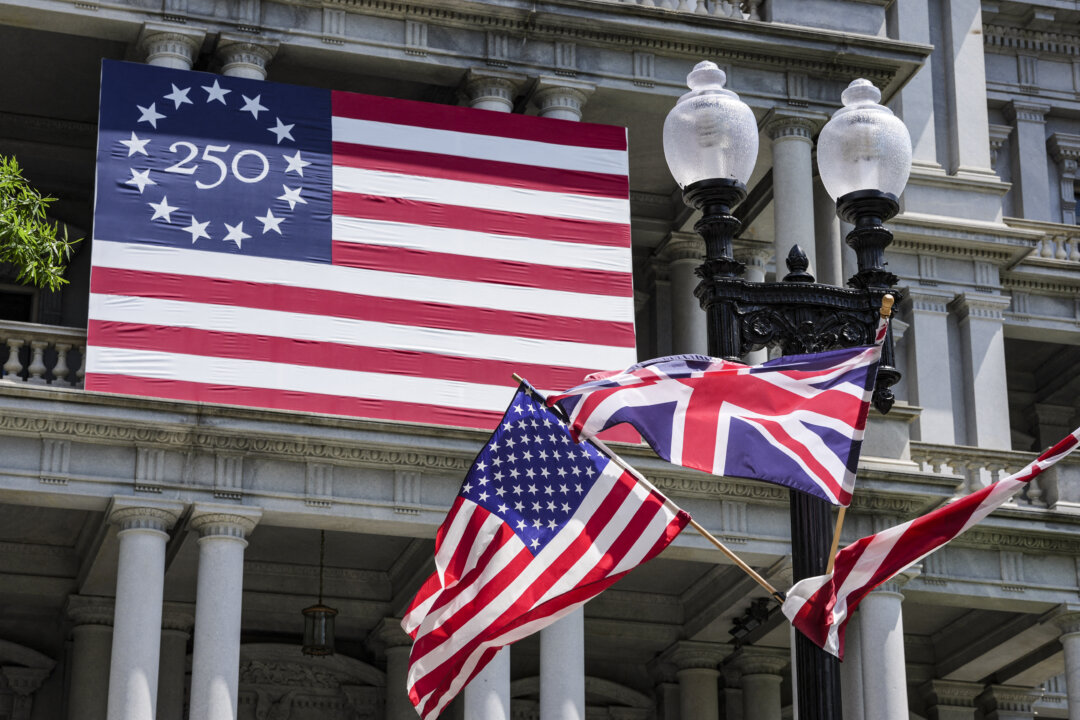
As the United States marks 250 years since declaring independence from Britain, the anniversary is being observed on both sides of the Atlantic, at a moment when some are questioning whether the “special relationship” between the two nations is fading or over altogether.On July 4, 1776, the Declaration of Independence was signed by America’s Founding Fathers, but it would take another five years before Gen. Charles Cornwallis surrendered after the British defeat at Yorktown.And it was not until the 1783 Treaty of Paris that “His Britannic majesty [King George III] acknowledge[d] the said United States … to be free sovereign and Independent States.”On America’s 250th birthday, historians are still asking whether independence was inevitable or whether Britain could have held onto its North American colonies.Eliga Gould, an expert in American history from the University of New Hampshire, who is a visiting professor at Oxford University in England, told The Epoch Times that once the first shot was fired at Lexington and Concord in Massachusetts in April 1775, it was hard to imagine a scenario where the Americans would bow down again and be willing to be the subjects of the king.“The best way to end the war would have been to end the conflict before it turned into a war,” Gould said. “Because once the fighting started, it took on a life of its own.”Gould said that in the pamphlet “Common Sense,” published in January 1776, Thomas Paine argued that once the fighting started, declaring independence was inevitable.“America is only a secondary object in the system of British politics,” Paine wrote. “England consults the good of this country no further than it answers her own purpose.”“I dread the event of a reconciliation with Britain now, as it is more than probable that it will be followed by a revolt somewhere or other, the consequences of which may be far more fatal than all the malice of Britain,” Paine wrote.Two months after Paine published “Common Sense,” an anonymous loyalist using the name Candidus responded with a pamphlet called “Plain Truth.”“Until the present unhappy period, Great Britain has afforded to all mankind the most perfect proof of her wise, lenient and magnanimous government of the Colonies, the proofs to which we already have alluded, viz. our supreme felicity and amazing increase,” Candidus—later revealed to be Maryland loyalist James Chalmers—wrote.Pro-Independence Lobby in the UKGould said British banks and industrialists later became major investors in American railroads and other booming businesses in the 19th century, and he said there was a lobby in the 1770s that believed Britain was better off if the United States became independent.“During the revolution, there are people in Britain who say, ‘Let the United States become independent, that means we don’t have to pay for their defense, but in exchange we’re going to continue to have this huge market,’” Gould said, and he added that a disproportionate share of what Britain produced and made was sold to customers in the United States, something that continued for more than 100 years after American independence.Gould added that the British government, under Lord North, was too intransigent and unwilling to negotiate with George Washington and the other Founding Fathers following the passing of the Stamp Act in 1765, which taxed the colonies.“Had there been some kind of reconciliation [earlier], let’s say parliament had stood down, the North ministry had been willing to negotiate, it’s hard to know what the [British] empire would have looked like,” Gould said.Gould said North did eventually offer terms to the Americans in the spring of 1778, when he sent a peace commission to Philadelphia in a bid to head off an alliance between the infant United States and France.Gould said London made a “huge concession” in that Britain permanently revoked its right to tax its American colonies for revenue, and offered to let the colonies elect their own governors and send representatives to the British Parliament.Reenactors dressed as British soldiers fire during a battle reenactment of the Battle of Lexington and Concord as part of Patriot’s Day celebrations in Lexington, Mass., on April 18, 2026. Joseph Prezioso/AFP via Getty Images“Another alternative was to recognize Congress as a kind of North American parliament,” Gould said.But Tony Williams, a senior fellow at the Bill of Rights Institute and co-author of “Divided Over The Declaration: How an Enduring Debate Sustains the Vision of America,” told The Epoch Times it was interesting to consider a counterfactual in which Britain retained America into the 19th century and possibly beyond.“But … once the Declaration of Independence was declared, that certainly changed a lot from the American perspective, that we are a separate nation, that we have left the British Empire,” Williams said.He said if the British had won the war, they would probably have tried and hanged the ringleaders, including those who signed the Declaration of Independence, and they would have imposed “oppressive measures.”“There was also a possibility of some kind of dominion status that the Americans might have gotten, such as Canada,” Williams said. “How long would that have endured? I just don’t know. I think probably at least a few decades.”Richard Carwardine, emeritus Rhodes professor of American History at Oxford University, told The Epoch Times, in an email, that Canada provides a clue to what might have happened if Britain had won the war.“Though of course the Canadian solution was itself shaped by the experience of losing the colonies to the south, and by the presence of many thousands of British-sympathizing loyalist refugees from the American revolutionary war,” Carwardine said.Andrew O’Shaughnessy, a professor of history at the University of Virginia, told The Epoch Times in an email that Britain could have held on to America and granted it autonomy within the empire, as it did with Canada, but the cost would have been prohibitive.“There are other scenarios in which the British kept East and West Florida (much of the later Louisiana Land Purchase),” O’Shaugnessy said. “It is possible [to] imagine a British South similar to British North America (Canada.) It would of course have been contested by the United States.”But Britain lost the war, and Williams said London expected the American republic to collapse, did not respect the United States as a great power, and sought to lock the Americans out of trade with the British Empire for decades, particularly in the West Indies and the Caribbean.This year, the 250th anniversary of the Declaration of Independence is being marked with festivities across the country, starting with a 16-day Great American State Fair, which President Donald Trump opened on June 25 on the National Mall in Washington.“With a single sheet of parchment and 56 signatures, America began the greatest political journey in human history,” Trump said of the anniversary.President Donald Trump speaks behind bulletproof glass during the kick-off celebration for the “Great American State Fair” on the National Mall in Washington on June 24, 2026. Jemal Countess/AFP via Getty ImagesThis historic moment, when the rebellious and freedom-loving American child broke away from the harsh British father, has also been marked in the United Kingdom. On June 23, a special service was held at St. Paul’s Cathedral in London to mark the 250th anniversary of American independence.The U.S. Ambassador to Britain, Warren Stephens, attended, along with several other prominent American businessmen and VIPs.Reverend Sam Wells, vicar of St Martin-in-the-Fields in central London, gave a sermon in which he explored the significance of American independence, and started by painting a picture of the political landscape in the run-up to July 4, 1776.King George Lacked ‘Wisdom’“Britain, a country deep in debt due to foreign wars, pursued a cynical ambition to extract soft money from its colonies, and its king, George III, lacked the wisdom to harness his subjects’ loyalty and seek a compromise,” he said.“What emerged was not just a new country,” said Wells. “What emerged was a philosophy—that sovereignty lay not just in might and historic authority, but in something called natural rights, which all people, being equal, could claim, and which no one could take away from them. Most memorably, these inalienable rights included life, liberty, and the pursuit of happiness.”Dame Susan Langley, the Lady Mayor of the City of London, addresses those attending a special Evensong service to mark the 250th anniversary of American independence at St. Paul’s Cathedral in London on June 22, 2026. City of London CorporationThose inalienable rights did not immediately extend to African-Americans or Native Americans, who were subjected to decades of slavery and land seizures. When the American Civil War broke out, Britain even flirted with backing the Confederacy, such was the need for southern-grown cotton for the textile mills of Manchester and other towns in northern England.“Officially, Britain remained neutral, but there is quite a lot of blockade-running, and southern slave-grown cotton became hugely important,” Gould said. “The mills of Lancashire and Yorkshire [were] heavily dependent on slave-grown cotton from the American South.”English Churches Opposed ConfederacyBut he said there were strong evangelical churches in many of those English mill towns that were anti-slavery.“It’s actually a fascinating moment in British history, where they stand by the British government’s decision not to intervene, because to intervene would have been to prolong the life of slavery, and Abraham Lincoln’s Emancipation Proclamation is hugely important in this regard,” Gould said.“Once this becomes a war to abolish slavery, the mill hands of Yorkshire and Lancashire are on the side of Lincoln’s war to save the union,” he said.Wells told The Epoch Times that it was important to bear in mind that many Americans are descended from Scottish and Irish immigrants who hated the English establishment and brought with them an “abrasive, go-getting, don’t-tell-me-what-to-do attitude” which still resonates in political discourse in the United States today.He said that the unwillingness to bow down to authority was now part of America’s DNA.The U.S. Ambassador to Britain, Warren Stephens (C-L) and Dame Susan Langley, the Lady Mayor of the City of London (C-R) at a ceremony to mark the 250th anniversary of American independence in St. Paul’s Cathedral in London on June 23, 2026. City of London CorporationWith the arrival of the 20th century, the United States was threatening to overtake Britain as the world’s biggest economy, but Gould said the tipping point was the two world wars.“Pound sterling is still the international currency of account, that’s what international transactions are conducted using,” Gould said, referring to the years before 1914. “It’s still the currency of account during the First World War. By the end of the Second [World War], it’s been replaced by the dollar.”President Donald Trump (L) shakes the hand of King Charles III after speaking during the ceremonial welcome on the South Lawn of the White House in Washington on April 28, 2026. Aaron Chown/Pool/Getty ImagesIn 1956, Britain realized its fading power when, during the Suez Crisis, President Dwight D. Eisenhower wrote to the British prime minister telling him to end the fighting and negotiate with Egyptian leader Gamal Abdel Nasser.In March 2026, The Times of London, in an editorial, said the so-called “special relationship” between Britain and the United States was over, while Daily Telegraph assistant editor Phillip Johnston wrote last year that it had ended decades ago.Carwardine agrees that the special relationship is over.“There are continuing cultural legacies and bonds, but under the current U.S. administration, that’s all,” Carwardine said.O’Shaughnessy said the Trump administration had certainly been hostile to the current British government, under Keir Starmer.“Nevertheless, both the president and his cabinet have often shown a fascination with Britain and especially the Royal Family that surpasses the administrations of Obama and Clinton,” O’Shaughnessy said.Gould argues reports of the special relationship’s demise are premature.“The two governments share intelligence at a level they do with no one else,” he said. “It’s also a cultural thing. It’s alive and well in a sentimental way.”Two hundred and fifty years after American independence, Gould said the relationship has evolved rather than ended, thanks to shared history, cultural ties, and common values.

On Americas 250th Birthday, the Special Relationship With Britain Is Under Scrutiny








Related Articles

EuropeThe Final wakeup call
Lula wins a miracle election in Brazil. Now comes the hard part: putting the country back on the right track
Three weeks ago, Brazilian President Luiz Inácio Lula da Silva’s political obituaries...
EuropeThe Final wakeup call
US midterms: what a new Congress could and could not change for Europe
US midterm elections traditionally attract fewer voters than presidential contests. But this...

EuropeThe Final wakeup call
Political power without balance leads to the erosion of democracy, what Montesquieu can teach modern-day France
KEY TAKEAWAYS Democratic erosion does not start by doing away with elections;...


China NewsEuropeGlobalUK NewsWorld News
UK Must Be Ready for War in 1,000 Days, Says British Defense Secretary
British Defense Secretary Wes Streeting has said the country must be ready...
