How the Epstein Scandal Points to The Real Hierarchy of Power By Kevork Almassian | Substack.com/@KevorkAlmassian When I read the latest batch of Epstein emails, I had the strange feeling that the story was getting bigger—not in the sensational sense, but in the serious sense that it starts pushing you toward questions normally considered too heavy for polite conversation: who really rules, who owns the money, who sets the limits of what is possible, and why the world often feels like it is being managed from above while the rest of us are simply reacting from below. I want to start this op-ed with a disclaimer. In today’s environment, people either want you to speak with religious certainty or they want you to shut up. I reject both demands. I’m going to be careful with my words, I’m going to raise controversial ideas, and I’m going to tell you openly that some of what I’m about to say is speculation—not to hide behind a hedge, but because anyone who speaks about these networks honestly must admit where the evidence ends and where interpretation begins. For years, you’ve heard people say, “We’re ruled by satanic cults.” I have always been skeptical of that framing—not because I think the world is morally pure, but because I don’t accept extreme claims without proof. However, what I have long argued—well before these documents—is that the people who dictate foreign policy, start wars, impose starvation sanctions, and can look at the suffering of millions and call it “strategy,” must share a certain psychological profile. Normal human beings do not casually destroy entire societies and then sleep well at night. If you think that’s an exaggeration, look at how sanctions operate as a weapon. In the United States, most people have food on the table. Yes, there is poverty and injustice in America. But families outside America often cannot afford bread for their children or milk for a newborn baby. The Western public is trained to believe this is always the result of local corruption or mismanagement. Yet anyone following my work on Syria knows that U.S.-led unilateral coercive measures—illegal economic sanctions—are employed as a tool of war, designed to break societies until they submit. Syria is the clearest example. The record is not even disputed. After Donald Trump’s sanctions—especially the Caesar Act—Syrians were pushed under the poverty line on a mass scale. We are talking about millions of people who watched their currency collapse, their purchasing power evaporate, and their society suffocate economically, even after the major battles quieted down. Here is where the Epstein emails begin to alter perception. For years, we assumed that decisions were made by visible institutions: the White House, Congress, the Senate, the Department of Defense, the Department of Justice, the intelligence agencies. Perhaps they are—partly. But these leaks invite us to consider that even those institutions may not sit at the top of the pyramid. Beyond presidents and politicians, beyond the faces on television, there may be stronger forces that finance, incentivize, and guide decisions—and that visible leaders sometimes act as executors rather than masters. Once you examine the relationships around Epstein—who he met, who he advised, who he had access to, who he claimed to represent—you begin to see a web: a connected network of money, ideology, and bureaucracy. The same names surface across finance, tech, academia, and politics. It becomes tempting to suspect that what we call democracy may function more like a stage—a circus of competing politicians who look like leaders but operate, in reality, as employees of a system they do not control. This is not melodrama. The implication is deeply unsettling. If power operates through networks we cannot see directly, then what is the meaning of elections, parliaments, campaign promises, televised debates, moral posturing? Are we choosing our future, or are we being offered a menu while the real chef remains hidden? The names that appear around Epstein thus become more than gossip. The point is not to worship or demonize a single family or dynasty. The internet loves turning analysis into tribal targeting. The point is to understand that banking dynasties, military-industrial interests, and elite tech projects are not separate universes. They are often intertwined. When Epstein boasted about representing major banking interests, and when one observes the proximity between Silicon Valley billionaires and networks like his, one begins to wonder whether many “visionary” projects sold to the public—transhumanism, brain chips, AI governance, digital currency systems—might be less like grassroots innovation and more like top-down projects in search of total control. Seen this way, the hierarchy itself comes into question. Maybe parliaments are not the first level of decision-making, but the fourth or fifth. Maybe prime ministers and presidents are not sovereign leaders, but third-level managers tasked with selling policy to the public. Maybe even the platform and AI elite are not the apex, but executive directors implementing projects designed elsewhere. Then we arrive at the most dangerous question of all: Do we truly live in democracies, or in managed democracies, where freedom is largely a feeling and choice largely a performance? From this perspective, parts of the modern agenda begin to look less like progress and more like a trap: digital IDs, central bank digital currencies, permanent verification, a future where transactions, movements, and interactions can be registered, controlled, possibly punished. Even public health—something that should belong to care and medicine—can become a domain of discipline and enforcement, where compliance is demanded not because debate is settled, but because dissent is deemed intolerable. People will ask: Do we have a choice? If these systems are built regardless of voter sentiment, democracy risks becoming a branding exercise rather than a governing reality. What changed for me after this recent Epstein drop is not the discovery that evil exists or that powerful people lie. What changed is that the veil feels thinner, the hierarchy clearer, and the notion of politicians as “leaders” harder to maintain. When figures responsible for catastrophic policies later reappear to promote new systems of control, they look less like statesmen and more like employees—middle managers—implementing the projects of unseen superiors. Perhaps this is the deeper geopolitical significance of the Epstein emails. Beyond depravity and scandal, they compel us to confront the possibility that the world is governed by networks more durable than governments, more influential than elections, and more insulated than any official institution will admit. I am not asking you to accept a grand theory. I am asking you to notice the pattern—and to ask whether it explains why the world feels increasingly unfree, increasingly managed, increasingly engineered, even as we are told, with straight faces, that we live in the most democratic era of human history. If this is where we are headed—toward a future of digital control layered on economic exhaustion and manufactured crises—then the most serious question is not who will win the next election, but whether ordinary people can recover enough clarity, unity, and courage to reclaim a political life that is not scripted from above. Because if we are reduced to permanent reaction—always reacting to the next war, the next crisis, the next panic—then we are not citizens. We are subjects. And perhaps that is the most mind-boggling part of all: that the Epstein story, which began as a sordid scandal, ends by forcing us to ask whether the civilization we inhabit is still what it claims to be. Kevork Almassian is a Syrian geopolitical analyst and the founder of Syriana Analysis Podcast. Originally published at substack.com/@kevorkalmassian







Related Articles
EuropeThe Final wakeup call
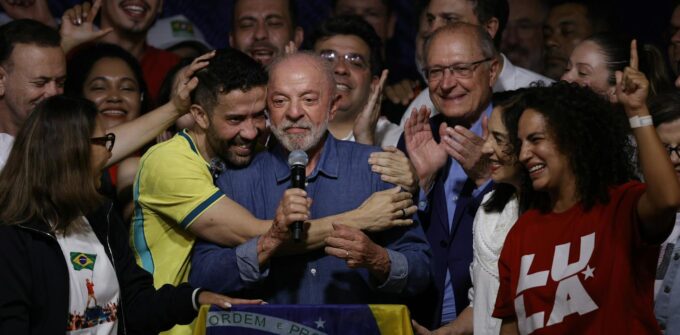
Lula wins a miracle election in Brazil. Now comes the hard part: putting the country back on the right track
Three weeks ago, Brazilian President Luiz Inácio Lula da Silva’s political obituaries...

EuropeThe Final wakeup call
US midterms: what a new Congress could and could not change for Europe
US midterm elections traditionally attract fewer voters than presidential contests. But this...
EuropeThe Final wakeup call
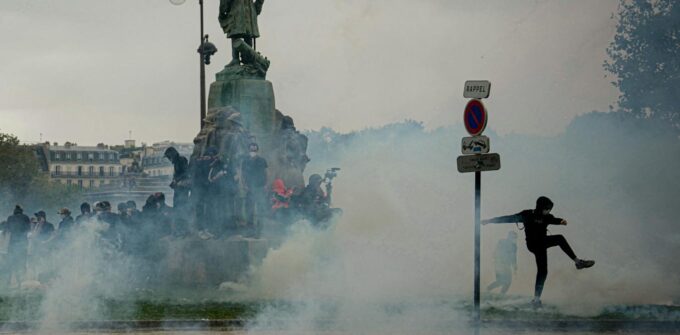
Political power without balance leads to the erosion of democracy, what Montesquieu can teach modern-day France
KEY TAKEAWAYS Democratic erosion does not start by doing away with elections;...



DruthersThe Final wakeup call
Facing the Crooked of Hormuz
By Tom Engelhardt | Substack.com/@TomEngelhardt I was born on July 20, 1944,...
