

China ‘builds the firewall because it knows very well that their ideas would not work if there were really a free exchange of ideas,’ Michael Pack said.
The Trump administration should prioritize finding a way to coordinate a strong, unified government effort to take down communist China’s internet firewall, according to Michael Pack, who led the U.S. Agency for Global Media (USAGM) during President Donald Trump’s first term.
In a recent appearance on EpochTV’s “American Thought Leaders,” Pack, who is now a documentary filmmaker and the president of Palladium Pictures, said Washington needs to allocate its resources more efficiently so it can project its soft power to counter the Chinese regime’s iron grip on the internet inside its borders.
“USAGM has a pot of money for internet firewall circumvention technology, and there are similar pots of money in other parts of the government, like the State Department and the Defense Department, but they don’t coordinate,” Pack said.
He said there should be a “big, unified budget” from these different U.S. government agencies to advance the technology to counter China’s united approach to developing its firewall.
“We should start to spend something like the money to get around the firewall that China spends on building it up,” Pack said.
“We believe here in the United States in the free exchange of ideas, and we believe our ideas would win … if people have a chance to hear them.
Related Stories

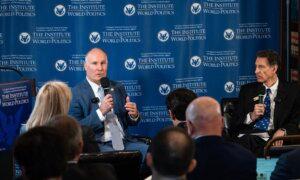
“The Chinese government builds the firewall because it knows very well that their ideas would not work if there were really a free exchange of ideas.”
The Chinese Communist Party (CCP) has built a vast censorship apparatus, officially known as the “Great Firewall of China,” to prevent its citizens from accessing certain IP addresses and domain names that it deems harmful. Consequently, people in China cannot access websites such as Facebook, Google, YouTube, and The Epoch Times.
USAGM oversees several broadcasters, including Voice of America (VOA), Radio Free Asia, and Radio Free Europe/Radio Liberty. In fiscal year 2024, the agency’s network reached a record 427 million weekly measured global audience, according to its findings.
The agency also oversees the Open Technology Fund (OTF), a nonprofit organization that funds internet freedom technologies, including those that allow internet users to circumvent online censorship.
For fiscal year 2024, USAGM received $866.9 million in federal appropriations, of which $43.5 million went to OTF, according to its report. The internet circumvention tools that OTF had supported had up to 46 million monthly active users, an increase of 400 percent from 2021, the report said.
“So we could do nothing better really than to knock that firewall down,” Pack said. “I think if the people in China had a chance to hear the range of ideas out there, it would change the country more than almost anything else.
“It’s not expensive compared to the military and all the other things we have to fund in relation to China.
“It’s a really important thing. I would like it to be given priority in the next Trump administration if I had my way, which I don’t.”
Trump has nominated Kari Lake, former Fox 10 Phoenix news anchor, as the new VOA director. Trump has also picked Brent Bozell, founder of the Media Research Center, to lead USAGM, a position that requires confirmation by the Senate.
Pack served as the CEO of USAGM from June 2020 to January 2021.
To counter censorship in China, Sens. Dan Sullivan (R-Alaska) and Jeanne Shaheen (D-N.H.), ranking member of the Senate Foreign Relations Committee, recently reintroduced the Informing a Nation with Free, Open, and Reliable Media (INFORM) Act. The legislation was first introduced in November 2024.
“Chinese citizens are subjected to extreme government censorship and as economic and social conditions deteriorate inside the People’s Republic of China, they’re seeking independent news sources and, increasingly, more freedom from the excessive control of the Chinese Communist Party (CCP),” Shaheen said in a statement on Feb. 12.
If enacted, one of the provisions would require the State Department and USAGM to further develop tools for circumventing online censorship and securing content-sharing tools for Chinese citizens.








Ohio State Agrees to $2.1 Million Federal Settlement Over Undisclosed China Research Ties
Ohio State University has agreed to pay $2.1 million to resolve federal...
Chinese Scientists Flagged Glacial Flood Danger One Year Before Nepal Catastrophe
More than a year before the catastrophic flash flood devastated the China–Nepal...
Chinas Humanoid Robot Companies Face Reality Check
China is showcasing humanoid robots as symbols of its technological ambitions. However,...


USDA Unveils New Support for Ranchers to Rebuild Cattle Herds
The U.S. Department of Agriculture has unveiled a new package of measures...
