
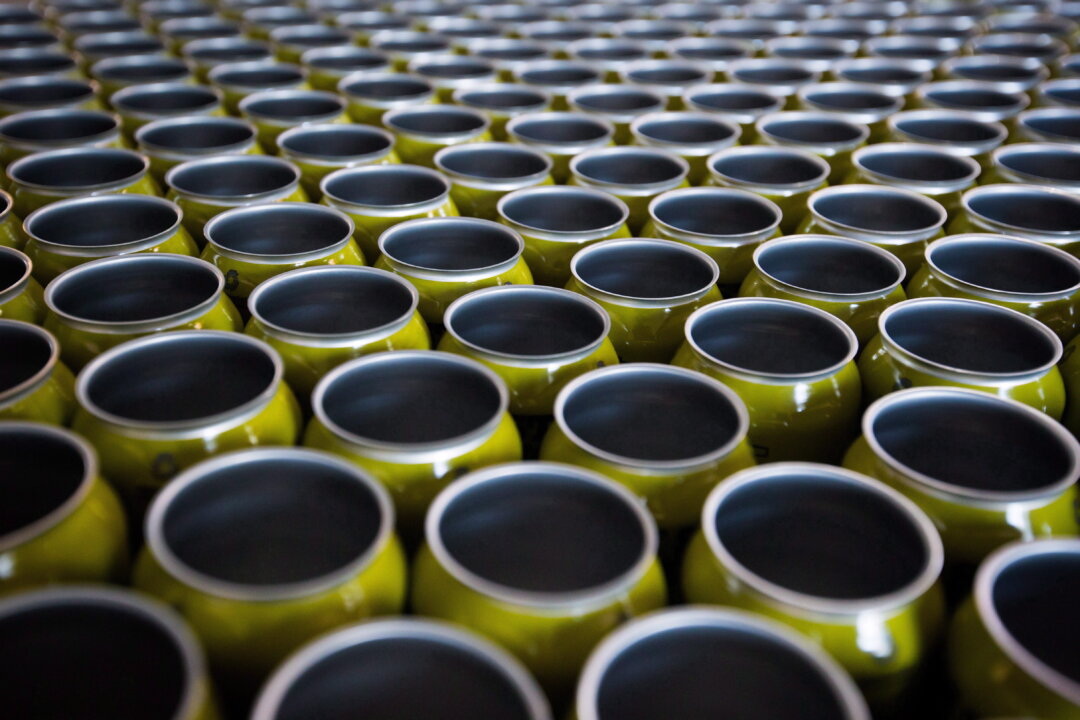
U.S. President Donald Trump’s threat to impose sweeping metals tariffs is creating worry and opportunity in can manufacturing and packaging, an industry that relies heavily on the raw materials.
The 25 percent tax on aluminum and steel coming into the United States starting March 12, and the possibility of retaliation tariffs, is expected to have cost ripples for buyers of beer, soup and everything else producers seal up in metal.
“It’s just another hit that the industry can’t take,” said CJ Hélie, president of Beer Canada.
“The magnitude and the timing, you know, couldn’t be worse.”
While almost 90 percent of beer consumed in Canada is brewed here, most of the cans are imported, including the popular 473 millilitre size popular among craft breweries, he said.
U.S. manufacturers of cans import metal from Canada—the metal makes up about 70 percent of the price of a can. Tariffs would make those imports more costly for the U.S. firms, in turn increasing the cost of those cans when they are sold back to Canadian companies.
Related Stories

If Canada imposes its own counter-tariffs, goods could be hit twice.
‘We’re still in an affordability crisis. Everybody is feeling it everywhere, and so if these tariffs and potential countermeasures by Canada come into play, brewers are going to face a very difficult decision,” said Hélie.
The industry faces aluminum tariffs that are much higher than the 10 percent imposed during Trump’s last term, and while the tax may only amount to a few cents per can, the costs for the industry will be in the hundreds of millions of dollars, said Hélie.
The potential costs are also higher because cans keep growing in popularity over glass bottles, making up 75 percent of sales in 2023, up from 53 percent in 2015, the trade association said.
The previous round of tariff threats did lead to some increased domestic production of cans, but given the costs involved and the integrated nature of the two countries’ economies it was not easy to increase capacity, said Hélie.
Erick Vachon is one of those who saw an opportunity for domestic production as supply chains have become less reliable.
He co-founded Ideal Can in 2020 and now leads what he says is the only Canadian producer of food cans while also producing a range of other can offerings across three lines, each producing about 1,000 cans a minute.
Anticipating more demand for his domestically-produced cans, Vachon is working to add another shift to increase capacity and offset a bit of the hit.
“The tariff is bad for, of course, for Canadian people,” said Vachon.
“So I need to have three shifts a week, and of course we’re looking to increase the capacity of the factory.”
But it will hardly make a dent in demand, with Ideal Can’s capacity about 400,000 a year compared with consumption of what he said is about 1.8 billion cans a year in Canada.
The total can market affected by the tariffs and countermeasures is much larger. The U.S.-based Can Manufacturers Institute said about 25 billion cans were produced for human and pet food in 2023 for the U.S. and Canada, plus some 103 billion beer and soda cans.
The trade association has urged Trump to at least exempt tin mill steel from the tariffs, as, contrary to the intent of the tariffs, American producers ended up shutting down nine mill lines after Trump last imposed the import taxes on metal.
Others are still trying to understand the implications of the tariffs, especially with Canadian countermeasures still unclear.
“We’re not very clear with directions at this point how it is going to be taxed,” said Maresh Singh, a co-owner of Canadian Canning based in Hamilton, Ont.
“There’s a lot of uncertainty about this at this point.”
The distributor has about 80 percent of its business in the U.S. and has manufacturers both there and in Canada as well as Mexico, underlining how integrated the market really is.
What he does know is that prices will go up with the tariffs.
“Certainly the products, the cost on the products, would go up for Americans. Definitely that is a fact.”
He said he hopes to have a better understanding of the implications in the days ahead, but one takeaway he already has is the need to boost supply security.
“Canada should have more production here in Canada itself, at least to safeguard Canadians versus such threats.”








Chinese Scientists Flagged Glacial Flood Danger One Year Before Nepal Catastrophe
More than a year before the catastrophic flash flood devastated the China–Nepal...

Iceland Focuses on Security Partnerships After Voters Reject Opening EU Membership Talks
Icelandic Minister for Foreign Affairs Thorgerdur Katrin Gunnarsdottir attends a press conference...
Italy, Spain Extend Tit-for-Tat Border Curbs After Ceuta Illegal Immigrant Crisis
Immigrants gather on a hill as they attempt crossing from the border...



Vaccine Maker Halts Trial on mRNA Cancer Shot
A pharmacist administers the Pfizer-BioNTech vaccine in Los Angeles, Calif., on October...
