
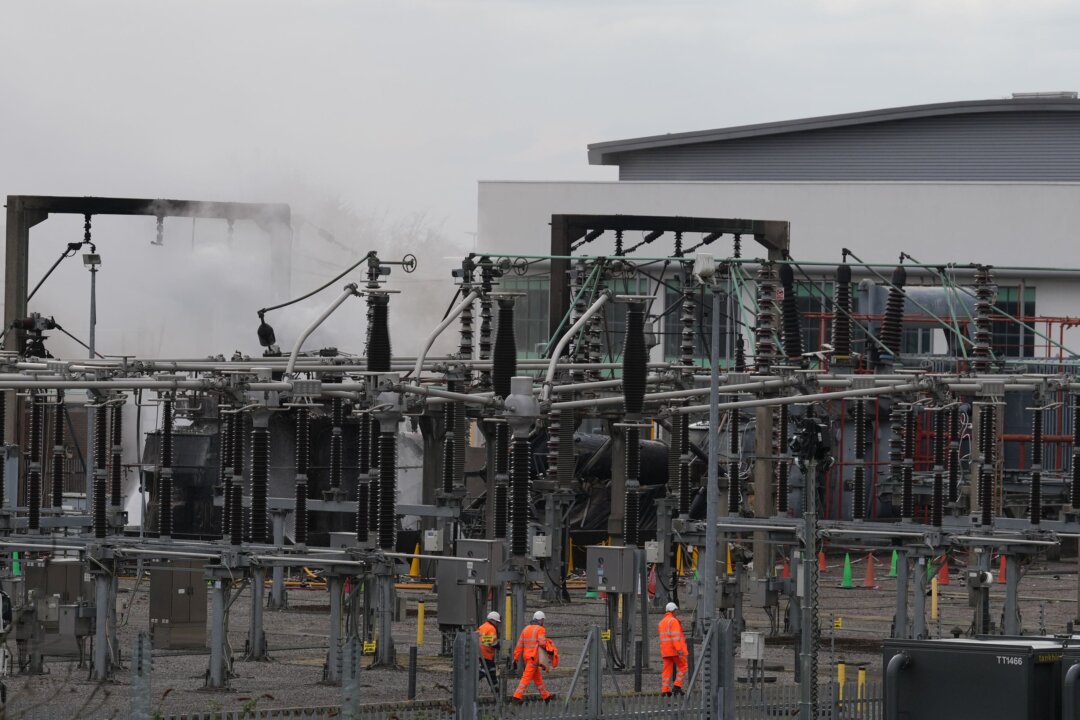
The west London airport was closed to all flights until about 6 p.m. on March 21.
Heathrow Airport was warned about its power supply in the days before it closed because of an outage, MPs were told.
Nigel Wicking, chief executive of Heathrow Airline Operators Committee, which represents airlines that use the west London airport, said there were a “couple of incidents” which made him concerned.
The airport was closed to all flights on until about 6 p.m. on March 21, after a power outage caused by a fire at a nearby electricity substation which started late the previous night.
This disrupted more than 270,000 air passenger journeys.
Wicking told the Transport Select Committee he spoke to the Team Heathrow director on March 15 about his concerns, and the chief operating officer and chief customer officer on March 19.
He said: “It was following a couple of incidents of, unfortunately, theft of wire and cable around some of the power supply that, on one of those occasions, took out the lights on the runway for a period of time.
Related Stories


“That obviously made me concerned and, as such, I raised the point I wanted to understand better the overall resilience of the airport.”
Wicking said he believed Heathrow’s Terminal 5 could have been ready to receive repatriation flights by “late morning” on the day of the closure, and that “there was opportunity also to get flights out.”
He went on: “In terms of T5, my understanding both from British Airways, but also on the day, was that pretty much everything was fine to operate by mid-morning, by 10 o’clock.”
Heathrow Chief Executive Thomas Woldbye, appearing alongside Wicking, responded: “If we had got this wrong, we might be sitting here today having a very different discussion about why people got injured, and I think it would have been a much more serious discussion.
“So there is a margin within which our people have to take very serious safety decisions, and that is what they are trained for, that is what they do, and that requires that every single system is up and running, tested, and safe.”
He told the committee: “It became quite clear we could not operate the airport safely quite early in this process, and that is why we closed the airport.
“If we had not done that, we would have had thousands of passengers stranded at the airport at high risk to personal injury, gridlocked roads around the airport, because don’t forget 65,000 houses and other institutions were powered down.
“Traffic lights didn’t work, just to give you an example, many things didn’t work. Parts of the civil infrastructure didn’t work.
“So the risk of having literally tens of thousands of people stranded at the airport, where we have would have nowhere to put them, we could not process them, would have been a disastrous scenario.”

Thomas Woldbye, chief executive of Heathrow Airport, gives evidence to the House of Commons Transport Select Committee at Portcullis House in London on April 2, 2025. PA
Woldbye told the committee the substation which caught fire was “by far the biggest” that served the airport, with a capacity of 70 megawatts.
Asked if some of the airport’s terminals could have reopened sooner, he said: “The fact that the lights were on at Terminal 5, which is entirely correct, doesn’t mean the terminal was operational.
“We didn’t have all CCTV, we didn’t have fire surveillance. The fire systems would work … but the fire surveillance systems of the airport [were] down, so we didn’t know where the systems were up and safe.
“All that had to be secured before we started operation.”
Woldbye added: “I cannot guarantee you whether T5 could have opened an hour earlier.
“We did all we could to get it open as soon as we could, because we fully understand the airlines’ concerns around getting repatriated flights, repatriated passengers, and also getting flights in there.”
Woldbye said it would cost more than £1 billion for the airport to have “full resilience” from power outages.
Asked by the committee if the estimated 10 hours it would take to re-power Heathrow sounded resilient, Woldbye said: “I think under an event like this one, which is as unlikely as has been described, that is the resilience that is in place. That is the playbook that is in place.”
Woldbye said there was “not endless, seamless switch-over for everything in the airport” and that bosses were “still at a stage where we don’t know why it happened.”

Nigel Wicking, chief executive of Heathrow Airline Operators’ Committee, gives evidence to the House of Commons Transport Select Committee at Portcullis House in London on April 2, 2025. PA
Wicking said the shutdown had cost airlines £60 million to £100 million.
He added that it was “unacceptable” the impact of a substation failure “hadn’t been shared with us” in advance.
Woldbye said the airport would need “double the amount of energy” to operate the planned third runway.
Wicking told MPs that airlines are “not sure about the foundations of Heathrow,” explaining that 82 “baggage system issues” last year meant thousands of bags were not put on aircraft as planned.
He added: “It’s the most expensive airport in the world for passenger charges, and the reality is that we don’t get good value for money as airline users and as consumers.”
Woldbye insisted Heathrow is “the most efficient airport in Europe” in terms of the number of passengers it processes per square metre.








Chinese Scientists Flagged Glacial Flood Danger One Year Before Nepal Catastrophe
More than a year before the catastrophic flash flood devastated the China–Nepal...
Iceland Focuses on Security Partnerships After Voters Reject Opening EU Membership Talks
Icelandic Minister for Foreign Affairs Thorgerdur Katrin Gunnarsdottir attends a press conference...

Italy, Spain Extend Tit-for-Tat Border Curbs After Ceuta Illegal Immigrant Crisis
Immigrants gather on a hill as they attempt crossing from the border...



Vaccine Maker Halts Trial on mRNA Cancer Shot
A pharmacist administers the Pfizer-BioNTech vaccine in Los Angeles, Calif., on October...
