Every week, Promethean Action holds a Saturday Class — a deep dive into the ideas, history, and strategic thinking that the mainstream won’t touch. We’d love for you to join us live. Sign up here and we’ll send you class details every week.A 20-year-old George Washington crashed a party he wasn’t invited to.He walked out with a poem.And that poem — memorized by ordinary colonists up and down the Atlantic seaboard — helped write the Declaration of Independence.Two weeks ago, Judy Hodgkiss demolished the schoolbook story that Jefferson’s pursuit of happiness came from John Locke. The real source was the German philosopher Gottfried Leibniz, carried into English politics by Henry St. John, Lord Bolingbroke — the disgraced Tory lord whose Idea of a Patriot King Benjamin Franklin printed for the colonies.But The Patriot King didn’t reach America until 1749. In this week’s class — Part 2 of her series drawn from her new book — Judy uncovers the earlier transmission line: Alexander Pope’s Essay on Man, the epic poem Bolingbroke personally commissioned, which hit the colonies fifteen years sooner and taught a generation of Americans to think like Leibniz before they ever heard his name. The Right to Pursue Happiness: How Leibniz and Bolingbroke Shaped America’s Founding Vision The 250th anniversary of the Declaration of Independence demands a serious reckoning with the nation’s true history. Conventional historians have told you that the Declaration’s immortal phrases—”endowed by their Creator with certain unalienable Rights…Life, Liberty and the pursuit of Happiness”—emerged from the cold calculations of a “social contract”, as in a business agreement. This book shatters that materialist narrative. Get it at Amazon and Kindle The scene that changed this week’s classJudy opens with a confession: she saw Angel Studios’ new film Young Washington on Tuesday, and it made her rip up her lesson plan.In the film, a 20-year-old Washington — a nobody, not yet a general, not even invited — slips into a party at Lord Halifax’s manor and finds his host hiding from his own guests in the library. What passes to Washington in that library is Pope’s Essay on Man.Hollywood invents plenty. But this detail is real history: the Essay on Man was one of the key transmission links carrying Leibniz’s philosophy into the colonies — and into the young man who would become the Republic’s indispensable figure. What drove Washington wasn’t the petty competitiveness we’re told defines American ambition. It was the ambition to do something new — the signature of a culture being shaped by Shakespeare revivals, Handel’s music, and Pope’s verse.“Reasons alone are not sufficient… something is needed which affects their passions and which ravishes their souls, as does music and poetry.”— LeibnizA poem addressed to a wanted manOpen the Essay on Man and the first line tells you who is behind it: “Awake, my St. John!” — Henry St. John, Lord Bolingbroke, who had fled England in 1715 with a treason charge at his back and, as he wrote, the certain knowledge that his enemies meant “to pursue me to the scaffold.”“My blood must be the cement of a new alliance… My death has been demanded from abroad.”— Bolingbroke, fleeing to France, March 1715“From abroad” meant Amsterdam — and we’ll come back to that.Nine years of exile in France turned out to be the making of him. In the salons and academies of Paris, Bolingbroke found a living network steeped in the ideas of Leibniz — privy counselor to the Electress Sophie, then heir to the English throne. When Bolingbroke returned, he set his friend Pope to work. In 1731, two years before the poem appeared, he wrote to Jonathan Swift:“Does Pope talk to you of the noble work which, at my instigation, he has begun? … He pleads the cause of God against that famous charge which atheists in all ages have brought: the supposed unequal dispensations of Providence.”— Bolingbroke to Swift, 1731Pope closes the poem the same way he opens it — to his “guide, philosopher, and friend.” The poem’s mission, in Pope’s own words: “vindicate the ways of God to man.” Today’s literary establishment manages to discuss the Essay on Man without mentioning any of this.When Bolingbroke was elevated to the peerage in 1712, his father congratulated him: “Harry, I always thought you would be hanged, but now I know you will be beheaded.”The poem every colonist knew by heartForget the image of poetry as an aristocrat’s parlor game. In the 1730s, poetry was the most popular entertainment in the colonies — recited, memorized, traded — and Pope was the most popular poet alive. When the Essay on Man arrived around 1734, its lines entered the American bloodstream:Pope wrote of rising “through Nature up to Nature’s God.” Jefferson opened the Declaration with “the laws of Nature and of Nature’s God.”Alexander Hamilton quoted the poem’s famous “poet or patriot” lines in Federalist 68 — “whatever is best administered is best” — and as a young man wrote his own poem “in humble imitation” of Pope.Jefferson told the actor John Bernard that Shakespeare and Pope gave him “the perfection of imagination and judgment, both displaying more knowledge of the human heart — the true province of poetry — than I could find elsewhere.”And Jefferson never hid the deeper debt. Asked by his grandson in 1821 for his opinion of Bolingbroke, he answered:“Lord Bolingbroke was called indeed a Tory; but his writings prove him a stronger advocate for liberty than any of his countrymen, the Whigs of the present day.”— Thomas Jefferson, 1821The best of all possible worldsWhat was the poem actually teaching? The heart of Leibniz’s philosophy: reasoned optimism. God has created the best of all possible worlds — not a world without suffering, but a world ordered toward the maximum happiness and the minimum evil of its creatures.Leibniz explained the apparent contradiction with images a farmer could grasp: you step back to gain the leverage for a leap you could never make walking steadily forward. A seed must dissolve in the soil before it produces an entirely new form of life.From that follows the revolutionary political conclusion Bolingbroke armed and Pope set to verse: if God has ordained maximum happiness, then government must — Leibniz’s word — promote the happiness of the governed. A king with a divine right to govern badly is not just a tyrant. He is a blasphemer.By 1776, the colonies had drawn the final inference: if you cannot have a Patriot King, you need no king at all.Underneath it all: the BankWhy was this poetry worth killing over? Because underneath the philosophy ran a financial war. The Whig party of John Locke was the party of the Bank of England — modeled on the Bank of Amsterdam and the Venetian oligarchy behind it. Bolingbroke’s newspaper, The Craftsman, said it plainly:“The Whigs have made a religion of Mr. Locke’s philosophy. His doctrine of money is the gospel of the Bank… Thus a private speculation becomes public oppression.”— The CraftsmanSwift was blunter still — “Damn Mr. Locke, who has made more confusion in the world by his notions of government and money than any man living.” And the man running Locke’s catastrophic recoinage as Master of the Mint was Isaac Newton — the same Newton then orchestrating the slander campaign accusing Leibniz of stealing the calculus. Economics, science, theology, culture: one fight, then as now.Next week: inside Leibniz’s worldJudy closes with a preview of Part 3: the astonishing family network of the Electress Sophie — the Leibniz-educated princesses, abbesses, and duchesses whose salons received Bolingbroke in his exile, and the Regent of France himself, who corresponded with Leibniz while befriending the fugitive English lord. Then, the deep dive into Leibniz’s philosophy itself — and what happiness really meant to the man who defined wisdom as its science.In the Republic’s 250th year, the lesson of this class is the one Pope put in a couplet the colonists knew by heart: happiness is “never to be bought, but always free.” It cannot be issued by a central bank — and it cannot be repealed by one, either.Watch the class and meet the poem that taught America to pursue happiness.—Promethean Action Editorial Staff

Saturday Class – How did Bolingbroke Bring Leibniz’ Ideas to America and into our Declaration of Independence? – July 11, 2026
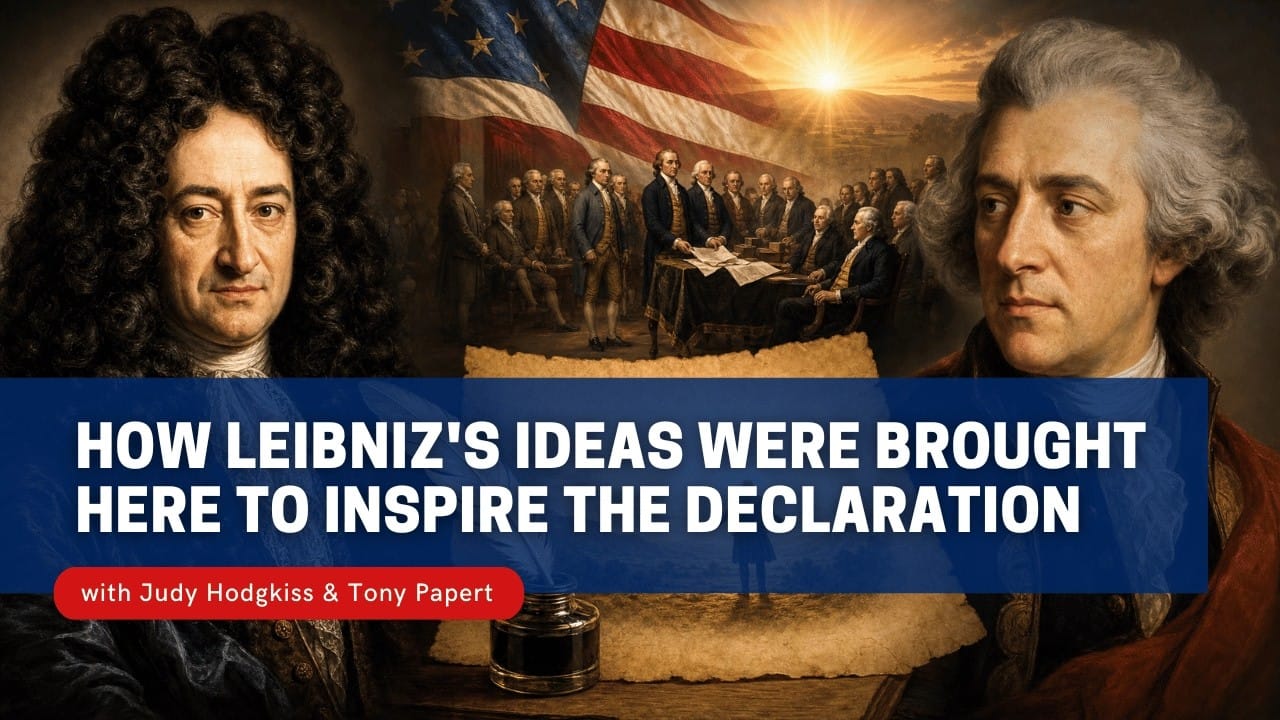
Saturday Class – How did Bolingbroke Bring Leibniz’ Ideas to America and into our Declaration of Independence? – July 11, 2026







Related Articles

EuropeThe Final wakeup call
Lula wins a miracle election in Brazil. Now comes the hard part: putting the country back on the right track
Three weeks ago, Brazilian President Luiz Inácio Lula da Silva’s political obituaries...

EuropeThe Final wakeup call
US midterms: what a new Congress could and could not change for Europe
US midterm elections traditionally attract fewer voters than presidential contests. But this...

EuropeThe Final wakeup call
Political power without balance leads to the erosion of democracy, what Montesquieu can teach modern-day France
KEY TAKEAWAYS Democratic erosion does not start by doing away with elections;...



DruthersThe Final wakeup call
Facing the Crooked of Hormuz
By Tom Engelhardt | Substack.com/@TomEngelhardt I was born on July 20, 1944,...
