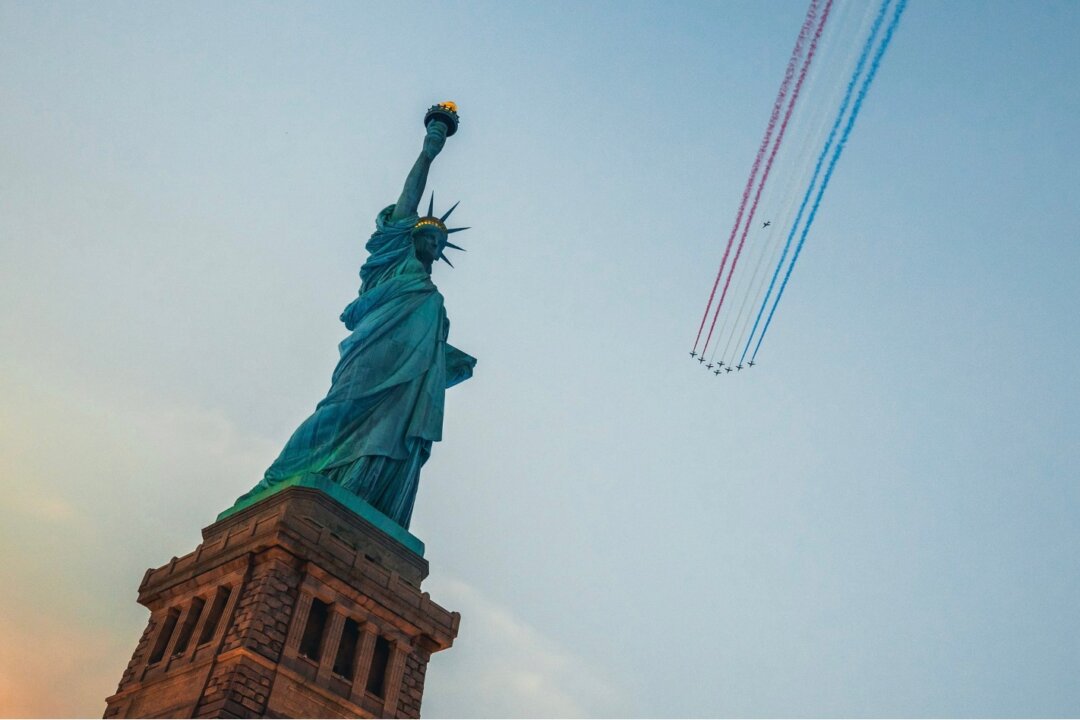
PARIS—“There is no better place outside of the United States for an American to celebrate our 250th anniversary than right here, in Paris,” deputy chief of mission at the U.S. Embassy in France, Mario Mesquita, told The Epoch Times on July 1.Mesquita had just addressed a gathering in Place des États-Unis, in Paris’s 16th arrondissement, where bronze figures of George Washington and the Marquis de Lafayette have clasped hands for more than a century. The statue was cast by Auguste Bartholdi, the sculptor of the Statue of Liberty, which France gifted to the United States in 1886 to honor the friendship between the two nations.Three days before the Fourth of July, officials, diplomats, and patriotic associations gathered at the foot of the monument.Audrey Pulvar, deputy mayor of Paris in charge of international relations, reminded the audience that the square once housed the first American embassy in Paris, and that France was the first country where the United States established an embassy abroad.“The history of our two countries has been intertwined for 250 years,” she told The Epoch Times. “It was only natural and fitting for the City of Paris to celebrate this anniversary.”Paris, she said, “is not merely a witness to Franco-American friendship; it is one of its beating hearts.”For Jérémy Redler, mayor of the 16th arrondissement and host of the ceremony, the anniversary distills “a quarter of a millennium of history, liberty, ambition, innovation, and friendship.”He told the crowd that 250 years ago, France stood beside “a young nation carrying a new aspiration: that of building a country founded on rights, liberties, and the sovereignty of the people.”He also invoked the founder whose name graces the garden, quoting the tribute attributed to Jefferson: Every man’s first country is his homeland, and his second is France.“For the 250th anniversary, I wished to give the ceremony a special character, a little more solemn than usual,” Redler told The Epoch Times. Part of that effort now lines the railings of the Thomas Jefferson garden: an open-air photography exhibition mounted with the U.S. Embassy and the magazine Paris Match, on view until the end of September.The U.S. Embassy and the town hall of the 16th arrondissement jointly celebrated American independence and the friendship between the two countries at Place des États-Unis in Paris on July 1, 2026, at the foot of the monument of the Marquis de Lafayette and George Washington. Etienne Fauchaire/The Epoch TimesSome guests carried that history in their bloodline. Charles-Paris de Bollardière is a descendant of Lewis Morris, the 18th signatory of the Declaration of Independence.“When Morris’ loyalist brother warned him of the consequences of signing, family memory records his reply: ‘Damn the consequence, give me the pen,’” de Bollardière told The Epoch Times.Mesquita traced the same arc, from Yorktown to the Meuse-Argonne, to Normandy, “and right here in Paris,” where the two nations “have fought side by side, have fought for the same values, and continue to do so today around the world.” France, he told the crowd, “is, in fact, the United States’ oldest ally.”The Marquis de La Fayette, described as “the hero of two worlds.” Public domainAn Anniversary in the MakingFor the U.S. Embassy, the ceremony was one bead on a much longer string.“For more than a year, the embassy and our consulates have been working with partners across France to prepare this celebration,” Francisco “Paco” Perez, the embassy’s spokesman, told The Epoch Times.“Through our Freedom 250 initiative, we have brought together museums, local authorities, universities, businesses, associations, and cultural institutions to showcase not only our shared history, but also the future we are building together.”The initiative operates as a label, certifying events and projects across the country that embody the spirit of the anniversary and gathering them into a single calendar on the embassy’s website, updated throughout the year.The story of American independence is also a French story, Perez said: “This celebration is therefore as much a tribute to our friendship as it is to our shared history.”“Without France, the United States would not be the country it is today. And over the generations, the United States has also stood alongside France, particularly during the two World Wars,” he added.That two-way ledger is the signature theme of Charles Kushner, the U.S. ambassador to France. “America would not exist without France,” he has said. “But France would not exist without America either, because we have been great allies through several wars.”U.S. Ambassador to France Charles Kushner and his wife, Seryl Kushner, at the U.S. Embassy in Paris, alongside Marines from the Marine Security Unit at Mission Paris. Courtesy of the U.S. Embassy to FranceThe embassy also wants the celebration to look forward. This spring, it launched Generation250, a scholarship program that will send 50 French students across the Atlantic in 2027 on need-based grants: half for a fully funded semester at an American university and half for intensive summer language stays. Tuition, housing, flights, and daily expenses are covered.“We want to give these students the opportunity to discover the United States, to study there, and to help write the next 250 years of our partnership,” Kushner said when applications opened in April.The week’s diplomatic culmination event occurred on the evening of July 3 at the ambassador’s residence on Avenue Gabriel. Close to 2,000 guests filled the lawn: ministers and business leaders, among them the evening’s guest of honor luxury group LVMH chairman Bernard Arnault and former French President Nicolas Sarkozy.America, Kushner told the gathering, was born in 1776 not in comfort or certainty but in conviction: “From America’s first breath, France was there.” The Italian tenor Andrea Bocelli performed, and the night closed with fireworks to celebrate a relationship the ambassador called” civilizational” rather than “transactional.”Celebration of American independence at the U.S. Embassy in Paris on July 3, 2026. Courtesy of the U.S. embassy to FranceA Sailboat Named L’IntrépideWhile Paris raised its glasses, a racing yacht was closing in on New York.L’Intrépide—a 70-foot ocean racer crewed jointly by officer cadets of France’s naval academy, the École navale, and of the U.S. Naval Academy at Annapolis—left Brest in northwestern France on May 23. Its arrival in New York Harbor was timed for July 4, after calls at Norfolk, Virginia, for SAIL250, a gathering of tall ships and more than 10,000 sailors, and at Annapolis, Maryland.On the night of July 3 in New York, France gifted a spectacular light show at New York’s Statue of Liberty to mark the 250th anniversary of the United States. On July 4, the French Air and Space Force’s elite aerobatic team, the Patrouille de France, painted the skies above Liberty State Park in red, white, and blue during a flyover celebrating America’s Independence Day.The crossing, christened “Sail for Liberty,” marks a double anniversary: the 400th year of the French Navy and the 250th of the Declaration of Independence. It retraces the waters where, on Sept. 5, 1781, the fleet of Admiral de Grasse blocked the Royal Navy at the mouth of the Chesapeake, opening the way for Washington and Rochambeau’s decisive victory at Yorktown.The French Naval Academy’s training sailboat L’Intrépide departs Brest on a transatlantic voyage to the United States. Courtesy of the French Marine NationaleBehind the voyage stands one of the oldest guardians of that memory: the Society of the Cincinnati, born of a gathering George Washington held with his officers in May 1783.“It was a moment of very great emotion,” Loÿs de Colbert, president of the society’s French branch, told The Epoch Times. “They had lived through something unique together, and they wanted to make sure that this brotherhood of arms would endure.” To make it last, the officers made the order hereditary, entrusting its memory to their descendants.Washington wrote to Louis XVI in May 1783 to invite France in; from 1784, Lafayette, Admiral d’Estaing, and Rochambeau drew up the list of French officers admitted. Dissolved in 1792 amid the Revolution, the French society was reborn in 1925 and counts some 650 members today, beside roughly 4,500 in the United States.“A man who is forgotten dies a second time,” Colbert said. “Our role is precisely to prevent that forgetting.”For the commemorative cycle running from 2026 to 2033, the society chose to invest in the young: the crews of L’Intrépide, and students in Amiens rebuilding a “gratitude train” of gifts bound for Maryland. “Investing in youth is the best path,” Colbert said.“We helped the Americans win their independence, and they helped us fight Nazism. It is essential that this spirit endures: this long history of friendship, which France set in motion through the political will of King Louis XVI.”Portraits of Marie Antoinette and King Louis XVI from the Palace of Versailles.The Marquis’s Second LifeMemory has its shrines as well as its ships. In the heart of the Marais in Paris, the Archives nationales, France’s national archives, are devoting their anniversary exhibition to the most beloved Frenchman in American history: Lafayette.The show traces the life of the hero of two worlds and his enduring bond with the young republic, and it leans on treasures sent from the other side of the Atlantic. “At the origin of the project is a proposal from Lafayette College,” Régis Lapasin, head of the exhibitions department, said referring to the Pennsylvania institution named for the marquis, which has built a museum collection of objects tied to its eponymous hero and lent many of the pieces on display.The staircase at the National Archives in Paris leading to the exhibition “Lafayette: Between France and America. Hostory and Legend.” Etienne Fauchaire/The Epoch TimesThe exhibition answers a double occasion, marking both the bicentennial of the college’s founding and the 250th anniversary of American independence.For the Archives, the decision required no debate, even though its programming committees weigh no shortage of possible subjects. “It was retained immediately,” Lapasin told The Epoch Times. “It was programmed without hesitation by the entire scientific staff of the Archives nationales. It was a way of celebrating Franco-American friendship.”Few champion the marquis’s American memory more energetically than Chuck Schwam, executive director of the American Friends of Lafayette, a society founded at Lafayette College in 1932 that today counts 1,500 members. Its mission, he said, rests on three pillars: the value of history itself, the Franco-American alliance, and Lafayette the man.“Without France, we would never have won the American Revolution,” Schwam told The Epoch Times. “There were more French military personnel at Yorktown than Americans. The Franco–American Alliance was important then and it’s important today, and we celebrate that.”The first floor of the National Archives in Paris. Etienne Fauchaire/The Epoch TimesFrom the Iron Lady to the Sun KingOn the evening of July 3, the Eiffel Tower carried a “USA 250” message in red, white, and blue to mark the 250th anniversary of American independence.The illumination opens a full Parisian program for Independence Day: exhibitions, American sports events across the city, and, on Saturday morning, a stroll through the capital by the mayor of Paris and the U.S. ambassador.The Eiffel Tower is lit up in Paris to commemorate the 250th anniversary of the United States’ Declaration of Independence, on July 3, 2026. Etienne Fauchaire/The Epoch TimesThe week reached its crescendo on July 4 where, in a sense, the American story’s French chapter began: Versailles.In 1776, as 13 colonies proclaimed their independence, the palace sat at the center of world diplomacy. There, Benjamin Franklin charmed a court, and Louis XVI took the decision to back the insurgents; from it flowed the money, the arms, the fleet of de Grasse, and the soldiers of Rochambeau, without which there would have been no Yorktown.Artists, dancers, musicians, singers, and fencers clad in Baroque costumes transport visitors back to the 17th-century royal court. Sébastien Camelot/Courtesy of the Palace of VersaillesTwo and a half centuries later, the château is restaging the story it helped write. On July 4 and July 5, hundreds of reenactors in period dress occupy the Trianon estate for “L’Amérique et Versailles,” with military encampments, troop reviews, diplomatic tableaux, and a staged Battle of Yorktown.The spectacles are produced by Château de Versailles Spectacles, whose director, Laurent Brunner, sees the commemoration as a correction to a lopsided memory. “Some French sometimes forget that they had been the key to American independence,” he told The Epoch Times. “The Americans have not: the square in front of the White House bears the name Lafayette Square.”Courtesy of the Palace of VersaillesIt was thanks to Lafayette, “that slightly reckless young officer who raised a regiment,” and then to Louis XVI, who sent French troops, that the American insurgents won their freedom, he said. What Versailles marks on July 4, he added, is not only American liberty but the palace’s own bond with America and “the passion that the French and the Americans still keep alive for one another.”That night, the Grandes Eaux Nocturnes, the palace’s celebrated fountain show, take on an American accent: fountains dancing to Lully and Rameau, a ballet of drones and pyrotechnics in the colors of the American flag, and a royal fireworks display over the Grande Perspective. ]As part of the Night Fountains Show on July 4, 2026, drones illuminated the night sky above the Royal Gardens of Versailles, forming an American flag to mark U.S. Independence Day. Etienne Fauchaire/The Epoch TimesVersailles has already had its diplomatic moment this season: on June 17, after the G7 summit, French President Emmanuel Macron received U.S. President Donald Trump there for a state dinner marking the anniversary, with a tour of the Hall of Mirrors and a concert in the Royal Chapel.Brunner saw the choice of setting as fitting. The memory of Frenchmen who fought and sometimes died beside American soldiers, he noted, helped carry U.S. forces back across the Atlantic in 1914 and again in World War II, borne by what he called a fraternal impulse.That impulse is worth recovering, he argued, even when foreign policy grows more tangled.“France’s interests and America’s do not always coincide,” he said, “but the fundamental interests remain the same: democracy, freedom, a certain vision of the world.”

From the Heart of Paris to the Gardens of Versailles, France Celebrates Americas 250th









Related Articles

EuropeThe Final wakeup call
Lula wins a miracle election in Brazil. Now comes the hard part: putting the country back on the right track
Three weeks ago, Brazilian President Luiz Inácio Lula da Silva’s political obituaries...
EuropeThe Final wakeup call
US midterms: what a new Congress could and could not change for Europe
US midterm elections traditionally attract fewer voters than presidential contests. But this...
EuropeThe Final wakeup call
Political power without balance leads to the erosion of democracy, what Montesquieu can teach modern-day France
KEY TAKEAWAYS Democratic erosion does not start by doing away with elections;...


China NewsEuropeGlobalUK NewsWorld News
UK Must Be Ready for War in 1,000 Days, Says British Defense Secretary
British Defense Secretary Wes Streeting has said the country must be ready...
