
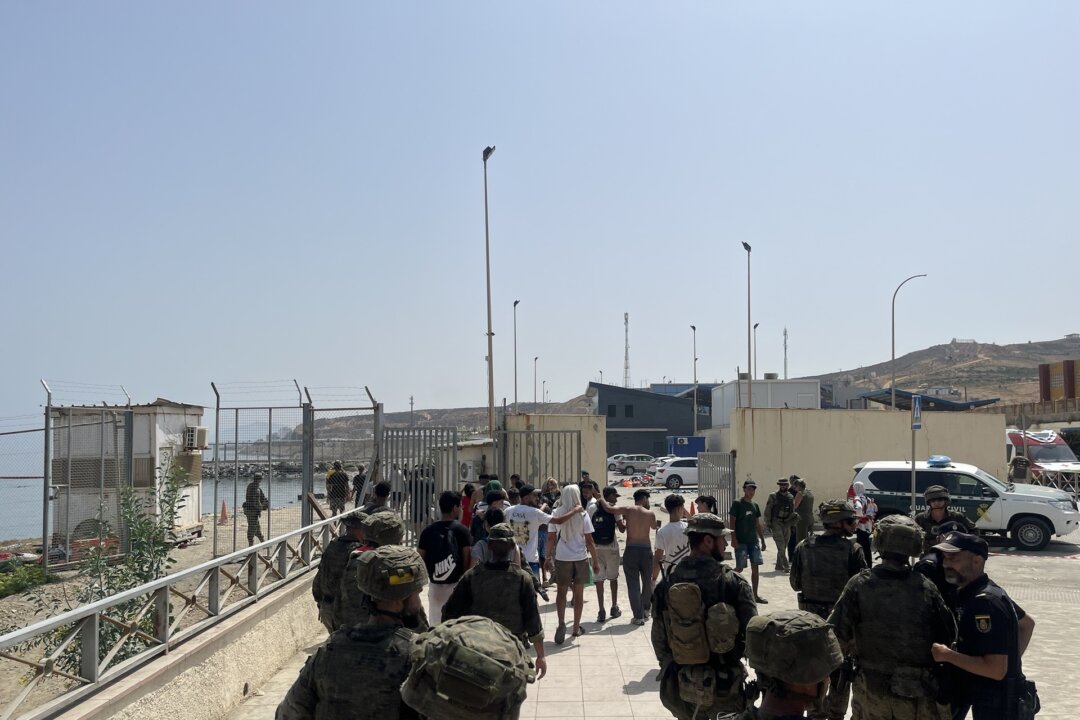
CEUTA, Spain—By Aug. 1, the beach where tens of thousands of illegal immigrants came ashore in Ceuta stood largely empty and patrol boats idled beside 550 yards of floating containment barrier that had gone up only that morning.But the impact of the mass influx of an estimated 50,000 on the city of 84,000 was not over.While some had returned across the border to Morocco, others had moved inland. Masses of illegal immigrants remained scattered across the city, waiting in doorways, side streets, and outlying neighborhoods, with no clear answer on how long sending them all back would take.The city’s president, Juan Jesús Vivas, appearing Saturday alongside People’s Party leader Alberto Núñez Feijóo, welcomed the return of many of the illegal arrivals but said “Ceuta has not achieved normality,” with several thousand still to be sent back amid a climate of unease.Residents who spoke with The Epoch Times blamed Prime Minister Pedro Sánchez’s government for the breach and doubted the remaining removals would be quick, with several saying the scenes were reminiscent of events from 2021.Soldiers and local police spent Saturday sweeping neighborhoods, directing any small encampments of illegal immigrants back toward the border and making clear that no regularization of such arrivals from Morocco was coming.The Civil Guard was also assigned to watch El Tarajal beach to deter fresh arrival attempts and to limit the risk of drownings, a soldier posted nearby said.The previous evening, The Epoch Times had witnessed illegal immigrants, far fewer than at the peak, swimming into Ceuta unimpeded.Sánchez’s Government Under PressureThe illegal migration crisis has intensified criticism of Spain’s socialist government from the right-wing opposition as well as the country’s European neighbors.The newly-installed floating barrier off Tarajal beach at the Ceuta–Morocco maritime border on Aug. 1, 2026. Etienne Fauchaire/The Epoch TimesJuan Sergio Redondo, president and spokesman of the national-conservative Vox party in Ceuta, told The Epoch Times that “the migrant crisis [has] not been solved because of the submission of Pedro Sánchez’s government to Morocco’s interests and our suicidal immigration policies.”He warned that the deportations will take time. “It is impossible for these people to leave, or to be sent back, in a matter of days,” he said, adding that “many go back voluntarily … but others have no intention of going back.”He predicted that a significant share of those who “stormed our border” would continue roaming the city for “many months,” while noting the insecurity and fear among legal residents, who will be left feeling that “the problem has not been solved.”Moroccan illegal immigrants sit on the steps near the Rafael Gibert archway in Ceuta, Spain, on Aug. 1, 2026. Etienne Fauchaire/The Epoch TimesSpain’s security forces, Redondo said, are “bound hand and foot” by the absence of legislation allowing for the immediate return of illegal immigrants. Vox, he said, has spent the past four years demanding reinforced fencing, extended breakwaters, and maritime containment barriers. “Could a great many things have been done? Yes. Have they done them? No.”Sánchez told a July 31 press conference in Ceuta that his government will “guarantee the safety of Ceuta’s residents by increasing the presence of security forces and law enforcement officers in the city’s streets” and “speed up the processing of repatriation cases for migrants who entered the country illegally.”A Breach Without Recent PrecedentThe Interior Ministry estimates that some 50,000 people entered Ceuta between July 30–31; city president Vivas put it closer to 60,000.A day earlier, crowds gathered outside Ceuta’s Palace of the Assembly for Sánchez’s visit with chants of “Sánchez, resign.” The prime minister called the influx a “violation of Spain’s territorial integrity” and said Interior Minister Fernando Grande-Marlaska would stay on to coordinate security alongside the army deployment.Moroccan illegal immigrants walk along Carretera N-352 near the border in Ceuta, Spain, on Aug. 1, 2026, heading back toward Morocco. Etienne Fauchaire/The Epoch TimesSpain and Morocco agreed on July 30 to hand back “as soon as possible” everyone who entered illegally, and Madrid has praised Rabat’s cooperation as excellent.A similar incident happened in May 2021, when about 8,000 people crossed in two days after Moroccan authorities appeared to loosen controls amid a Western Sahara dispute. Spain deployed troops then, too; this week’s influx was several times larger.The Long Walk BackThe exodus back to Morocco was as striking as the influx. Columns of young men filed on foot toward the crossing, some chanting “¡Viva Marruecos! (Long live Morocco),” as officials reported hundreds more departures amid the repatriation deal and days without food or shelter.At one point, a cluster broke away to approach The Epoch Times, shouting “Free Palestine!” and aggressive slogans aimed at Israel, before rejoining the column.Those who stopped to talk gave consistent reasons for turning back: no food or water since arriving and, with tens of thousands entering at once, no opportunities.Several said they had never intended to stay in Spain at all, hoping to push on to France or Denmark.Some also said they did not feel welcome, claiming they had been attacked by some residents.The Epoch Times witnessed one violent clash in which residents and illegal immigrants hurled rocks at each other on Friday.Young illegal immigrants gather near road signs pointing toward Príncipe Alfonso and El Tarajal in Ceuta, Spain, on Aug. 1, 2026. Several told The Epoch Times they planned to stay in the Spanish enclave. Etienne Fauchaire/The Epoch TimesCourt Ruling Recast OnlineBilal, 39, told The Epoch Times he believed “Europe was manipulating us” by making Moroccans believe they were “very much needed for work” and that a far better life awaited them. He criticized videos being shared on Instagram and Facebook that were carrying this message.Sánchez officials have since said that “mafia” human trafficking networks used these videos to spread the false narrative and misleading information about Spain’s July 8 Supreme Court ruling. The videos sit at the center of the official explanation for the surge.In the ruling, the court blocked summary pushbacks or “hot returns” of migrants intercepted while swimming toward Ceuta or Melilla. Such arrivals would receive the ordinary procedure, including access to a lawyer, an interpreter, and the opportunity to claim asylum, the court said. It noted, however, that hot returns are allowed when immigrants attempt to overcome a physical “containment element,” which officials say will now be enforced with the new barrier.On social media, that narrow legal point was recast as something else: claims that Spain had opened its border and that sea arrivals could not be deported.Clips of successful swimmers circulated widely. Several young immigrants told The Epoch Times the Instagram videos convinced them to come.For now, the water off El Tarajal is empty and the barrier is holding. Some male illegal immigrants were unmoved. “We will try again another time,” one told The Epoch Times.Lola, a Ceuta resident, told The Epoch Times she expected as much. “Sadly, we are likely to see a crisis like this happen again.”










The EUs repair policies are changing the way tech is designed
In the late 1970s, concerned by resource use and scarcity, German industrial...
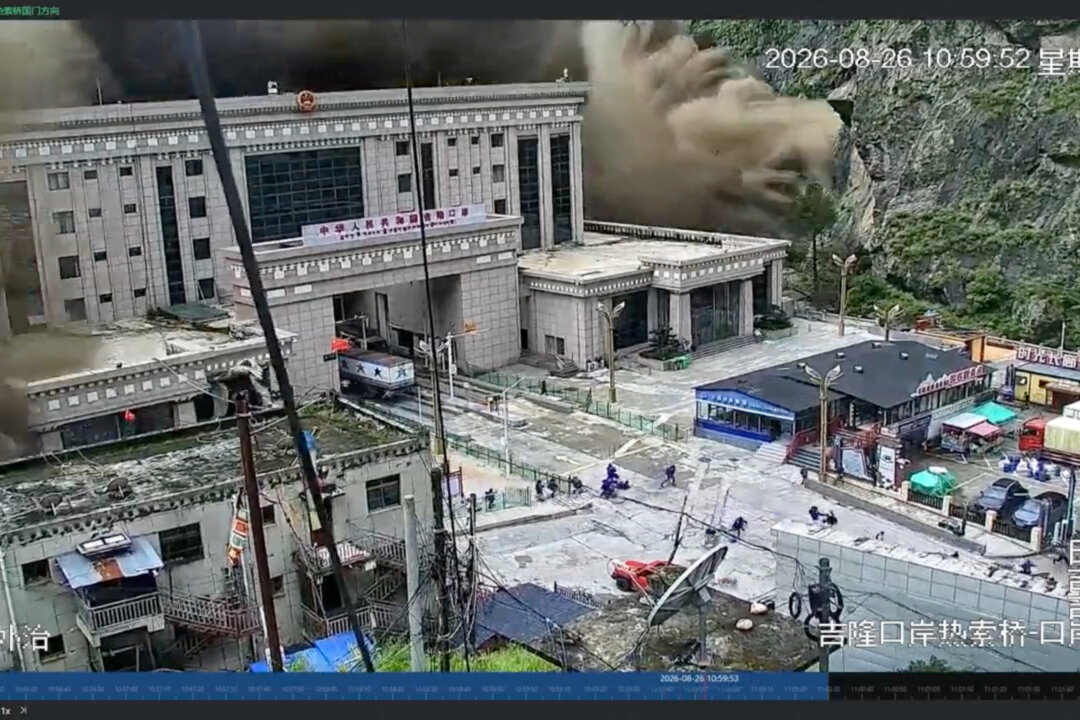
Chinese Scientists Flagged Glacial Flood Danger One Year Before Nepal Catastrophe
More than a year before the catastrophic flash flood devastated the China–Nepal...

Iceland Focuses on Security Partnerships After Voters Reject Opening EU Membership Talks
Icelandic Minister for Foreign Affairs Thorgerdur Katrin Gunnarsdottir attends a press conference...
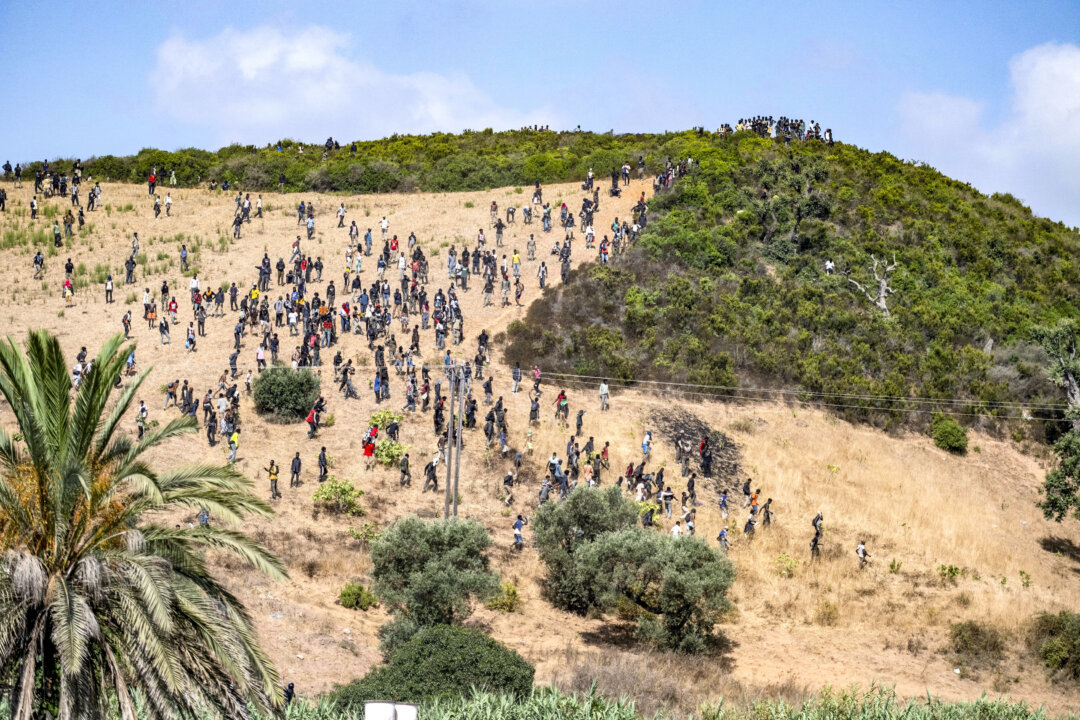


Italy, Spain Extend Tit-for-Tat Border Curbs After Ceuta Illegal Immigrant Crisis
Immigrants gather on a hill as they attempt crossing from the border...
